Casino bonuses often look simple until you try to withdraw.
That is where the details start to matter. A welcome bonus may show a large match percentage, a generous bonus amount, or a long list of free spins, but the real question is not only how much the casino adds to your balance. It is also what happens to that bonus money later.
Can the bonus itself be withdrawn?
Does the casino use your real money first or the bonus first?
Can you cash out before touching the bonus?
Will the bonus disappear when you request a withdrawal?
These questions are the reason sticky and non-sticky bonuses matter. The two bonus types can look similar on the surface, but they behave very differently once you start playing.
What Is a Sticky Bonus?
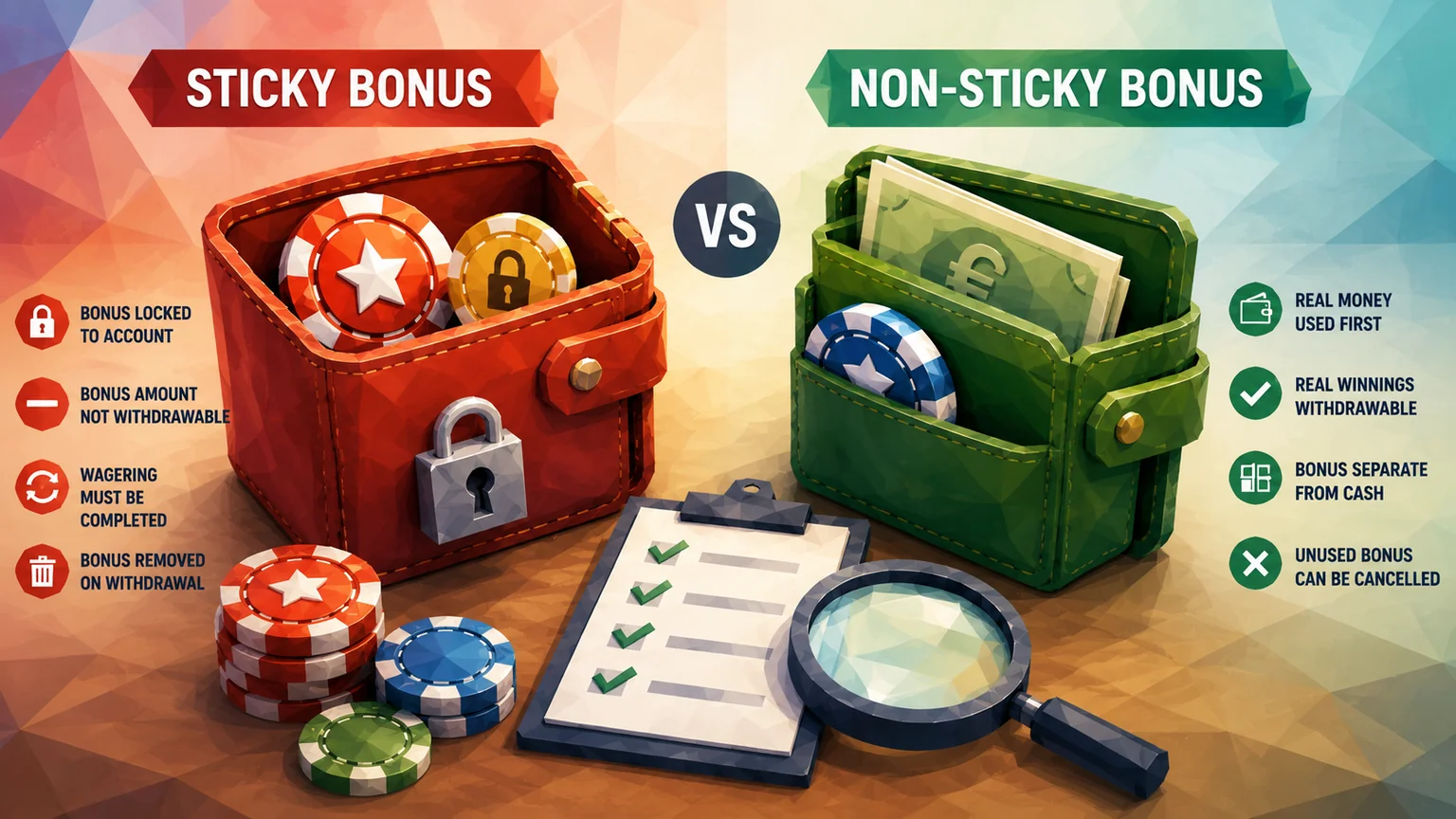
A sticky bonus is a casino bonus that is added to your balance for playing purposes, but usually cannot be withdrawn as cash.
That is the core idea. The bonus may increase the amount you can play with, but it is “stuck” to the account. If you win and later request a withdrawal, the casino may remove the original bonus amount before paying out your withdrawable winnings.
For example, imagine you deposit 100 and receive a 100 sticky bonus. Your playing balance becomes 200. If you complete the wagering requirement and your balance is 350, the casino may remove the 100 bonus and allow you to withdraw 250.
The exact rules vary, but the important point is this: with a sticky bonus, the bonus amount itself is often not yours to cash out. It is there to support play, not to become withdrawable money.
That can be fine if the terms are clear. It becomes a problem when players assume the whole balance is theirs.
What Is a Non-Sticky Bonus?
A non-sticky bonus is usually more flexible.
In many cases, your real-money deposit is used first, while the bonus sits separately in the background. If you win with your real money before touching the bonus, you may be able to withdraw those winnings and forfeit the unused bonus.
That structure can be more player-friendly because it keeps your own money and the bonus money clearer. You are not immediately locked into wagering the bonus just because you claimed it.
For example, you deposit 100 and receive a 100 non-sticky bonus. You start playing with your real-money deposit. If your balance grows to 180 before the bonus is used, you may be able to withdraw the real-money balance and lose the bonus. If you continue and start using the bonus, wagering requirements and bonus rules then apply.
Again, the exact structure depends on the casino. “Non-sticky” is not a magic word. You still have to read the terms.
The Main Difference in Plain English
The easiest way to think about it is this:
A sticky bonus is usually attached to your account and cannot be withdrawn. It gives you more to play with, but the casino may remove the bonus amount before paying winnings.
A non-sticky bonus is usually kept separate from your real money. You may be able to play with your deposit first and withdraw real-money winnings before the bonus becomes active.
That difference affects flexibility.
Sticky bonuses often look larger, but they can make cashouts less straightforward. Non-sticky bonuses may look smaller or less dramatic, but they can give you more control over your deposit and early winnings.
Neither type is automatically good or bad. The better choice depends on the terms, the wagering requirement, the games you want to play, and how much simplicity you want.
Why Sticky Bonuses Can Look Attractive
Sticky bonuses often look generous because the casino can offer a larger bonus amount.
You may see 200%, 300%, or even larger match offers in some cases. The headline number can be impressive. A player deposits a relatively small amount and suddenly has a much bigger balance to play with.
That is the appeal. A larger balance can make the first session feel more comfortable. It may allow more spins, more hands, or more time exploring the casino.
But there is a trade-off. The bigger balance may come with stricter rules, and the bonus amount may not be withdrawable. If you do not understand that before playing, the withdrawal process can feel like a nasty surprise.
This is why sticky bonuses should be judged carefully. The size of the bonus is only one part of the offer.
The Withdrawal Problem With Sticky Bonuses
The biggest confusion with sticky bonuses usually appears at withdrawal.
A player sees a balance in the account and assumes the full amount can be withdrawn once wagering is complete. Then the casino removes the sticky bonus portion. From the player’s perspective, it may feel as if money has disappeared.
From the casino’s perspective, it was never withdrawable in the first place.
This is exactly why the terms matter. A sticky bonus should clearly explain whether the bonus amount is cashable, when it is removed, what happens after wagering, and whether withdrawing early cancels the bonus and any related winnings.
If the casino does not explain this clearly, that is a bad sign.
A sticky bonus can be acceptable when the rules are transparent. It becomes risky when the offer is large, the wording is vague, and the player only learns how it works after trying to cash out.
Why Non-Sticky Bonuses Are Often Easier to Understand
Non-sticky bonuses are often easier because they separate the player’s own money from the promotional money.
That separation can make the first part of the session cleaner. You deposit, play with your real balance, and if you win before the bonus is activated, you may be able to withdraw. The bonus can then be cancelled or left unused, depending on the casino’s system.
This does not remove all conditions. Once the non-sticky bonus is active, wagering requirements and bonus terms still apply. But the early-stage flexibility is the main advantage.
For cautious players, this can be useful. You are not forced into bonus wagering just because you accepted the offer. You may have a chance to take real-money winnings and walk away.
That is why many experienced players prefer non-sticky bonuses, especially when the terms are clear and the casino shows separate balances properly.
Real Money First vs Bonus Money First
One of the most important things to check is the order in which funds are used.
With reload bonuses and cashback credits, as with welcome offers, the order in which funds are used matters. Some bonuses use real money first. Others use bonus money first. Some mix balances in ways that are not immediately obvious.
This matters because the fund order changes your options.
If real money is used first, you may be able to win with your deposit and withdraw before the bonus becomes active. If bonus money is used first, you may be under bonus rules immediately. If balances are mixed, it may be harder to know which rules apply at any given moment.
A good casino should explain this clearly. Ideally, it should show separate balances for cash, bonus funds, and withdrawable money.
If you cannot tell which balance is being used, be careful. Confusion around balances is one of the easiest ways to make mistakes with bonuses.
Wagering Requirements Still Matter
Sticky and non-sticky bonuses can both have wagering requirements.
A wagering requirement tells you how much you must bet before bonus-related winnings can be withdrawn. For example, a 100 bonus with 35x wagering means 3,500 in qualifying bets may be required before the bonus is cleared.
The sticky or non-sticky structure affects how the bonus behaves, but the wagering requirement affects how difficult it is to turn bonus play into withdrawable money.
A non-sticky bonus with very high wagering may still be unattractive. A sticky bonus with reasonable wagering may be acceptable if the bonus amount is clearly non-withdrawable. You have to look at both parts together.
The type of bonus tells you how the money is structured.
The wagering requirement tells you how hard it is to clear.
Game Weighting Can Change the Picture
Bonus wagering usually does not treat all games equally.
Slots may contribute 100% toward wagering. Table games may contribute less. Some games may not count at all. Live casino games, blackjack, roulette, baccarat, video poker, jackpots, and high-RTP games are often restricted or weighted differently.
This matters for sticky and non-sticky bonuses because a bonus that looks flexible may still be poor if it only works well on games you do not want to play.
If you mostly play blackjack, a slot-focused bonus may not suit you. If you prefer live dealer games, check whether they count toward wagering. If the offer has a big bonus amount but forces you into a narrow set of eligible games, the real value may be lower than it looks.
A bonus should match the way you actually play. Otherwise, it may push you into games you would not normally choose.
Maximum Bet Rules Apply Too
Maximum bet rules are another common source of bonus disputes.
A casino may set a maximum stake while a bonus is active. If you bet above that amount, even accidentally, the casino may void winnings. This can happen with both sticky and non-sticky bonuses.
The risk is especially high when players increase stakes during a winning session or switch to games where the default bet is higher than expected.
Before using any bonus, check the maximum allowed bet. Then stay comfortably below it. Do not assume the casino will warn you before you break the rule. Some casinos do. Many do not.
A bonus with a strict max bet is not necessarily unfair, but the rule needs to be visible and easy to follow.
What Happens If You Withdraw Early?
Early withdrawal rules are especially important with bonuses because payment and bonus balances may be treated differently.
With a sticky bonus, withdrawing early may cancel the bonus and sometimes remove bonus-related winnings. With a non-sticky bonus, withdrawing before the bonus is used may simply cancel the bonus. But once the bonus has been activated, the rules may become stricter.
This is why you should know the exit route before you start.
If you win early, can you withdraw?
Will the bonus be cancelled?
Will winnings be removed?
Does the deposit become locked?
Can you cancel the bonus manually?
A good bonus should make these answers clear. A confusing withdrawal rule is not a small detail. It can decide whether the offer is worth claiming at all.
Which Type Is Better?
Non-sticky bonuses are often better for players who want flexibility and clearer control over their own money.
Sticky bonuses may be interesting for players who understand the terms and want a larger playing balance, but they are easier to misunderstand. They can also be less attractive if the bonus amount is not withdrawable and the wagering requirement is high.
So if you want a simple rule, use this:
For most cautious players, a clear non-sticky bonus is usually preferable to a large sticky bonus with complicated terms.
That does not mean every sticky bonus should be avoided. It means the burden of clarity is higher. The casino needs to explain exactly how the bonus works, and the player needs to know what will happen at withdrawal.
If you are unsure, do not claim the bonus yet.
When a Sticky Bonus Might Still Be Worth Considering
A sticky bonus may be worth considering if the rules are clear, the wagering requirement is reasonable, the eligible games suit you, and you understand that the bonus itself may not be withdrawable.
It may also suit players who simply want a longer entertainment session and are less focused on withdrawing the bonus amount itself.
But that only works if the deposit fits your gambling budget. A large sticky bonus should not tempt you into depositing more than planned. It should not make you play longer than intended. It should not make you ignore max bet rules or chase wagering requirements after you no longer want to play.
A sticky bonus can add playing value. It should not become the reason you abandon your limits.
When a Non-Sticky Bonus Might Be Better
A non-sticky bonus may be better if you want to protect the flexibility of your real-money deposit, but it should still be judged as part of the whole welcome offer.
It is especially useful when the casino allows you to play with cash first and withdraw real-money winnings before the bonus is used. That gives you more control. You can benefit from the promotion if needed, but you are not immediately locked into bonus wagering.
This structure can be helpful for players who prefer simple decisions. If the session goes well early, they may cash out. If the real balance is lost, the bonus can then provide extra play, subject to the terms.
The key word is still “may.” You need to confirm that the casino’s version of non-sticky actually works this way.
Common Phrases to Look For
Bonus terms often contain clues about whether a bonus is sticky.
Look for phrases such as “for wagering purposes only,” “bonus amount is non-withdrawable,” “bonus funds will be removed upon withdrawal,” or “bonus cannot be cashed out.”
For non-sticky bonuses, look for wording around “cash balance used first,” “bonus funds activated after real-money balance is depleted,” or “withdrawal will cancel unused bonus funds.”
The wording may vary, and some casinos use their own terminology. If you cannot understand the terms, ask support before claiming the bonus. Keep a copy of the answer if the explanation affects your decision.
It is better to ask a boring question before playing than argue about a withdrawal later.
What to Check Before Claiming Either Type
Before claiming a sticky or non-sticky bonus, check the following details.
- Is the bonus amount withdrawable, and could its conditions put pressure on the amount you planned to spend?
- Is your deposit locked?
- Which balance is used first?
- What is the wagering requirement?
- Which games count?
- What is the maximum bet?
- Is there a maximum cashout?
- What happens if you withdraw early?
- Can you cancel the bonus?
- When does the bonus expire?
These questions do not make the bonus less fun. They make it less confusing.
If the casino answers them clearly, you can make a better decision. If the information is hidden or vague, that tells you something too.
The Sensible Way to Choose
A casino bonus should be easy enough to understand before you claim it.
Sticky bonuses and non-sticky bonuses both have a place, but they are not the same thing. Sticky bonuses usually give you a larger playing balance while keeping the bonus amount locked or non-withdrawable. Non-sticky bonuses usually offer more flexibility by separating real money from bonus money.
For most players, the better bonus is not the biggest one. It is the one with the clearest rules, fair wagering, reasonable limits, and a structure that matches how you actually want to play.
If the bonus makes withdrawals harder to understand, be careful. If it makes you deposit more than planned, be even more careful.
A bonus should support your play. It should not take control of it.