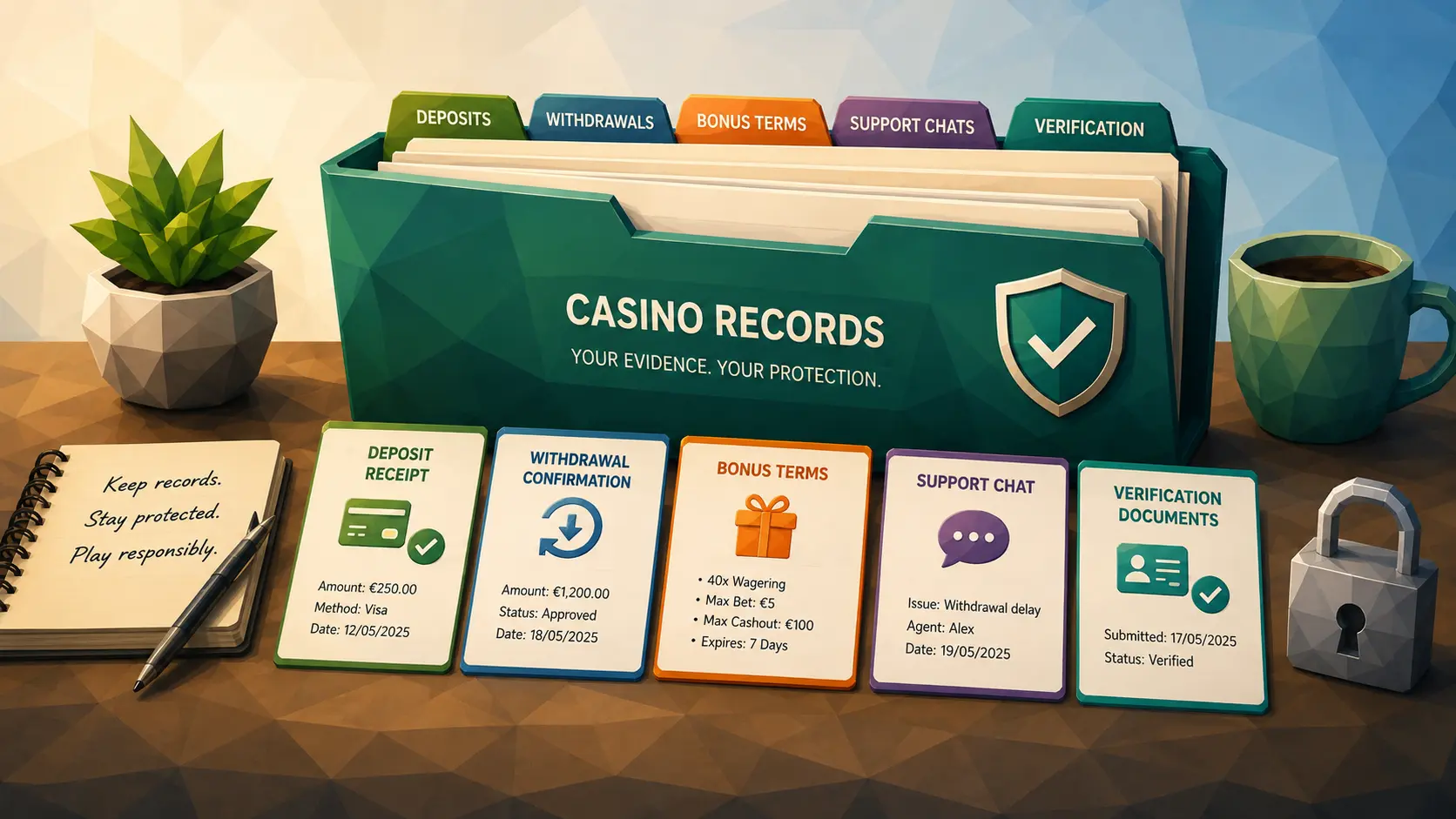
Keeping casino records sounds dull.
Most players do not register at an online casino because they want to organize emails, save screenshots, or track withdrawals in a spreadsheet. They want to play.
But records matter.
They help you see how much you are really spending. They make withdrawals easier to follow. They help with bonus disputes. They give you evidence if support gives unclear answers. They also make it easier to spot when gambling is no longer staying inside the limits you set.
Good records do not need to be complicated.
You do not need to document every spin, every card, or every roulette number. The useful records are the ones that show money movement, account status, bonus conditions, and communication with the casino.
Those are the records that matter if something goes wrong.
Why Casino Records Matter
Online gambling moves quickly.
Deposits can happen in seconds. Bonuses can be accepted with one click. Terms can be updated. Support chats can disappear. Withdrawal requests can sit pending. Verification requests can arrive by email. A player may think they will remember the details, but after a few days the timeline becomes less clear.
Records give you a stable version of events. They help answer simple questions:
- How much did I deposit?
- When did I request the withdrawal?
- Which payment method did I use?
- Was a bonus active?
- What were the bonus terms when I claimed it?
- Did support ask for documents?
- Did I send them?
- What did the casino say?
If you cannot answer those questions, it becomes harder to challenge a delay, explain a complaint, or understand your own gambling activity.
Keep Deposit Records
Deposits are the starting point.
For each deposit, it is useful to know the date, amount, payment method, casino name, and whether a bonus was claimed. You can usually find this information in the casino cashier history, payment provider account, bank statement, e-wallet, crypto wallet, or confirmation email.
You do not need to make the process dramatic. A simple note, screenshot, or exported transaction history can be enough.
Deposit records are especially useful if:
- a payment is taken but not credited
- a bonus does not appear
- the casino asks for proof of payment
- a payment provider dispute occurs
- you want to compare spending against your gambling budget
- you need to understand the full cost of a session
The goal is not to make gambling feel like accounting. The goal is to avoid guessing.
Keep Withdrawal Records
Withdrawal records are even more important than deposit records.
When you request a withdrawal, save the date, amount, payment method, casino account status, and any confirmation message. If the casino shows a pending withdrawal screen, take a screenshot.
Also keep track of when the withdrawal changes status.
Was it pending? Approved? Rejected? Reversed? Split into smaller payments? Sent to a different method? Held for verification?
This matters because withdrawal disputes often depend on timing.
A casino may say the payment is still inside the normal processing period. That may be true. But if the stated time has passed, clear records help you ask better questions.
A useful withdrawal record includes:
- casino name
- withdrawal amount
- request date
- payment method
- stated processing time
- verification status
- bonus status
- support replies
- date received, if paid
If a withdrawal is delayed, those details save time.
Keep Bonus Terms Before You Play
Bonus disputes are common because players and casinos often focus on different parts of the offer.
The player remembers the headline. The casino applies the terms.
That is why it is worth saving the bonus terms before playing.
If you claim a welcome bonus, free spins, cashback offer, reload bonus, no-deposit bonus, sticky bonus, or crypto promotion, keep a record of the important conditions.
Save:
- wagering requirement
- whether wagering applies to bonus only or deposit plus bonus
- game contribution rules
- maximum bet rule
- maximum cashout
- expiry date
- restricted games
- withdrawal restrictions
- bonus cancellation rules
A screenshot or saved PDF can help if the terms later change or become difficult to find.
This is not paranoia. It is basic protection.
If a bonus is clear and fair, the terms should support the casino’s position. If the terms are confusing, that is useful to know before money is involved.
Keep Verification Messages
Verification is a normal part of online gambling, but it can become a source of delays.
Casinos may ask for proof of identity, proof of address, payment method ownership, or source-of-funds information. If that happens, keep a record of what was requested and when you provided it.
Casino account security matters when verification documents are involved. You do not need to store sensitive documents in an unsafe place. Be careful with identity documents, bank statements, and payment screenshots, but keep a note of the request, the upload date, and the casino’s response.
Useful records include:
- the date documents were requested
- what documents were requested
- where you uploaded them
- whether the casino confirmed receipt
- whether the account was marked as verified
- any reason given for rejection
- the date verification was completed
If support later says documents are missing, you can respond with facts instead of frustration.
Keep Support Chats and Emails
Support conversations can become important evidence.
If you contact live chat, save the transcript if possible. If there is no transcript option, take screenshots of key replies. For email support, keep the full thread.
Focus especially on messages where the casino explains a delay, confirms a rule, asks for documents, approves verification, rejects a withdrawal, or gives a deadline.
Support replies should be treated as part of the record.
This does not mean every weak support answer becomes a scandal. Sometimes support agents make mistakes or give incomplete answers. But if the issue escalates, a written record helps show what was said and when.
Good records also help you stay calm.
Instead of repeating the entire story every time you contact support, you can refer to dates, amounts, and previous replies.
Keep Responsible Gambling Confirmations
Confirmations for player-protection tools can also matter.
If you set a deposit limit, loss limit, session limit, cooling-off period, or self-exclusion, keep the confirmation message. If the casino confirms account closure, save that too.
These records are important because they show what tool was requested, when it was requested, and whether the casino applied it.
If a player protection tool fails or the account remains active when it should not, the timeline matters.
This is one of the few areas where small details can be very important.
Keep the confirmation. Keep the email. Keep the date.
Track Gambling Spend Honestly
Records are not only useful for disputes.
They also help with self-control.
Online gambling can make spending feel fragmented. A player may not make one large deposit. Instead, they may make several smaller payments across a session, a weekend, or a month. Each payment may feel manageable on its own. The total can look different later.
A simple gambling log can show the real number.
It can include:
- date
- casino
- deposit amount
- withdrawal amount
- net result
- bonus used or not
- short note about the session
This does not need to be perfect. Even a basic monthly overview can reveal whether gambling is staying within budget.
If the records make you uncomfortable, do not ignore that feeling. It may be telling you something useful.
Do Not Rely Only on the Casino Account History
Casino account histories are useful, but they are not the only record you should trust.
Accounts can be closed. Access can be restricted. Older transaction history may be hard to find. Support chats may not remain visible. Terms pages can change. A dispute can start after the information has already become difficult to access.
Keep your own records for important events.
That can mean screenshots, downloaded statements, email confirmations, or notes in a secure document.
The goal is not to assume every casino will behave badly. The goal is to avoid depending completely on the casino’s own system if a problem appears.
Be Careful With Sensitive Data
Keeping records does not mean storing personal documents carelessly.
Casino records may include identity documents, addresses, bank details, payment screenshots, and account numbers. Store them securely. Avoid leaving them in unprotected folders, shared devices, or public cloud links.
For most players, it is enough to keep confirmation emails, screenshots of transaction status, and notes about what was submitted.
If you need to store sensitive files, use secure storage, strong passwords, and two-factor authentication where possible.
Good record keeping should reduce risk, not create a new one.
Records and Taxes
Tax treatment of gambling winnings depends heavily on where the player lives, whether gambling is recreational or professional, the type of gambling, and local law.
Because of that, casino articles should be careful with tax claims.
Keeping records may still be useful if you need to discuss gambling activity with a tax adviser or local authority. But this article cannot tell every player how winnings or losses are treated in their country.
The safe advice is simple: keep accurate records and check local rules if tax questions matter to you.
Do not rely on a casino’s promotional page or a general gambling article for tax advice.
What to Save Before Making a Complaint
If a casino problem turns into a complaint, your records become the case file.
Before escalating, collect:
- casino name and URL
- account email or username
- deposit history related to the issue
- withdrawal request details
- bonus terms, if a bonus was involved
- verification requests and responses
- support emails or chat transcripts
- screenshots of account status
- relevant terms and conditions
- a short timeline of events
- the outcome you are asking for
Keep the complaint factual.
A strong complaint is not the longest or angriest one. It is the one that makes the issue easy to understand and backs it up with evidence.
A Simple Record-Keeping Template
A useful gambling record can be very simple.
For each casino, note:
- Casino name:
- Casino URL:
- Account email:
- Registration date:
- Payment method used:
- Deposits:
- Withdrawals:
- Bonus claimed:
- Important terms saved: yes/no
- Verification completed: yes/no
- Support contact dates:
- Open issue:
- Final outcome:
For ordinary play, this may be more than you need. For a withdrawal delay or complaint, it can be extremely useful.
You can keep this in a spreadsheet, notes app, password manager note, or secure document. The format matters less than whether you can find it when needed.
The Sensible Way to Keep Casino Records
Keeping records is not about making gambling more serious than it should be.
It is about staying clear.
Clear records show what you deposited, what you withdrew, which bonus rules applied, what support said, and whether gambling is staying within your budget.
They also reduce stress if something goes wrong. Instead of trying to reconstruct the timeline from memory, you already have the details.
Save the important emails. Screenshot withdrawal requests. Keep bonus terms before you play. Record verification requests. Track deposits honestly. Store sensitive information safely.
If everything goes smoothly, the records may never matter.
If something goes wrong, they may matter a lot.