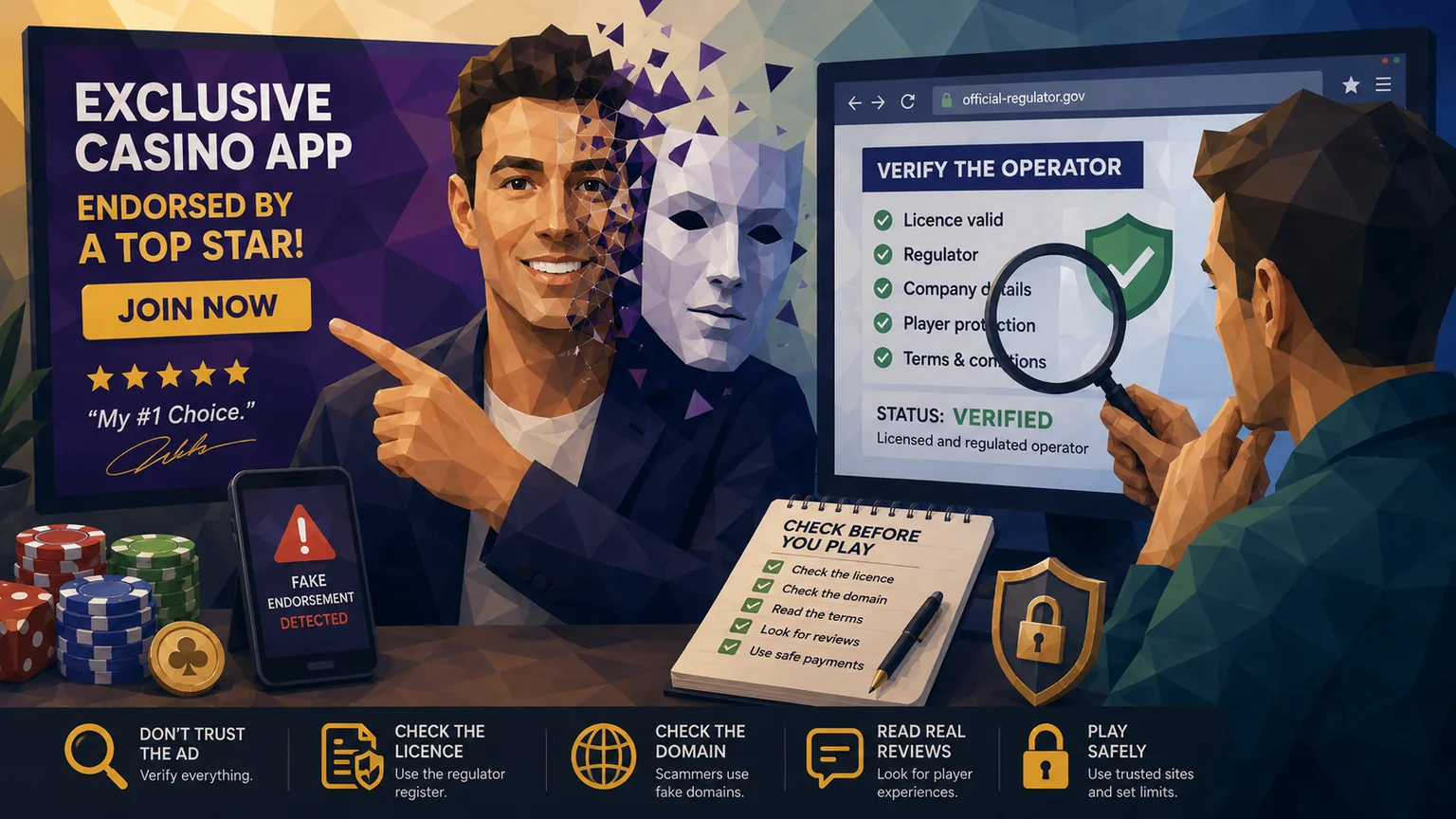
Fake casino ads used to be easier to dismiss.
They had bad spelling, strange logos, unrealistic promises, and celebrity photos that looked obviously stolen. Many still do. But the better scams are changing. Artificial intelligence now makes it possible to create videos where a footballer, actor, influencer, streamer, or public figure appears to promote a gambling app they have never heard of.
That changes the problem. A fake endorsement can now look like an interview clip, a news segment, a social media story, a signing event, or a casual message to fans. The person’s face may move. The voice may sound close enough. The setting may look familiar. And the ad may be placed where normal casino or sports betting ads already appear.
In July 2026, The Guardian reported that Bruno Fernandes and Jude Bellingham had been targeted by illicit betting operators using their identities without consent, including AI-generated deepfake videos and fabricated endorsement material for unlicensed or offshore gambling platforms.
That is the part players need to understand. The danger is not only that a celebrity’s image is being misused. The bigger danger is that the fake endorsement can push people toward gambling sites that may not be licensed, may not follow proper player-protection rules, and may be difficult to complain about if something goes wrong.
What an AI Deepfake Casino Scam Is
An AI deepfake casino scam uses manipulated media to make a person appear to promote, explain, recommend, or endorse a gambling site.
The person might be a footballer, actor, celebrity, streamer, journalist, finance expert, or influencer. The scam may use a cloned voice, AI-generated facial movement, edited interview footage, fake screenshots, fabricated news articles, or a mix of all of these.
The goal is simple: trust transfer.
The scammer borrows the trust people already have in a known person and uses it to make the casino, betting app, or “exclusive offer” feel more legitimate. If a famous footballer seems to have signed with a betting brand, some viewers may assume the site must be real. If a familiar TV presenter seems to explain a new casino app, the ad may feel safer than a random banner.
That assumption is exactly what the scam is built around.
A real endorsement should be verifiable. A real licensed operator should be identifiable. A real gambling site should have clear company details, licence information, terms, complaint routes, and responsible gambling tools. A deepfake ad usually wants the viewer to skip that work and click quickly.
Why Gambling Is an Attractive Target for Deepfake Scams
Gambling is a natural target for this kind of fraud because it already involves money, urgency, and emotion.
Casino ads often use excitement. Betting ads often use sport, timing, and the feeling that something is happening right now. A scammer can add a fake endorsement to that environment and make the offer feel even more urgent: limited access, special app, private bonus, celebrity-backed platform, or “official partner” of a team or player.
The World Cup and major sports events make the problem worse. Footballers are already highly visible. Fans are already watching clips, highlights, predictions, odds, and betting-related content. A fake football endorsement can slip into that stream more easily than it would in a quieter media environment.
Reports from scam-detection companies and media investigations suggest that deepfake ads using footballers and other public figures are becoming a recurring feature of online fraud, especially around major events. One recent analysis claimed to have detected thousands of deepfake scam ads impersonating football players to promote gambling apps and other schemes.
Even if some numbers come from private research rather than regulators, the direction is clear enough: scammers go where attention already is.
The Ad May Not Mention a Casino Immediately
One reason these scams work is that the first ad does not always look like a casino ad.
It may look like a news story. It may look like a video interview. It may look like a sports update. It may show a famous person “announcing” a partnership, “revealing” a new app, or “sharing” a way to win money.
Sometimes the ad sends the user through several steps. First there is a fake story. Then a landing page. Then a download button. Then a casino or betting platform. The names may change along the way. The fake brand in the ad may redirect to another operator entirely.
That structure is useful for scammers because it creates distance. If the ad is removed, the landing page may still exist. If the landing page disappears, the casino may continue under another campaign. If one brand name becomes toxic, another appears.
For the user, this creates a basic rule: do not judge only the ad. Check the actual gambling site you are being sent to.
Celebrity Endorsement Is Not a Safety Check
A celebrity endorsement, even a real one, is not proof that a casino is safe.
Celebrities are paid to promote products. They may not personally use them. They may not understand the licence structure. They may not know how withdrawals are handled, how complaints are processed, or whether the operator treats players fairly.
With deepfake ads, the situation is worse because the endorsement may not exist at all.
The Advertising Standards Authority in the UK has warned more broadly that scam ads continue to use celebrities and public figures, and that scammers are increasingly relying on AI-generated images and deepfake videos. Most of those examples are outside gambling, but the same trust-abuse pattern applies.
So the question is not, “Do I recognize the person in the ad?”
The question is, “Can I verify the operator?”
That means checking the casino name, company name, licence number, regulator, domain, payment terms, complaint process, and whether the site is actually allowed to target players in your country.
How Unlicensed Operators Use Deepfakes
Unlicensed operators can use deepfake ads in several ways.
They may create a fake partnership with a famous person. They may invent a betting app that appears connected to a footballer. They may use a club stadium, shirt, press conference, or interview setting to make the promotion look official. They may also create fake news pages that copy the visual style of legitimate media.
The Guardian’s July 2026 report described cases involving footballers’ identities being used without consent by illicit online betting operators, including fake videos and fabricated promotional material. It also highlighted the difficulty of enforcement when operators sit offshore or move through complicated networks of domains and jurisdictions.
That enforcement gap matters for players. A licensed operator in a strong jurisdiction is not automatically perfect, but there is at least a regulator, complaint route, and set of rules. With an unlicensed or illegal operator, those protections may be weak, unclear, or absent.
A fake ad is often only the first warning sign. The bigger issue may be what sits behind it.
Red Flags in Deepfake Casino Ads
Some deepfake ads are very convincing, but they still tend to share certain warning signs.
Be careful if the ad claims that a famous person has launched a “secret” casino app, a special betting method, or a limited offer that is not mentioned on their official website or verified social media channels.
Be careful if the ad pushes you to download an app outside normal app stores, or sends you through a strange redirect chain before you reach the gambling site.
Be careful if the endorsement appears only in paid ads, random social posts, or unknown “news” pages, but not in credible press releases, official club announcements, regulator records, or the operator’s properly licensed website.
Be careful if the video looks slightly wrong: odd mouth movement, unnatural blinking, flat voice tone, mismatched lighting, strange pauses, or a face that seems too smooth. These signs are not always present, and deepfakes are improving, but they are still worth noticing.
And be especially careful if the offer promises easy money. A celebrity cannot change the odds of a casino game. A famous person cannot make a gambling app safe.
Check the Licence Before You Deposit
The most useful casino safety check is the boring one: verify the licence.
If a gambling site claims to be licensed in Great Britain, the Gambling Commission says players should check that the business has a Gambling Commission licence before gambling; licensed businesses must display that they are licensed and provide a link to the public register.
The Commission also publishes a public register where users can search licensed businesses, individuals, regulatory actions and premises.
This kind of check is not glamorous, but it is far more useful than believing a video ad. Do not only look for a logo in the footer. Logos can be copied. Licence numbers can be fake. Company names can be confusingly similar.
Search the regulator’s own register where possible. Check whether the domain matches the licensed business. Check whether the operator is allowed to offer the product in your country. If the name in the ad, the name on the casino, and the name in the licence register do not line up, stop.
App Stores Are Not a Perfect Safety Filter
Some players assume that if an app appears in an app store, it must be safe.
That is not reliable enough.
App stores can remove bad apps, but scam campaigns often move quickly. Fake brands, cloned designs, and misleading app descriptions may appear before platforms or regulators catch up. Media reports have also described concern around fake gambling apps and “false shop fronts” used by illegal operators.
An app store listing should not replace licence verification. The same basic checks still apply: who operates the app, where is it licensed, what domain does it use, what regulator supervises it, and what happens if there is a dispute?
If those answers are unclear, do not deposit.
Look Beyond the Front Page
Scam gambling sites often work hard on the front page.
The homepage may look polished. The bonus may look generous. The fake endorsement may be slick. The graphics may feel modern. That does not prove the back end is legitimate.
Before depositing, look for the parts of the site that are less exciting:
licence details, terms and conditions, withdrawal rules, bonus terms, responsible gambling tools, company address, complaint procedure, privacy policy, and support contact.
A trustworthy casino should not make these hard to find. If the site is vague about who owns it, where it is licensed, how withdrawals work, or who handles complaints, that is a problem.
Also watch for copied text, broken links, mismatched brand names, unclear payment terms, and responsible gambling pages that feel like decoration rather than real support.
The more the site pushes urgency, the more slowly you should move.
Deepfake Ads Can Also Lead to Phishing
Not every deepfake casino scam is only about gambling.
Some may be designed to collect personal information, payment details, identity documents, passwords, or crypto wallet access. A fake casino registration page can become a phishing tool. A fake app can ask for permissions it does not need. A fake bonus claim can push users into sharing documents before they understand who is receiving them.
That is why you should be careful with any site reached through a suspicious ad.
Do not upload identity documents to a gambling site unless you have verified the operator. Do not save card details with an unknown casino. Do not connect a crypto wallet to a gambling app you have not checked. Follow basic casino account security, including not reusing passwords from important accounts.
The risk is not only losing a casino deposit. It can become wider financial fraud.
Why These Scams Are Hard to Police
Deepfake casino scams are difficult to stop because the pieces are spread across different systems.
The celebrity may be in one country. The ad platform may be global. The operator may claim a licence in another jurisdiction. The domain may be registered through a privacy service. The payment processor may be somewhere else. The victims may be scattered across several markets.
Regulators can warn, remove, block, or pressure platforms, but enforcement becomes harder when operators are offshore or unlicensed. The UK Gambling Commission has also warned about illegal gambling websites and licensed software appearing on illegal sites available to Great British consumers, which shows how complicated the illegal market can become.
This is why player caution still matters. It is not fair that users have to do this work, but it is practical. A scam ad can disappear and return under another name. A careful verification routine travels with you.
What To Do If You Already Deposited
If you deposited after seeing a suspicious deepfake ad, act quickly.
Keep records of the ad, landing page, casino site, account page, payment confirmation, terms, chat messages, emails, and any licence claims. Save the URL and the date. If the ad appeared on a social platform, report it there as a scam or impersonation.
Contact your bank, card provider, payment wallet, or crypto exchange if relevant. The options will depend on the payment method. Card payments may have dispute routes. Bank transfers may be harder. Crypto transactions are usually difficult or impossible to reverse once sent.
Do not upload more documents unless you have verified the operator. Do not deposit again to “unlock” a withdrawal. Be especially careful if support asks for extra fees, taxes, verification payments, or deposits before releasing winnings.
If the site claims a licence, report the issue to the named regulator. If it falsely claims a UK licence, you can check and report through Gambling Commission resources. If the operator is not licensed where it should be, your options may be limited, but reporting still helps build a record.
If the Ad Used a Real Person’s Image
If a fake ad uses a celebrity, athlete, streamer, journalist, or public figure, that does not mean the person is involved.
Scammers use familiar faces because they work. The person shown may be a victim too. Their image may have been scraped from interviews, sports footage, social posts, press conferences, podcasts, or TV appearances.
Do not contact the celebrity expecting help with your casino account. They probably have no relationship with the site. The practical route is still the platform, payment provider, regulator, and, where appropriate, local fraud reporting service.
It is also worth checking the person’s verified social channels. If they have genuinely partnered with a gambling brand, there will usually be official confirmation. If the endorsement exists only in a paid ad or strange article, assume nothing.
How Reviewed Casino Sites Should Handle These Claims
Casino review sites need to be careful here too.
A review should not repeat celebrity endorsement claims unless they are verified. It should not treat a fake ambassador page as a trust signal. It should not list a casino as safe because the operator shows a famous face in its marketing.
The stronger approach is to separate marketing claims from operator facts.
- Who owns the casino?
- Where is it licensed?
- Does the licence match the domain?
- What regulator applies?
- Are withdrawals and complaints clearly explained?
- Are responsible gambling tools available?
- Is the operator connected to known warnings or suspicious campaigns?
Those questions are less exciting than a celebrity promotion. They are also much more useful.
A Simple Verification Routine
Before trusting any casino promoted through a celebrity or influencer-style ad, pause and check five things.
First, search for the endorsement outside the ad. Look for confirmation from the public figure, their club, their official channels, or a credible media outlet.
Second, check the exact casino domain. Scam ads often redirect through several pages or use names that are close to legitimate brands.
Third, verify the operator’s licence with the regulator, not only with the casino’s own footer.
Fourth, read the withdrawal and bonus terms before depositing. Scam sites often use vague payout rules or aggressive bonus conditions.
Fifth, search for complaints, warnings, and regulator notices connected to the operator name, company name, and domain.
If any of these checks feel difficult, slow down. A legitimate casino should become clearer when you investigate it. A scam usually becomes blurrier.
The Main Rule: Verify the Operator, Not the Ad
AI deepfake casino scams work because they make the wrong thing look trustworthy.
- They make the face look familiar.
- They make the video look official.
- They make the offer look urgent.
- They make the casino look connected to someone players already know.
But none of that is the real safety check.
The real safety check is the operator. Who runs the site? Where is it licensed, and is online gambling legal where you are? Is the licence real? Does the regulator list the domain? Are payments, complaints, and responsible gambling tools clear? Can you find independent evidence that the casino is legitimate?
A fake video can be convincing. A copied celebrity face can be polished. A scam landing page can look professional.
Still, the rule stays simple: do not deposit because an ad looks real. Deposit only after the casino itself checks out.