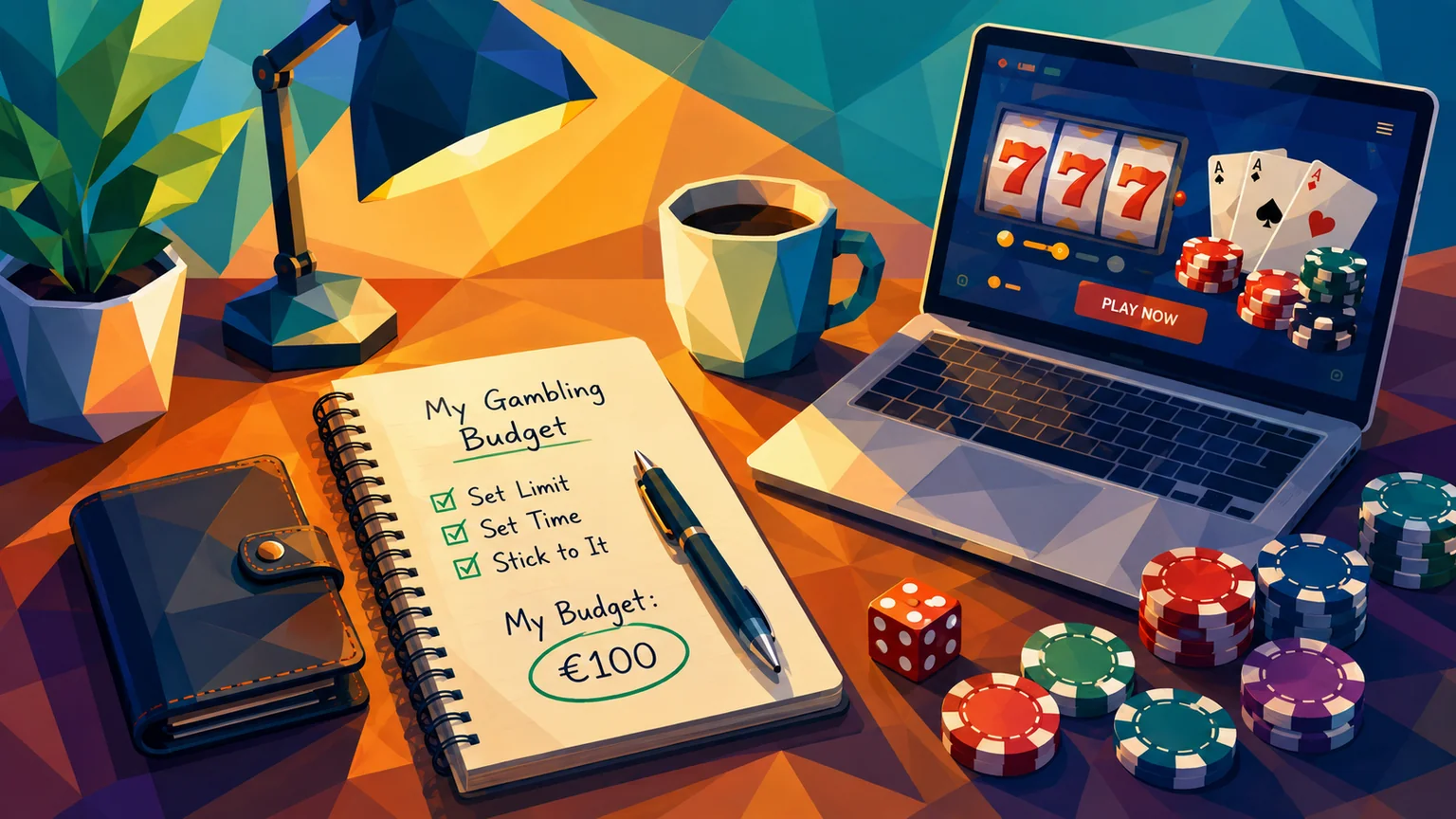
A gambling budget sounds simple. Decide how much you can afford to lose, play with that amount, and stop when it’s gone.
That is the basic idea, yes. But in practice, many gambling budgets fail because they are too vague, too flexible, or created at the wrong moment. A limit that only exists in your head is easy to move. A budget decided halfway through a losing session is usually not a budget at all. It’s more like a negotiation with yourself while your judgment is already under pressure.
A useful gambling budget has to be set before you start playing. Before the first deposit. Before the bonus offer. Before the first loss makes you want to recover your money, and before the first win makes you feel as if you can afford to take more risk.
What a Gambling Budget Actually Means
A gambling budget is not a strategy for winning. It does not improve the odds, reduce the house edge, or make casino games more predictable.
It is simply the amount of money you are prepared to spend on gambling as entertainment. That distinction matters. A gambling budget should be treated in the same way you might treat money spent on a meal out, a football ticket, a film, or a concert. Once the money is spent, it is gone. A win is possible, of course, but it should not be the reason the budget exists.
This is where many players get into trouble. They call something a budget, but emotionally they still expect the money to come back. Then, when it doesn’t, the session starts to feel unfinished. The loss feels temporary. Another deposit starts to look like a way to correct the situation.
A real gambling budget accepts the loss before play begins. If that feels impossible, the amount is probably too high.
Use Only Money You Can Afford to Lose
The phrase “only gamble what you can afford to lose” is repeated so often that it can start to sound empty. But it is still the central rule.
Money used for gambling should not be needed for rent, mortgage payments, food, bills, debt repayments, insurance, family expenses, tax payments, savings goals, or anything else that keeps your normal life stable. If losing the money would create stress, arguments, missed payments, or the need to borrow, it is not gambling money.
This also applies to money that feels temporarily available. For example, money sitting in your account before a bill is due is not spare money. A credit card limit is not spare money. Money you plan to “replace after payday” is not spare money either.
A gambling budget should come from genuinely disposable income. And even then, it should be an amount you can lose without feeling the need to win it back.
Set the Limit Before You Open the Casino
The best time to set a gambling budget is when you are calm and not already involved in a session.
Once you are playing, the situation changes. A few losses can make you impatient. A near miss can make the next spin feel more promising. A win can make extra risk feel harmless. Casino games are built around quick decisions, and quick decisions are not where good budgeting usually happens.
So decide the amount before you log in. Write it down if that helps. Use the casino’s deposit limit tools if they are available. If your bank or payment provider offers gambling blocks or spending controls, consider using those too.
The point is not to make gambling feel joyless. The point is to remove the need for financial decision-making while you are already emotionally involved.
A budget decided in advance is a boundary. A budget adjusted during play is often just permission to continue.
Separate Gambling Money From Everyday Money
It is easier to stay in control when gambling money is clearly separated from normal money.
That separation can be practical, not complicated. Some players use a separate e-wallet or account for gambling, funded only with a fixed entertainment amount. Others decide on a monthly gambling allowance and do not deposit again once it has been used. The exact method matters less than the separation itself.
When gambling money sits in the same mental category as everyday money, things get messy. A player might think, “It’s only another small deposit,” while forgetting that several small deposits have already been made. Or they may treat a casino balance differently from money in a bank account, as if it is less real because it is already inside the gambling site.
Casino balances are real money. Deposits are real money. Small payments are real money. A budget helps only if you keep seeing them that way.
Decide on a Time Limit Too
A money limit is important, but it is not the whole picture.
Long sessions can weaken judgment. After enough time, gambling can become automatic. You may stop noticing how quickly bets are being placed. You may stop checking the balance properly. You may also become more willing to continue simply because you have already invested so much time in the session.
That is why a useful gambling budget should usually include a time limit as well.
The time limit does not need to be complicated. It can be as simple as deciding to play for 30 minutes, an hour, or one short session after dinner. What matters is that the session has an end point. Without an end point, gambling can stretch until the money is gone, the mood changes, or the losses become uncomfortable.
A time limit also makes it easier to notice when gambling is starting to take up more space in your life than you intended.
Avoid Chasing Losses
A gambling budget is tested most clearly after a loss.
If you lose the amount you planned to spend, the session is over. That sounds obvious, but it is often the hardest part. The urge to continue can be strong because stopping after a loss feels unsatisfying. It can feel as if the casino has “taken” something that you now need to get back.
That is chasing losses.
Chasing losses usually feels logical in the moment. You may tell yourself that one more deposit gives you a chance to recover the previous one. You may lower the stakes and promise to be careful. Or you may raise the stakes because a bigger win would solve the problem faster.
The problem is that the next bet is still a gamble. It does not know you are behind. It does not become more likely to win because you need it to.
If your budget is gone, stop. Not because stopping feels good, but because continuing is exactly how small losses become larger ones.
Set a Win Limit Before You Play
Most people think about limits in terms of losses, but wins need boundaries too.
A win can make a player feel protected. The phrase “playing with the casino’s money” is common, but it is misleading. Once the money is in your balance, it is yours. If you gamble it away, you have lost your money, not the casino’s.
This is why a win limit can be useful. Before you start, decide whether you will withdraw after reaching a certain amount. For example, you might decide that if your balance doubles, you withdraw the winnings and end the session. The exact number is personal, but the decision should be made before the excitement of winning changes your thinking.
Without a win limit, a good session can turn into a bad one surprisingly quickly. A player wins, keeps playing, gives some of it back, becomes annoyed, and then continues because they want to return to the higher balance they had a few minutes earlier.
That is still chasing. It just starts from a win instead of a loss.
Be Careful With Bonuses
Bonuses can make budgeting harder because they change the way a session feels.
A deposit bonus may appear to give you more money to play with, but it usually comes with conditions. Wagering requirements, game restrictions, maximum bet rules, withdrawal limits, and expiry times can all affect how the bonus works. The bonus balance may encourage longer sessions or higher total wagering than you originally planned.
This does not mean every bonus is bad. It means a bonus should never be used as an excuse to ignore your budget.
If claiming a bonus makes you deposit more than planned, play longer than intended, or chase wagering requirements after you no longer want to play, the bonus is not helping. It is pulling you away from the limit you set.
Sometimes the more responsible choice is to skip the bonus and keep the session simple.
Track What You Actually Spend
Many players underestimate how much they gamble because they remember individual deposits, not the total.
Ten small deposits can feel less serious than one large deposit, even if the final amount is the same. This is especially true when deposits happen quickly and the casino account balance changes constantly during play.
Checking your gambling history can be useful. Many online casinos provide account statements, deposit history, withdrawal history, and session records. Banks and payment apps can also show the real pattern more clearly than memory does.
Look at the numbers over a week or a month, not just one session. The question is not only, “Did I lose too much today?” It is also, “Is this becoming a regular expense that I did not really plan for?”
A gambling budget should be visible. If you do not know how much you have spent recently, the budget is probably not doing enough work.
What It Means If You Keep Breaking Your Budget
Breaking a gambling budget once may be a mistake. Breaking it repeatedly is a warning sign.
That does not automatically mean someone has a gambling addiction, but it does mean the current system is not working. The answer is not simply to create a new budget and hope next time will be different. If the same pattern keeps happening, something stronger is needed.
That might mean lowering the limit. It might mean using deposit limits that cannot be changed instantly. It might mean taking a break, closing accounts, using gambling-blocking software, or asking someone you trust to help you put practical barriers in place.
It may also mean looking honestly at why you are gambling. Are you playing for entertainment, or are you trying to recover losses? Are you gambling because you enjoy the games, or because you feel stressed, bored, angry, lonely, or under financial pressure?
A budget is a tool. If you keep pushing past it, pay attention to that. The broken limit is information.
When a Budget Is Not Enough
Budgeting can help players who still have control over their gambling. It is less useful when gambling already feels compulsive.
If you feel unable to stop, if you gamble with money you need, if you hide gambling from people close to you, or if you feel anxious and restless when you cannot gamble, a budget may not be enough protection. In that situation, the priority should be distance from gambling, not a better spreadsheet.
Self-exclusion, time-outs and blocking tools, along with bank gambling blocks, support groups, counselling, and help from trusted people, may be necessary. There is no shame in that. Gambling problems often become worse when people try to manage them privately for too long.
A responsible gambling budget is there to keep entertainment within limits. If gambling is already damaging your finances, relationships, work, sleep, or mental health, the next step is not a new limit. It is getting help and making access harder.
Simple Rules for a Safer Gambling Budget
A good gambling budget does not need to be complicated.
Set the amount before you play. Use only money you can afford to lose. Keep gambling money separate from essential money. Decide on a time limit. Stop when the money is gone. Withdraw when you reach the win point you decided in advance. Do not increase the budget during a session. Do not gamble to recover losses.
The hardest part is not understanding these rules. The hardest part is following them when gambling has become emotional.
That is why the budget has to be created before the session begins, while the decision is still calm. Once the game has started, the budget should no longer be up for debate.
Whether you´re new to gambling, or have been a seasoned card or Slots player at live casinos, it´s important that you set a gambling budget and ensure that you stick to it.It’s no secret that people who gamble often become addicted to the thrill they receive when they begin; and like with any addiction, those who are addicted to gambling find themselves needing to up the ante in order to get the same feeling of excitement that they did in their early gambling days.
Those who become addicted to gambling may find a need to increase the amounts that they wager to increase the thrill, and hopefully increase the size of the jackpot available to them; although while their risks may increase, their winnings rarely do and they find themselves losing everything else that’s important in their lives, from family and friends to the careers that they worked so hard to establish. With safety and moderation in mind, gambling can be a thrilling form of entertainment, and the best way to prevent a slip into gambling addiction is to set a budget and exercise will power to ensure it’s abided by.
Smart gamblers need to look at gambling as a form of entertainment; while winning can be a nice perk, the expectation should be to lose and any money spent should be perceived as an investment in the joy of your game of choice, whatever that may be. Look at what you can afford to spend when playing at online casinos and set a weekly or monthly maximum. If you’re using an alternative payment method like Neteller to fund your virtual casino account, make sure you transfer no more than that maximum and as soon as you’ve used it all up, you need to stop playing and not be tempted to transfer more money.
In order to make your gambling budget go farther, choose casino games that are suitable based on what you have to spend. If your weekly or monthly gambling budget is small, don’t pick the high-roller American Roulette tables and risk losing all your money in one shot or you won’t feel like you satisfied your desire to gamble. Instead, check out the Slot machines, Card Tables, Table Games or other casino games which allow you to wager small amounts so you get to play more before you reach your budget.
Of course, with gambling at online casinos, it does happen, but you can’t expect to win any major jackpots. However if you do happen to receive a payout, it’s up to you whether you stop while you’re ahead and walk away with your winnings or keep on playing at the risk of losing it all. Just remember, that once your account is empty, there’s no more online casino gaming until you’ve reached your next budgeted period.
Coming up with your gambling budget is a pretty simple process. Look at the monthly expenses for your family; everything from housing, to food, to your family activities. Make sure you consider any necessary savings amounts, and leave a buffer for unexpected expenses, but then any amount remaining after that can make up your maximum gambling budget which is never to be exceeded!
Gambling at virtual casinos can be a fun and entertaining pastime, but precautions need to be taken to ensure it remains a safe experience that does not have a negative impact on your financial security or your relationships with the important people in your life. As soon as that line is crossed, it’s probably time to reconsider the reasons why you gamble and modify your gambling habits. But if you’re a responsible gambler who can stick to a budget; relax, enjoy, and let the excitement take you away!