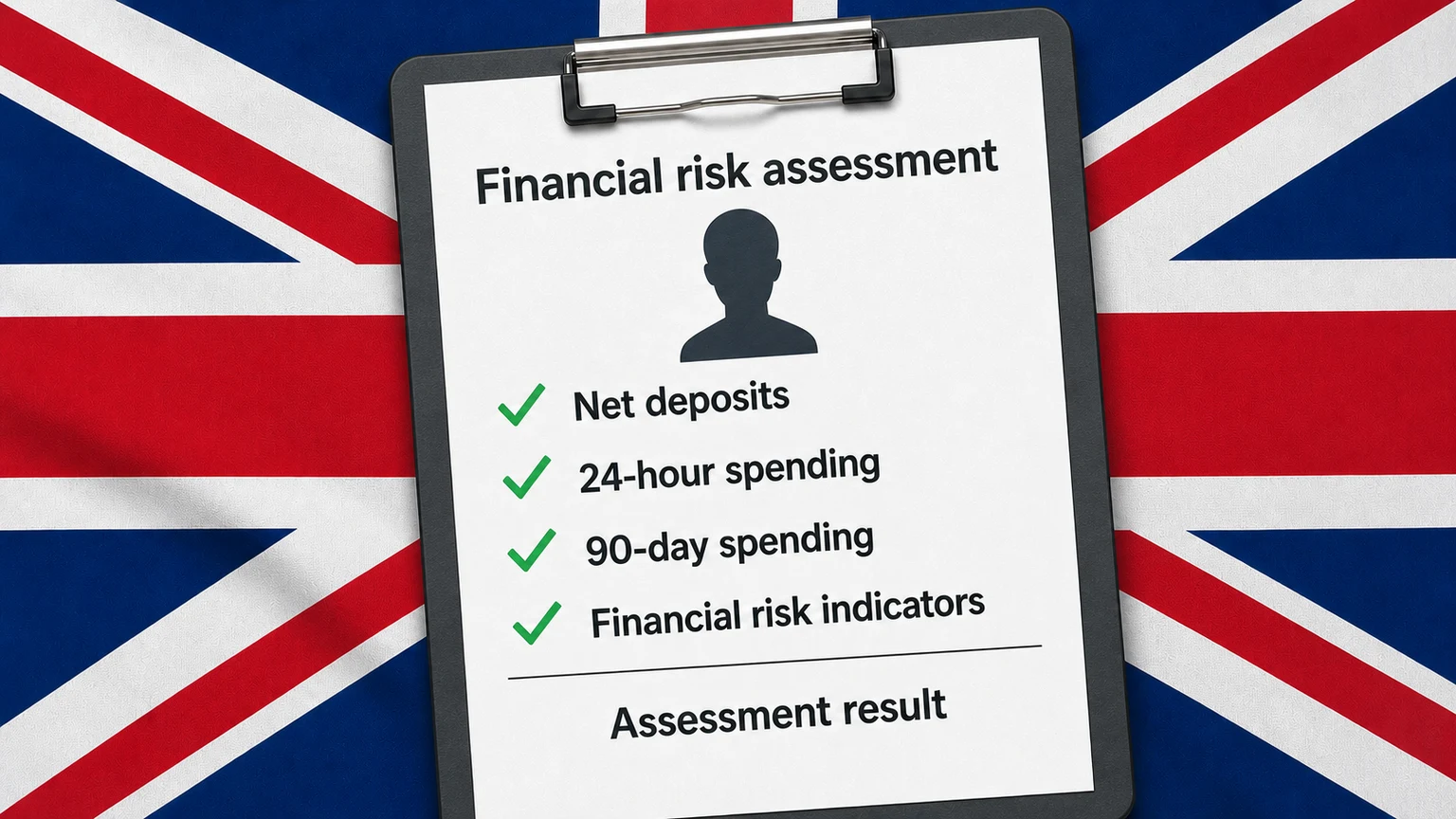
Financial risk assessments (FRA) are planned checks for a small proportion of customers spending unusually large amounts with gambling businesses licensed in Great Britain.
They are intended to help operators identify situations where high gambling expenditure may be connected to serious current financial difficulties. In most cases, the assessment should happen automatically through a credit reference agency, without the player supplying bank statements, payslips or other financial documents.
The Gambling Commission announced the staged approach on 7 July 2026. However, the first implementation date had not yet been confirmed when this article was prepared. The thresholds below should therefore be understood as planned triggers, not as checks already operating throughout the market.
The rules concern gambling offered under a Gambling Commission licence in Great Britain. They should not be treated as a worldwide standard or assumed to apply to every operator using a British-facing brand.
What Is a Financial Risk Assessment?
A financial risk assessment is designed to give a gambling operator limited information about whether a high-spending customer appears to be experiencing certain forms of financial difficulty.
According to the Gambling Commission, the assessment will normally be performed through a credit reference agency. The operator will not receive the player's complete credit report.
The information supplied may include an overall assessment and indicators connected to:
- defaults;
- multiple arrears;
- significant arrears; and
- a debt-management plan.
The purpose is not to calculate how much money a particular person can afford to gamble. The result instead becomes one piece of information the operator can consider alongside what is happening on the gambling account.
That wider account activity may include sudden changes in spending, increasingly long sessions, repeated payment attempts, use of gambling-management tools or other recognised signs of harm.
These Are Not General Affordability Checks
Financial risk assessments are sometimes described as “affordability checks”, but that expression can be misleading.
The planned assessment does not produce a personalised gambling budget or confirm that a particular level of spending is affordable. It will not give the operator access to a complete picture of the customer's income, household costs, savings and financial responsibilities.
A clear automated result also does not certify that continued gambling is safe.
It only indicates whether the limited credit-reference information used in the assessment shows specified signs of financial difficulty. Someone can be financially vulnerable without those indicators appearing, while an indicator may exist for reasons that require further context.
The result therefore needs to be considered together with the customer's gambling behaviour and any other relevant information already available to the operator.
When Will an Assessment Be Triggered?
The Gambling Commission has set out a staged introduction using net deposits over rolling periods.
Net deposits are the customer's deposits minus withdrawals. This means the trigger is not based simply on the total amount ever deposited or the amount wagered.
At the time of the July 2026 announcement, the proposed stages were:
| Stage | Customer group | Planned net-deposit trigger |
|---|---|---|
| Stage 1 | Customers aged 25 or over | More than £5,000 over a rolling 24-hour period |
| Stage 1 | Customers under 25, or otherwise treated as higher risk | More than £2,500 over a rolling 24-hour period |
| Final threshold | Customers aged 25 or over | More than £1,000 over 24 hours or £3,000 over 90 days |
| Final threshold | Customers under 25 | More than £750 over 24 hours or £2,000 over 90 days |
These figures describe the planned rollout. They should not be read as confirmation that every licensed operator is already applying the final thresholds.
The Commission said it would work with implementation groups before confirming the start of Stage 1. Anyone affected should check the latest Gambling Commission announcement and the notices supplied by their operator rather than relying on an older article or social-media summary.
How Many Players Are Likely to Be Assessed?
The Commission expects the checks to affect only a small proportion of gambling accounts.
Its pilot found that approximately 97% of customers above the relevant thresholds could be assessed without the customer providing documents. When the system is fully implemented, the Commission estimates that fewer than 3% of gambling accounts will receive an assessment.
It also estimates that fewer than one customer in every 1,000 accounts may be unable to receive an automated result and could therefore be asked for information through another route.
These are market-level estimates rather than guarantees for an individual customer. Whether a player encounters a check will depend on their net deposits, age, account activity and the implementation stage in force at the time.
Will the Check Affect Your Credit Score?
The Gambling Commission says the assessment will not affect the customer's credit score.
It is intended to be a frictionless check using limited information from a credit reference agency. It is not a credit application, and the operator should not receive the full credit report that a lender might use when deciding whether to offer a loan.
That distinction matters. A financial risk assessment should not be treated as borrowing money or applying for credit merely because a credit reference agency is involved.
Players should still read the operator's privacy information. It should explain which organisation is carrying out the assessment, what personal data is used, the purpose for which it is processed and what rights the customer has.
Will the Casino See Your Bank Transactions?
An ordinary automated financial risk assessment is not supposed to give the casino access to a customer's complete bank account or transaction history.
The planned assessment uses limited credit-reference information. It is therefore different from open banking, a bank-statement review or a conventional source-of-funds investigation.
In the relatively rare situation where an automated assessment cannot be completed, an operator may need to consider another way of obtaining relevant information. That could potentially involve open banking or documents, depending on the circumstances and the applicable rules.
The operator should explain what it needs, why it needs it and how the information will be handled. A request for sensitive documents should not be accepted merely because it arrives in an email carrying a casino logo. Players should sign in through the official website or independently verify the request with the licensed operator before uploading anything.
What Happens After an Assessment?
Passing a threshold does not automatically mean that the account will be closed or that a withdrawal will be confiscated.
It also does not mean that the operator must ignore the result if the assessment identifies possible financial difficulty.
The operator is expected to consider the assessment together with other available indicators and decide whether proportionate action is required. Depending on the circumstances, that might include:
- contacting the customer;
- reviewing recent gambling activity;
- stopping or restricting direct marketing;
- encouraging or applying gambling controls;
- limiting further deposits;
- pausing gambling while concerns are reviewed; or
- requesting additional information where it is genuinely necessary.
The correct response will depend on the information available. A single automated result should not be treated as a complete diagnosis of someone's finances, but an operator should not disregard credible signs of harm simply because the customer wishes to continue gambling.
During the early rollout stages, the Commission has said it does not intend to take enforcement action solely because an operator failed to act on the result of a financial risk assessment. Existing obligations to identify and respond to gambling harm will nevertheless continue to apply.
Financial Risk Assessments and Financial Vulnerability Checks Are Different
The terminology is easy to confuse because Great Britain's system also includes financial vulnerability checks.
A financial vulnerability check uses publicly available information such as:
- bankruptcy records;
- county court judgments;
- individual voluntary arrangements;
- debt-relief orders; and
- comparable public insolvency or court records.
The Gambling Commission has specifically clarified that these checks do not include credit-reference information.
A financial risk assessment is the planned additional check for a smaller group of customers reaching much higher net-deposit thresholds. It uses limited credit-reference information and can identify certain financial difficulties that do not necessarily appear in public records.
The two checks therefore have different triggers, different data and different purposes within the operator's wider customer-interaction process.
How Is This Different From KYC and Source of Funds?
Financial risk assessments do not replace identity verification, anti-money-laundering checks or source-of-funds investigations.
KYC—short for “know your customer”—is used to establish who controls an account. It may involve checking a name, date of birth, address, identity document and payment method.
A source-of-funds request examines where particular gambling money came from. Depending on the circumstances, the operator might ask for bank statements, payslips, business records, evidence of an asset sale or other supporting material.
A financial risk assessment has a narrower purpose. It looks for specified indicators of financial difficulty after the relevant net-deposit threshold has been reached.
A customer may encounter more than one kind of check because they answer different questions:
| Check | Main question |
|---|---|
| KYC | Is this customer who they claim to be? |
| Source of funds | Where did the gambling money come from? |
| Financial vulnerability check | Do public records show severe financial difficulty? |
| Financial risk assessment | Does limited credit-reference information indicate current financial difficulty? |
Our guide to online casino verification, KYC and source-of-funds checks explains the document-based processes in more detail.
What If the Information Is Wrong?
Credit information can contain errors or may not reflect a recent change in circumstances.
If an operator says that an assessment has identified information you believe is inaccurate, ask it to explain the nature of the issue and which credit reference agency supplied the result. The operator may not be able to disclose every part of its internal risk process, but it should give you enough information to understand the decision and exercise your data rights.
You can obtain your statutory credit report from the relevant credit reference agency without paying for it. Check whether the report contains an incorrect account, status, address, court record or association with another person.
The Information Commissioner's Office advises consumers to dispute inaccurate credit information with the credit reference agency and the organisation that supplied it. If the information is not corrected appropriately, a data-protection complaint may be possible.
Correcting an inaccurate record does not oblige a gambling operator to restore unrestricted access immediately. It may still have other regulatory, security or safer-gambling concerns to consider.
What If Your Account or Withdrawal Is Restricted?
Ask the operator to identify the reason for the restriction.
A financial risk assessment, identity check, source-of-funds request, anti-money-laundering review and ordinary payment investigation are not interchangeable. Knowing which process is underway helps you understand what information may reasonably be required.
Keep copies of:
- the notice explaining the restriction;
- the date the assessment or review began;
- every information request;
- confirmation that documents were received;
- relevant deposit and withdrawal records; and
- support or complaints correspondence.
Do not send several different versions of the same document unless the operator explains what was missing from the earlier submission. Sensitive information should be shared only through a verified secure channel.
A pending regulatory review can delay access to an account, but it should not become an excuse for vague or indefinite communication. Our guide to casino withdrawals explains how to separate routine processing, verification and a more serious delay.
If the operator does not explain its decision or you believe the process has been handled incorrectly, follow its formal complaint procedure. The guide to making an online casino complaint covers evidence, escalation and Alternative Dispute Resolution in Great Britain.
Can the Information Be Used for Marketing?
Information obtained to evaluate financial risk should not be turned into a marketing opportunity.
The purpose of the assessment is to identify risk and support an appropriate customer-interaction decision. It should not be used to target someone with bonuses, VIP treatment or advertising based on their apparent financial position.
That boundary is particularly important when an assessment suggests difficulty. A player who appears financially vulnerable should not receive stronger incentives to deposit or gamble more.
Customers can ask the operator how assessment data is used, how long it is retained and whether it is shared with other companies. The operator's privacy notice should provide the relevant details and identify the routes available for a data-protection request or complaint.
What the Planned System Cannot Tell You
A financial risk assessment is a safety measure, not a guarantee.
It cannot establish that a player is comfortable with their losses. It cannot see every debt, expense or financial commitment. It cannot decide that gambling is affordable merely because no listed risk indicator appears.
It also cannot replace the player's own limits.
Someone does not need to reach £1,000, £3,000 or £5,000 in net deposits before gambling becomes financially harmful. A much smaller loss can be serious when it affects rent, bills, savings or borrowing.
The regulatory thresholds tell operators when a particular assessment may be required. They are not recommended gambling budgets.
What Players Should Remember
The main points are straightforward:
- The staged rollout was announced in July 2026, but the first implementation date was not yet confirmed.
- The checks apply to gambling businesses licensed for customers in Great Britain.
- Only a small proportion of accounts are expected to reach the relevant thresholds.
- Most assessments should be automatic and should not require documents.
- The assessment should not affect the customer's credit score.
- Operators receive limited indicators, not the customer's complete credit report.
- A financial risk assessment is different from KYC, source-of-funds checks and financial vulnerability checks.
- The result does not prove that gambling is affordable.
- The thresholds are regulatory triggers, not safe spending targets.
The planned system is designed to give operators an earlier warning when very high gambling expenditure may be colliding with serious financial difficulty. Whether it works well will depend on more than the automated result: operators will need to communicate clearly, protect customer data and respond proportionately when genuine risk appears.