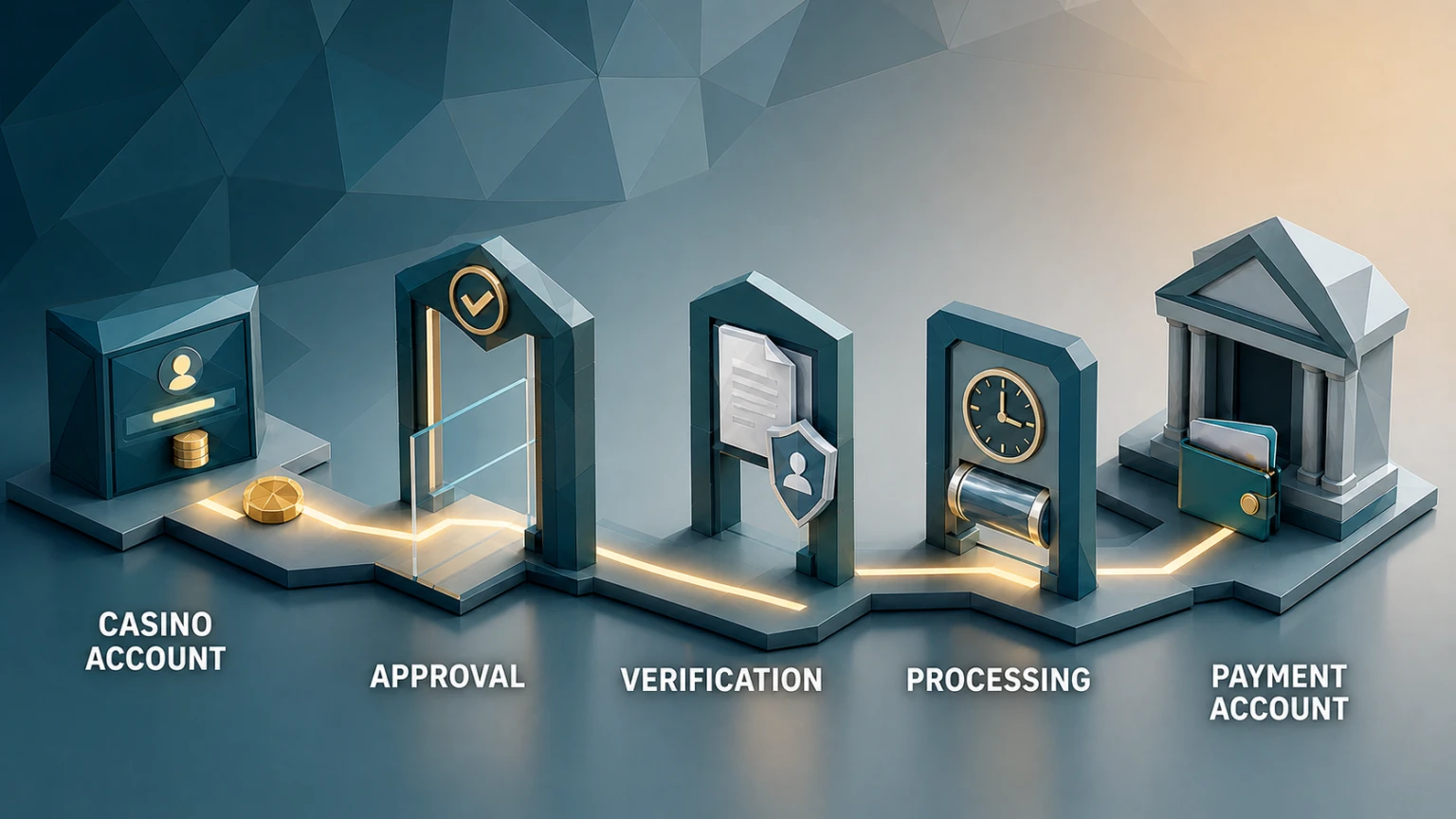
Requesting a casino withdrawal should be straightforward: you choose an available method, enter the amount and wait for the operator and payment provider to complete their checks. In practice, the route can involve several distinct stages, and the time shown on a casino’s payments page may cover only part of them.
Understanding those stages makes it easier to choose a suitable method before depositing, recognise a routine verification request and identify when a withdrawal has moved beyond an ordinary delay. The rules and protections also depend on where you live, so general payment information should never replace local regulatory guidance.
Check the Withdrawal Rules Before Depositing
A casino’s withdrawal arrangements matter before any money enters the account. The terms should explain which methods can receive withdrawals, whether deposits must be returned through their original route, the minimum and maximum transaction amounts, any fees and the operator’s expected processing time.
Start by checking:
- whether your deposit method can also receive withdrawals;
- whether a different method must be registered as a fallback;
- which currencies are supported;
- the minimum amount for one withdrawal;
- any transaction or processing charges;
- whether the operator divides larger payments into instalments; and
- what verification may be required.
These checks belong alongside the broader process of choosing an online casino. A fast deposit does not prove that the same method will offer a fast or even usable withdrawal.
Avoid relying only on a payment logo in the footer or cashier. The written terms and the options displayed in your account are more useful, but they are only part of determining whether an online casino is safe and legitimate. Neither overrides the law or regulatory rules that apply where you live.
The Normal Casino Withdrawal Lifecycle
The wording varies between operators, but an online casino withdrawal usually passes through several stages.
A request may first appear as requested or pending. The casino has received it, but the funds have not necessarily been approved for release. During this stage, the operator may check the account balance, bonus conditions, identity information, payment ownership or transaction history.
An approved or processed status normally means the operator has released the payment. It does not always mean the money has reached your bank, card or wallet. The payment provider may still need to transmit, clear or credit it.
A completed status generally means the casino considers its part finished. If the money is still missing, ask for the processing date, destination, transaction reference and any trace information available. Those details help the receiving provider investigate the transfer.
A request can also be rejected, cancelled or returned. That may happen because the destination cannot accept the payment, the account details do not match, a method is no longer supported, verification remains incomplete or the transfer has been returned by an intermediary.
Status labels are not standardised. If the cashier does not define one clearly, ask the operator what it means and whether the money is still under its control.
Casino Processing Time Is Only Part of the Wait
A quoted withdrawal time may refer only to the casino’s internal review. Once the operator releases the payment, a bank, card network, e-wallet, payment processor or blockchain network may add further time.
Processing can also be affected by weekends, public holidays, currency conversion, correspondent banks and the receiving provider’s own checks. This is why an operator’s “processed” date and the date the money becomes available are not always the same.
Treat estimates as estimates rather than promises unless the terms create a specific commitment. At the same time, vague or repeatedly changing explanations should not be accepted indefinitely. Record the time of the request and compare it with the operator’s published timeframe.
If the stated period has passed without a clear explanation, follow the structured checks in the guide to a delayed casino withdrawal.
Why the Deposit Method May Affect the Withdrawal
Casinos commonly try to return funds through the method used to deposit. This can help them confirm payment ownership and reduce fraud or money-laundering risk. It does not mean every deposit method can receive money.
Some cards, prepaid products and mobile payment services may support deposits but not withdrawals. An e-wallet may be available only if it was registered or used previously. Bank transfers may require accurate account details and can involve intermediary banks. Crypto transfers require a compatible network and wallet address, and a mistaken or incompatible transfer may be irreversible.
The practical differences between cards, bank transfers, e-wallets, vouchers, mobile payments and crypto are covered in Casino Payment Methods Explained. Before depositing, check the withdrawal side of the method rather than choosing purely for deposit speed.
Never send more money because someone claims an additional deposit will “unlock” a withdrawal. A genuine fee or verification requirement should be documented in the operator’s terms and explained through its official support channel. Requests to pay an unexpected tax, release charge or security deposit deserve particular caution.
Verification Before a Withdrawal Is Released
A casino may need to confirm who controls the account and whether the withdrawal is going to an account or payment instrument belonging to that person. Depending on the circumstances and jurisdiction, checks can involve identity, age, address, payment ownership, transaction history or the source of funds.
The operator should explain what it needs and provide a secure submission route. Common documents include government-issued identification, proof of address and evidence showing ownership of a bank account, card or wallet. A document can be rejected because it is expired, cropped, blurred, incomplete, too old or inconsistent with the details registered on the casino account.
Do not email sensitive documents to an address found in an advert, social-media message or unsolicited contact. Sign in through the operator’s verified website or app and confirm the submission process with official support. Check that you understand which details may be covered and which must remain visible before redacting anything.
A verification request is not automatically evidence that the casino is refusing to pay. However, repeated demands for information already supplied, unexplained changes in requirements or requests unrelated to a stated legal or security purpose should be documented and challenged.
Bonus Conditions Can Change the Withdrawable Balance
A displayed casino balance is not always fully withdrawable. If a bonus is active, the terms may distinguish cash funds from bonus funds and place wagering, game, stake or time restrictions on the promotion.
Requesting a withdrawal can cancel an unfinished bonus, remove bonus funds or trigger a review of the play associated with it. A breach may affect promotional winnings, but an operator should be able to identify the exact term it is relying on rather than referring vaguely to “bonus abuse”.
Check the bonus history, wagering progress and applicable version of the terms before submitting the request. Preserve a copy if a substantial balance depends on them. Do not continue gambling simply to satisfy unclear requirements; ask the casino to explain the calculation first.
Withdrawal Minimums, Maximums and Instalments
A payment method can have a minimum transaction amount or a technical per-transaction ceiling. Those operational limits are different from a casino using low daily, weekly or monthly caps to prevent a player from accessing their balance.
The distinction matters in Great Britain. UK Gambling Commission guidance says operators must not impose a maximum limit on how much a consumer may withdraw from their deposit balance. Reasonable limits on the size or number of individual transactions may still be used, but they must not become a restriction on withdrawing the overall balance.
Elsewhere, the contract and local rules may differ. If a casino proposes instalments, ask whether the limit comes from the payment method or the operator, how many payments will be made, whether every instalment has been approved and whether any further checks or charges apply.
Do not assume that a limit is fair or enforceable merely because it appears in the terms. Consumer and gambling rules can override contractual wording.
When Withdrawal Fees May Apply
A withdrawal can involve an operator fee, a charge from the receiving provider, currency conversion or an intermediary-bank deduction. Crypto transactions may also involve a network fee.
The cashier or terms should disclose any operator charge before you commit money. Check whether the fee is fixed, percentage-based or charged separately on each instalment. A percentage fee can become significant on a large withdrawal, while repeated fixed fees can make several small withdrawals unnecessarily expensive.
For customers in Great Britain, the Gambling Commission says a withdrawal processing fee must reflect the operator’s direct cost and be made clear before deposit. It also says a player must not be charged for withdrawing their entire deposit balance.
Even where that particular UK rule does not apply, unexplained deductions should be queried. Ask the casino for the gross amount, each deduction, the currency and exchange rate used, and the net amount sent.
Why a Withdrawal May Be Returned or Rejected
A returned payment is not necessarily the same as a refused withdrawal. The transfer may have left the casino and then come back because:
- the destination details were incorrect;
- the account or payment method was closed;
- the recipient name did not match;
- the provider could not accept gambling-related payments;
- the method did not support withdrawals;
- an intermediary rejected the currency or transfer; or
- a technical or network error prevented completion.
Ask whether the money has returned to the casino balance and request the payment reference or return reason. Confirm any replacement destination through the secure account area. Be cautious if someone asks you to send new bank, card or wallet details through an informal messaging channel.
With crypto, confirm both the asset and network. Two addresses can appear valid while belonging to incompatible networks. A blockchain confirmation proves that a transaction occurred on that network; it does not by itself prove that the correct person or compatible destination received usable funds.
Keep a Clear Record of the Request
Save the information needed to reconstruct the withdrawal without relying entirely on the casino account remaining accessible. Useful records include:
- the request date, time and amount;
- the selected payment method;
- screenshots of the status and balance;
- the relevant withdrawal and bonus terms;
- verification requests and submission receipts;
- support transcripts and complaint references;
- the approval or processing message; and
- any payment or blockchain transaction reference.
The purpose is not to collect every screen indiscriminately. It is to preserve the facts needed to identify where the money stopped moving and what the operator said at each stage. The guide explaining why casino players should keep records covers how to retain this evidence without exposing documents unnecessarily.
Withdrawal Rules in the United Kingdom
Players in Great Britain should first confirm that the business is licensed by the UK Gambling Commission for the activity being offered. The Commission’s current guidance says online gambling businesses must verify age and identity before allowing a customer to gamble.
A withdrawal should not be used as the first opportunity to demand information that the operator could reasonably have requested earlier. Further checks can still be required when they become necessary for legal, anti-money-laundering, fraud or security reasons, but the business should request them promptly.
UK guidance also says operators must allow customers to withdraw their deposit balance, including winnings, and must not impose a maximum limit on the total amount that can be withdrawn. Reasonable transaction arrangements and properly disclosed, cost-reflective fees can still apply.
If a request exceeds the published timeframe, ask the operator for the reason in writing. A payment dispute should normally go through the operator’s formal complaints procedure before any external dispute route is considered.
Withdrawal Rules in Canada and Ontario
Canada does not have one universal online-casino withdrawal system. Gambling is conducted and managed provincially or territorially, so the regulator, authorised operators and complaint route depend on the player’s location.
Ontario has a distinct regulated internet-gaming market. Players should check that the site is offered by an operator participating in that market rather than assuming that a Canadian-looking brand is authorised. Ontario standards require withdrawals to be verified and authorised, including checks that the request comes from the account holder and is sent to an account legally held by that player. Funds must be withdrawn accurately, completely and within a reasonable timeframe.
If an Ontario-regulated operator does not resolve a withdrawal issue, the player should first complete the operator’s formal complaint process and retain the complaint reference. An unresolved matter can then be taken through iGaming Ontario’s Player Support process. iGaming Ontario can review eligible disputes involving regulated operators, but states that it does not itself settle bets, refund wagers or award compensation.
That Ontario process should not be presented as the route for every Canadian player. Readers elsewhere in Canada need to check the rules and complaint process of their own province or territory.
What Australian Readers Need to Know
Australian readers should not treat offshore online casinos as a normal regulated option. The Australian Communications and Media Authority states that online casinos and casino-style games such as slots, blackjack, roulette and poker are prohibited from being provided to people in Australia.
A site may still be accessible or accept a deposit, but accessibility does not make it legal or protected. ACMA warns that Australian regulators may be unable to help recover money when an illegal provider refuses or obstructs a withdrawal. It also blocks illegal gambling websites, which can interrupt later access to an account.
This article does not recommend offshore casino play to Australian readers. If money is already held by a service, preserve the account and transaction evidence, stop sending further deposits and use ACMA’s process to report a suspected illegal gambling service. Separate legal advice may be necessary where a substantial balance or suspected fraud is involved.
When a Routine Withdrawal Becomes a Problem
A withdrawal deserves closer attention when the published processing period has passed and the casino cannot provide a specific reason, owner or next action. Other warning signs include requirements that change after each submission, repeated requests for the same accepted documents, pressure to reverse the withdrawal, demands for another deposit or a refusal to identify the term being applied.
First establish where the request is:
- Ask whether it is still awaiting casino approval or has been released.
- Confirm whether verification or bonus review is outstanding.
- Request the exact transaction or rejection reference.
- Compare the response with the terms that applied when you deposited.
- Move to a formal written complaint if ordinary support does not resolve it.
Do not cancel and resubmit repeatedly unless there is a clear technical reason. Doing so can restart the processing clock and make the record harder to follow.
Do Not Gamble With a Pending Withdrawal
A pending withdrawal should not be treated as money available for further play. If cancellation or reversal is possible, leave the request in place unless correcting a genuine error.
Do not deposit again while trying to recover a payment. Mixing new deposits, wagers and bonus activity into an unresolved balance makes the account history more difficult to interpret and can increase the amount at risk.
A withdrawal is part of the same spending plan as a deposit. Managing deposits and withdrawals responsibly means deciding in advance what can be spent, keeping gambling money separate from essential funds and treating a requested withdrawal as the end of that session rather than a new bankroll.
A Practical Withdrawal Checklist
Before submitting the request, confirm that the destination belongs to you, can receive the payment and uses the correct currency or network. Read the current withdrawal and bonus terms, check whether verification is complete and save the request confirmation.
While it is processing, avoid cancelling, gambling the balance or sending additional deposits. Track the operator’s stated timeframe and keep important correspondence.
Once the casino marks the payment as processed, retain the transaction reference until the funds arrive. If the expected period passes, establish whether the operator or payment provider still controls the transfer before escalating.
The central question is not whether every withdrawal is instant. It is whether the process, checks, deductions and timing are explained clearly and applied consistently. A legitimate delay should have a reason and a route to resolution.