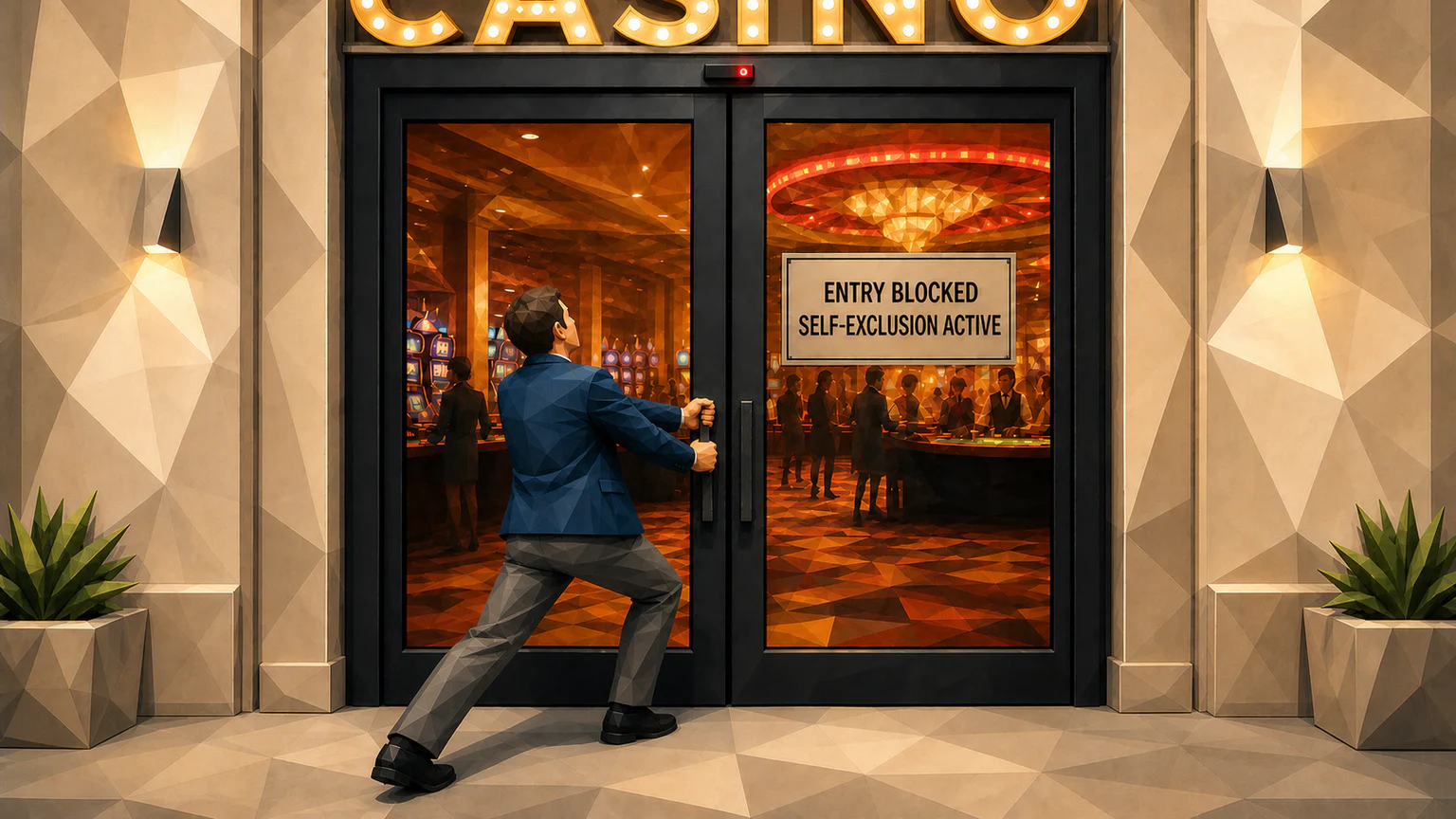
Self-exclusion is a formal request to block your access to gambling for a chosen period. Depending on the scheme, it may close one casino account or stop you using every licensed online operator in a market. It is intended for situations where ordinary limits or a short break no longer provide enough protection.
The block can be powerful, but it has boundaries. It may not cover unlicensed sites, operators outside the scheme, every form of gambling or payment methods used to fund gambling. Before registering, it is important to understand exactly which businesses are covered, how long the exclusion lasts and what happens to your accounts and remaining balances.
Scheme details and regulatory sources in this guide were checked on 7 August 2026.
When Self-Exclusion Is the Right Tool
A time-out pauses gambling for a relatively short period. Deposit, loss and session limits are designed to control particular parts of play. Self-exclusion goes further by removing access to gambling accounts for a longer period.
It may be the appropriate step if you no longer trust yourself to observe a budget, repeatedly reverse decisions to stop, open new accounts after losses or return as soon as a short time-out ends. The wider guide to player protection tools explains how limits, reminders, time-outs and account-history tools differ. Self-exclusion owns a narrower but more serious job: putting a substantial barrier between you and further gambling.
You do not need to wait for a crisis or a formal diagnosis. Self-exclusion is voluntary, and using it is a practical decision rather than an admission of failure.
Operator Exclusion and Multi-Operator Schemes
An operator-specific exclusion applies to one gambling business. The precise scope may be one website, every brand run by the same company or a wider group, depending on the rules and how the operator identifies connected accounts. Ask for written confirmation of what has been excluded rather than assuming that one request covers every related brand.
A multi-operator scheme uses one registration to block access across participating licensed businesses. This is normally the stronger option when someone has several accounts or is likely to move from one operator to another. It can also reduce the need to contact each casino separately while gambling urges are still strong.
Neither model automatically covers the whole internet. A national or provincial scheme applies only to the products, operators and territory within its rules. An offshore site that is unlicensed in your location may sit outside the system entirely.
What Usually Happens After You Register
The consequences depend on the scheme, but a regulated self-exclusion commonly affects four things:
- access to existing gambling accounts;
- attempts to open new accounts using matching identity details;
- direct gambling marketing from participating operators; and
- the handling or return of money left in an account.
The block may take time to propagate through operator systems. Keep the confirmation and follow the scheme's instructions during that period. Do not test whether the block works by attempting to gamble.
Account funds do not always move automatically. Check the scheme and operator instructions, then contact the operator through a non-gambling account or support route if a legitimate withdrawable balance remains. Self-exclusion should not be treated as surrendering money that is properly yours, but pending bets, unsettled transactions, bonus balances and disputed funds may require separate handling.
Marketing suppression is also not the same as removing every gambling advert from view. A participating operator should stop direct marketing where the scheme requires it, but general television, website, social-media or outdoor advertising may still appear. Email filters, social-media controls and blocking software can add another layer.
Prepare Before Activating the Block
If it is safe to do so, take a few practical steps before or immediately after registration:
- Choose the broadest appropriate scheme for your location, not only the casino used most recently.
- Add every current and previous name, address, email address and phone number the scheme requests. Identity matching is weaker when important details are missing or out of date.
- Save the registration confirmation, chosen period and the date the exclusion should begin.
- Record existing account balances and any pending withdrawals without delaying the exclusion in order to keep gambling.
- Remove casino apps, saved payment methods and promotional subscriptions.
- Consider a bank gambling block and independent blocking software where available.
- Tell a trusted person or support service if that will help you maintain the decision.
Keeping the confirmation and account records is not about preparing for a fight. It makes the scope of the agreement clear and gives the operator or scheme useful information if something goes wrong. The guide to keeping casino records explains which account and communication details are worth preserving.
Self-Exclusion in the United Kingdom
People living in the UK can use GAMSTOP Online to block access to websites and apps run by gambling companies licensed in Great Britain. The current minimum-period options are six months, one year, five years or five years with automatic renewal. GAMSTOP states that registration can take up to 24 hours to become effective and cannot be cancelled during the selected minimum period.
Keep your details current after registering. Matching depends on information such as names, addresses, email addresses and phone numbers. A new address or contact detail should be added rather than used to get around the exclusion.
GAMSTOP is a multi-operator online scheme. A person may also ask an individual business to exclude them, although an operator-only block is narrower. The UK Gambling Commission's self-exclusion guidance says a gambling business must close the account, return money held in it and remove the person's details from marketing databases. Its remote-operator rules also require reasonable steps to prevent further gambling and access to an immediate self-exclusion process.
GAMSTOP does not automatically return every withdrawable balance. Its registration guidance tells customers to contact operators directly about funds. Nor does it cover illegal operators that are not licensed in Great Britain. Searching for a casino advertised as “not on GAMSTOP” means leaving the regulated protection the exclusion was designed to create and may expose the player to weaker identity, payment and complaint safeguards.
Self-Exclusion in Canada
Canada does not have one online-casino self-exclusion system covering every province and territory. The correct route depends on where the player lives and which regulated products they use.
Ontario launched BetGuard in May 2026. It allows people aged 19 or older to exclude themselves from all regulated Ontario online-gambling platforms through one registration. Available terms run from six months to five years; the selected term cannot be shortened, although it can be extended. Participating sites should prevent access to existing accounts, new registration and direct marketing during the exclusion.
Ontario operators also maintain their own self-exclusion processes. A player who wants the widest regulated-market block should understand the difference between excluding from one operator and using BetGuard across the Ontario market.
Other provinces use their own systems. British Columbia's Game Break, for example, covers PlayNow and specified land-based gambling facilities for terms of six months, one year, two years or three years. It cannot be cancelled or changed before the chosen term expires. That is a British Columbia programme, not a national Canadian scheme.
Readers outside Ontario and British Columbia should check their provincial or territorial gambling authority and regulated operator. Do not assume that an Ontario registration covers a site or venue elsewhere in Canada.
Self-Exclusion in Australia
Australia requires a careful distinction between licensed wagering and online casinos.
BetStop is the national register for Australian-licensed online and telephone wagering providers. It can exclude a person from those wagering services for three months through to a lifetime. Covered providers must close accounts and must not allow new accounts, bets or direct marketing during the exclusion.
BetStop is not a regulated-online-casino scheme. The Australian Communications and Media Authority states that online casinos are prohibited from being offered to people in Australia. An offshore casino accessible from Australia is not made lawful or protected because it offers an account-level self-exclusion button.
Australian readers who have used an offshore casino should not assume BetStop will block it. They can report an illegal service to ACMA, use bank and device-level blocks where available, remove access to the operator and contact a gambling-support service. This guide does not direct Australian readers towards offshore casino play.
What Self-Exclusion Cannot Do by Itself
Self-exclusion creates a barrier; it does not remove every route back to gambling or resolve the reasons someone is gambling.
It may not block:
- illegal or unlicensed websites;
- operators outside the participating market;
- products not covered by that scheme;
- general gambling advertising that is not directed personally to you;
- gambling transactions through every bank or payment provider; or
- access created with identity details the scheme cannot accurately match.
Trying to bypass the block with changed details, another person's account, a VPN or an offshore site weakens the protection and can introduce new financial and legal risks. If the urge to work around the exclusion feels urgent, add barriers immediately rather than treating that urge as a reason the scheme has failed.
Blocking software, bank transaction controls, removal of saved payment methods and support from another person can make the exclusion harder to bypass. None is perfect alone. Their value comes from adding several layers between an urge and the ability to act on it.
What to Do if an Operator Lets You Gamble
If a participating operator lets you deposit or gamble during an active exclusion, stop using the account. Continuing to gamble in order to build a larger complaint is likely to increase the harm and complicate the record.
Save:
- the exclusion confirmation and effective date;
- the operator, brand and exact website or app;
- the details used for both the exclusion and gambling account;
- login, deposit, wager and withdrawal records; and
- any marketing received after the exclusion should have taken effect.
Tell the operator in writing and ask it to restrict the account, preserve the records and explain why the exclusion was not matched. If the response is inadequate, follow the formal route described in How to Make an Online Casino Complaint.
A regulator may use the information to examine whether an operator's controls are working, but that does not mean the regulator will decide an individual refund claim. Keep the regulatory report, operator complaint and any claim about money as related but distinct steps.
When the Exclusion Period Ends
Do not assume access returns automatically at midnight on the final day. Some schemes keep the block in place until the person takes a positive step to remove it, require a waiting period or impose a return-to-play process. Others allow the exclusion to be extended before it ends.
Check the current scheme terms rather than relying on what happened with a previous operator. If the prospect of renewed access feels risky, extend or renew the exclusion before the minimum period expires where the scheme permits it.
Ending an exclusion does not mean gambling has become safe or that earlier harms have been resolved. Before requesting access, look honestly at why the exclusion was needed, what has changed and whether the other protections around money, time and support are strong enough.
Use the Block to Create Space
Self-exclusion works best as the beginning of a wider plan rather than a solitary account setting. It can close access while you deal with debt, secrecy, stress, compulsive behaviour or the practical consequences of gambling.
If gambling is already affecting your finances, relationships, work, sleep or mental health, use the exclusion period to get appropriate support. Where to Get Help for a Gambling Problem lists current services and explains when gambling support, debt advice or urgent crisis help may be needed.
The purpose of self-exclusion is not to test your willpower. It is to make gambling harder to reach while you protect the parts of life that gambling has begun to affect.
Frequently Asked Questions About Casino Self-Exclusion
What is online casino self-exclusion?
Online casino self-exclusion is a formal, voluntary request that blocks access to covered gambling accounts for a chosen period. Depending on the scheme, it may apply to one operator or multiple licensed operators in the same market.
Is self-exclusion the same as a time-out?
No. A time-out is normally a shorter pause, while self-exclusion creates a longer and more substantial block. The available periods and removal rules depend on the operator or scheme.
Does self-exclusion cover every online casino?
No. It covers only the operators, products and territory included in the selected scheme. Illegal or unlicensed sites and operators outside the participating market may not be blocked.
How quickly does self-exclusion take effect?
Activation time varies. Some operator exclusions may be applied promptly, while a multi-operator scheme can need time to distribute the registration. GAMSTOP, for example, says registration can take up to 24 hours to become effective. Follow the scheme's instructions and do not test the block by trying to gamble.
Can I cancel self-exclusion early?
Usually not during the chosen minimum period. Some schemes also require a positive request, waiting period or return-to-play process after that period ends, so access may not resume automatically.
What happens to money left in my casino account?
A legitimate withdrawable balance does not normally disappear because of self-exclusion. Check the scheme and operator instructions and contact the operator about returning it. Pending bets, bonus balances, unsettled transactions and disputed funds may need separate handling.
Will self-exclusion stop me opening a new account?
Participating operators should use identity details to identify and block new registration attempts where the scheme requires it. Accurate names, addresses, email addresses and phone numbers improve matching, but no system covers operators outside its scope.
Will self-exclusion stop all gambling advertising?
No. It should stop direct marketing from participating operators where the rules require it, but general television, website, social-media and outdoor advertising may remain visible. Email filters, social-media controls and blocking software can reduce further exposure.
Does online self-exclusion also cover land-based casinos?
Only if the scheme expressly includes them. Some systems cover online gambling only, while others include specified venues or products. Check the scheme's coverage rather than assuming one registration blocks every form of gambling.
What should I do if a casino lets me gamble during self-exclusion?
Stop using the account and preserve the exclusion confirmation, account details, deposits, wagers and marketing records. Tell the operator in writing and use its formal complaint process if the response is inadequate. A regulatory report and an individual claim about money may be separate steps.