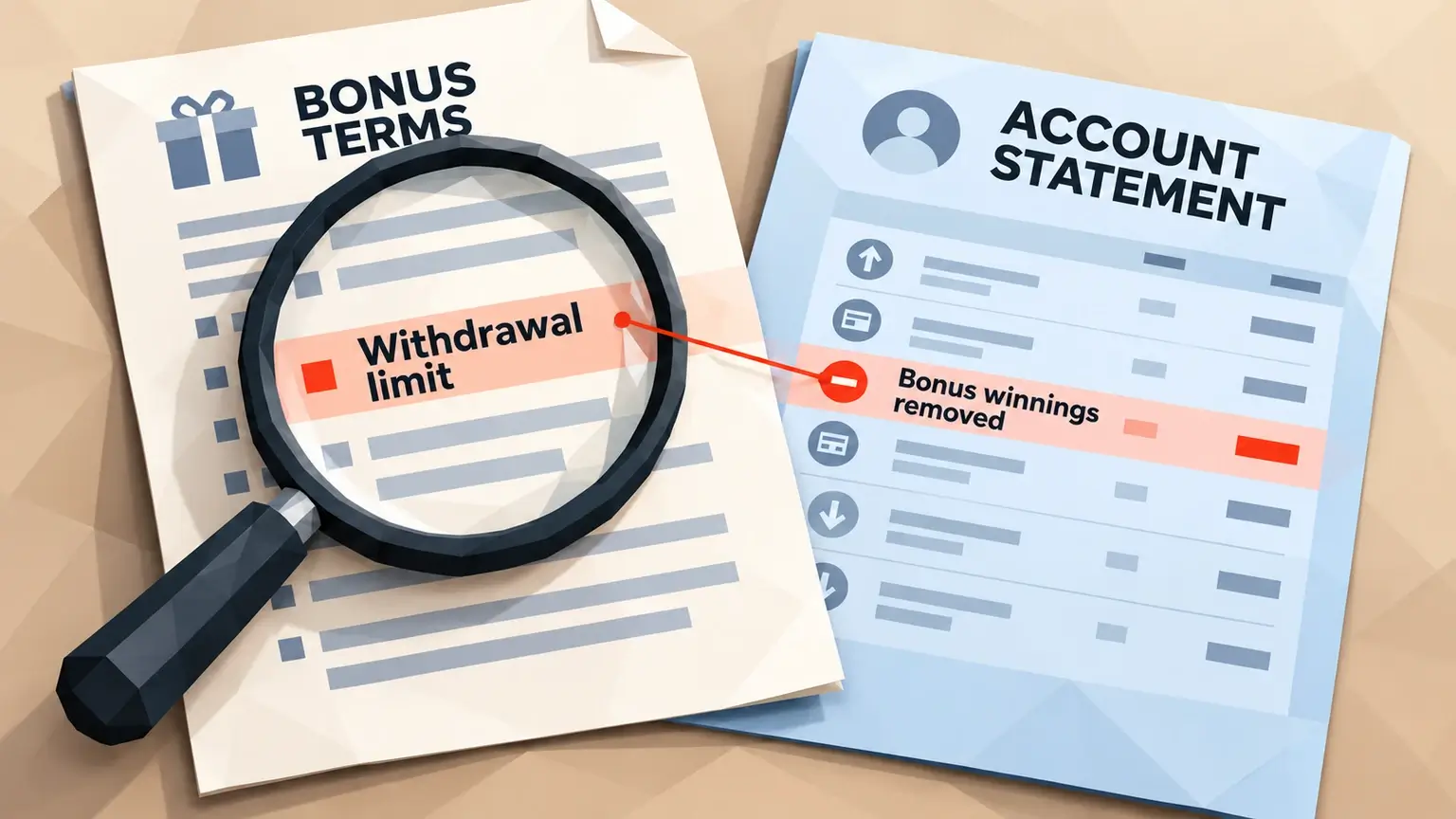
If a casino removes bonus winnings, first establish what changed: a promotional balance may have expired, winnings may have been reduced to a stated cash-out limit, or the operator may be alleging a breach of its terms. Ask for the amount removed, the exact rule applied and the transactions behind the decision before accepting the explanation.
Avoid further play with the disputed balance while you collect that information. More wagers, another bonus or a deposit made to “unlock” winnings can make the account history harder to follow and put more money at risk. A balance adjustment does not by itself prove either that the casino acted correctly or that the full amount must be paid.
Find out which money was removed
A total on the account screen may include deposited cash, bonus credit and winnings subject to different conditions. Request the balance immediately before and after the adjustment, with each part identified. You need to know whether the operator removed an unused promotion, deducted winnings, returned a deposit or simply moved money into a pending withdrawal.
Check the transaction history as well as the headline balance. A withdrawal request can reduce the available balance without the money being forfeited. Likewise, the removal of non-withdrawable bonus credit at cash-out is a different event from confiscating winnings. The distinction between sticky and non-sticky bonuses helps explain why the displayed balance and the amount available to withdraw may differ.
Suppose, purely as an example, a promotional balance falls from $300 to $100 and support cites a $100 maximum cash-out. That explains the $200 difference arithmetically. It does not establish that the cap applied to this offer, was disclosed properly, covered the funds deducted or was valid under the applicable rules. Those are the questions to investigate.
Match the explanation to a specific rule
“Bonus conditions not met” is not enough detail to check a deduction. Ask support to identify the promotion, the relevant clause and what happened on your account. Different explanations call for different evidence:
| Explanation given | What to check |
|---|---|
| A maximum bet was exceeded | The stated limit, currency, affected bet IDs, actual stakes and whether bonus conditions were active when those bets were placed. |
| An excluded game or feature was used | The game or feature named in the rule and the transactions involved. Distinguish prohibited play from play that merely contributes less, or nothing, to wagering. |
| Wagering was incomplete | The starting requirement, qualifying stakes, game contribution rates and remaining amount. A low contribution rate can explain slow progress without establishing a breach. |
| The promotion expired | The activation time, deadline, stated time zone and the terms describing what expires. Check whether the date shown in the account matches the rule cited. |
| A cash-out cap or bonus cancellation applied | Which funds were capped or removed, when the adjustment occurred and whether the cited withdrawal or cancellation event actually happened. |
| The player was ineligible or used multiple accounts | The particular eligibility condition and the operator’s explanation of the alleged connection. Do not open another account to test or bypass the restriction. |
For a wagering calculation, compare the operator’s figures with the actual wagering basis and game contribution. Completing the displayed wagering total does not answer a separate allegation about a maximum bet, eligibility or prohibited play. Equally, a rule about wagering progress should not be treated as a forfeiture rule without checking what it says.
If the explanation is “irregular play” or “bonus abuse”, ask whether the operator is alleging a defined promotional restriction or something different, such as fraud or account misuse. Request the relevant clause and as much supporting detail as it can provide. Some investigations involve information the operator cannot lawfully disclose; that does not make a vague label a calculation of the amount removed.
Preserve the terms and reconstruct the timeline
Save the offer you accepted, its specific conditions and the general bonus terms it referred to. Record when you claimed it and keep any confirmation email, bonus code or account message. A current terms page may not show the version that applied at the time.
Download the available transaction and gaming history, including bet IDs, stakes, returns, bonus adjustments and withdrawal events. Keep screenshots with their dates and the original support messages. If account access has been restricted, request the relevant records in writing. The guide to keeping casino records explains how to organise this material.
Build a short sequence: when the offer was accepted, when the disputed activity occurred, when wagering ended or the promotion expired, and when the balance changed. Note the time zone. This can expose a simple mismatch, such as a deduction attributed to a bet placed after the promotion had already ended.
Keep the evidence proportionate. A useful complaint connects a rule to specific events and amounts; hundreds of unlabelled screenshots make that harder. Retain the complete originals privately and send the relevant extracts through the operator’s official channel. Remove unrelated personal information from copies, but do not alter the facts needed to assess the dispute.
Ask for a calculation you can follow
The operator’s reply should let you trace how it reached the remaining balance. Ask it to separate your deposited funds, any winnings attributed to those funds, the bonus credit and the disputed promotional winnings. If it says all winnings arose from a prohibited bet, ask which bet and how that conclusion produces the deduction shown.
You can put the request simply:
Please identify the promotion and the version of its terms that applied when I accepted it. Which clause do you say was breached, and which bets or account events establish that breach? Please provide a breakdown of the amount removed, separating deposited funds, bonus credit and winnings, and explain how you calculated the remaining balance.
If an answer addresses only part of the question, follow up on the missing point. For example: “You have identified the maximum bet, but not a bet on my account that exceeded it.” If the terms and records do support a mistake you made, describe it accurately. The remaining question may be whether the stated consequence was applied correctly and is permitted, rather than whether the bet happened.
Do not assume that a game accepting a wager proves the wager complied with every bonus condition. Whether a restriction should have been prevented automatically depends on the applicable rules and circumstances. Similarly, a customer-service message saying an offer is “fine” may not resolve a specific restriction; preserve the exact question and answer.
Check the rules that apply where you played
The operator’s terms are part of the evidence, but they are not the only test. Requirements differ by jurisdiction, and a condition appearing on a website does not establish that it can lawfully be enforced.
Great Britain
For Gambling Commission-licensed gambling in Great Britain, the Commission’s promotional play guidance says prohibited types or patterns of play must be specified. Where winnings or a withdrawal are refused for breaching those restrictions, the operator must explain the breach and identify the terms involved, subject to its regulatory obligations.
There are also specific protections for deposited funds. The Commission’s deposit-balance guidance says players must be able to withdraw their deposit balance while a bonus is pending or active, subject to necessary regulatory checks. Wagering requirements must not prevent that withdrawal. Promotional play restrictions on deposited funds have a particular safeguard: the operator must use software that prevents the prohibited wager.
These distinctions matter if the deduction included your own cash or winnings from it. They do not mean every promotional balance must be paid in full. Identify the funding source and the restriction before drawing a conclusion.
Canada
Identify the province and the operator’s regulated status. Do not assume that British bonus rules or complaint procedures apply across Canada.
For gambling conducted and managed by iGaming Ontario through its regulated operators, first follow the operator’s complaint process. An unresolved or unsatisfactorily resolved dispute can then be raised through iGaming Ontario’s player-support process. Its guidance specifically includes bonus offers and terms disputes, but says iGaming Ontario cannot directly settle bets, refund wagers or award compensation. That process is not a nationwide route for every Canadian casino complaint.
Australia
Online casino-style services, including slots, blackjack and roulette, are prohibited from being provided to people in Australia. An offshore bonus offer does not change that position. ACMA warns that Australian regulators cannot help recover winnings withheld by illegal providers. Reporting an illegal service is different from obtaining a decision that it must pay your disputed balance.
Do not send more money to an offshore operator to try to release bonus winnings. Preserve the records and use ACMA’s official guidance on reporting illegal services and the limited options for money-recovery problems.
Turn an unresolved deduction into a formal complaint
Once you have the explanation and records, state precisely what you dispute: the term used, the alleged activity, the funding source, the calculation or the fairness of the restriction. Specify the amount you want reviewed and attach the evidence that supports it. A concise, factual account is more useful than an unsupported accusation of theft or rigged games.
Use the operator’s formal complaints procedure and retain its reference number. The casino complaints guide covers the wider escalation process. In Great Britain, an unresolved gambling-transaction dispute can normally reach the operator’s approved ADR provider after eight weeks, or sooner if the complaints process reaches a final position. The Commission explains the timing and the requirement for a free service in its ADR guidance.
Read any proposed settlement carefully, especially wording that closes the complaint or requires you to give up further claims. For a substantial sum or an unclear legal position, independent advice may be appropriate. A complaint does not guarantee recovery, and another deposit or gambling session does not strengthen the evidence.
The practical aim is to obtain a decision that can be checked against the applicable terms, the account history and the relevant rules. Keep the dispute separate from further gambling, so trying to recover a removed balance does not create another loss.