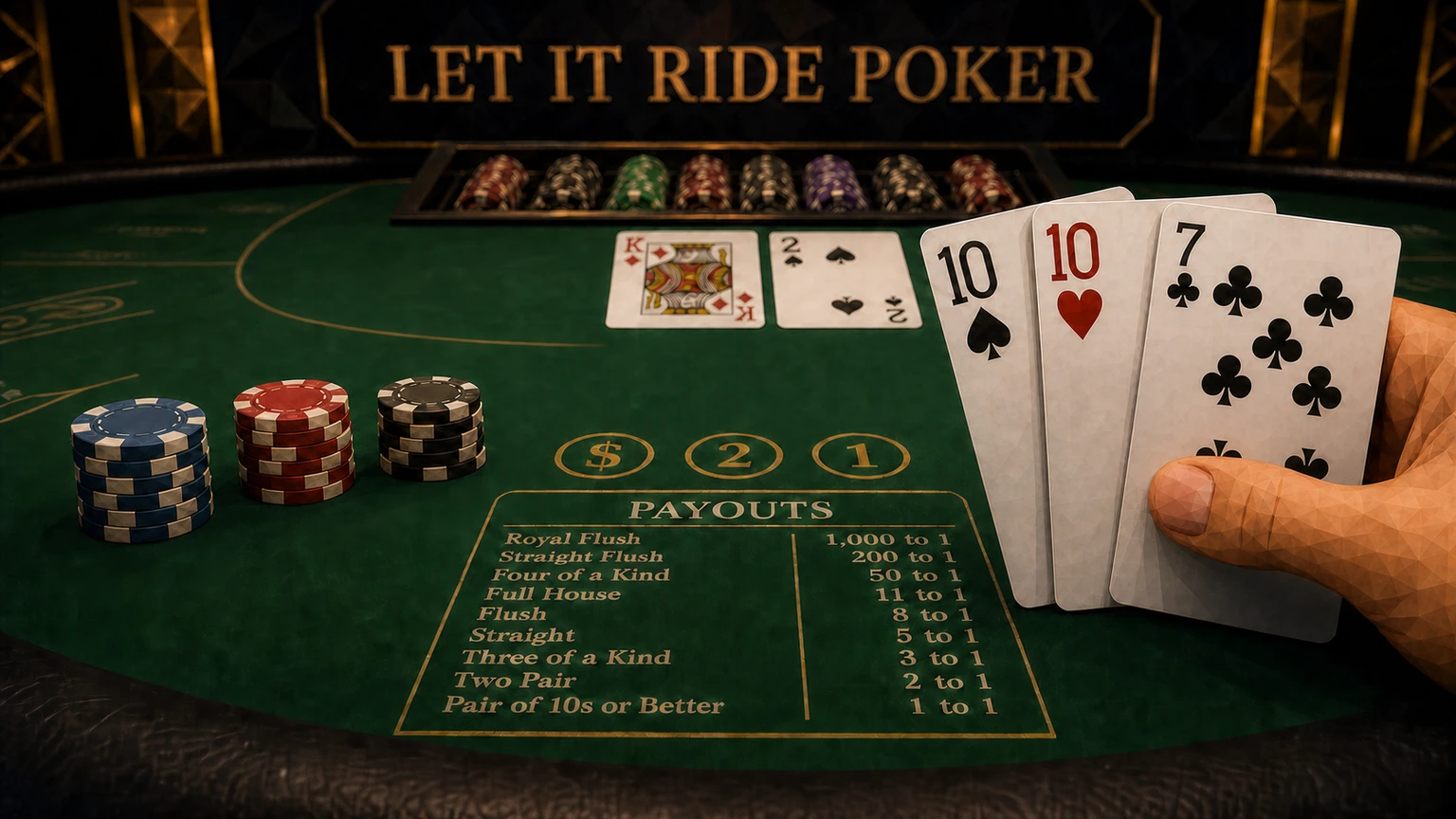
Let It Ride Poker is a casino table game built around one five-card poker hand and three equal wagers. The player receives three private cards, two community cards are revealed in stages, and two of the wagers may be withdrawn before the final hand is known.
The player is not trying to beat the dealer or the other seats. Each remaining wager is settled against a fixed paytable. That makes the quality of the hand and the timing of the two withdrawal decisions more important than anything the dealer holds.
The Table and Three Wagering Spots
A standard betting position has three marked areas, commonly labelled 1, 2 and $. Before cards are dealt, the player places the same stake on all three. A £5 game therefore requires £15 in main wagers at the start, before any optional side bet.
The 1 and 2 wagers may later be taken back at their respective decision points. The $ wager must remain until the hand is settled. Withdrawing a wager returns that stake; it is not a win, and it cannot be placed back into action later in the round.
Table minimums can be quoted per wagering spot rather than as the total initial commitment. Confirm whether a displayed £5 minimum means £15 across the three main circles.
Cards and the Aim of the Game
The standard game uses one 52-card deck without jokers. Each active player receives three cards. The dealer also prepares community cards and discards the unused card according to the dealing procedure, leaving two community cards that every player uses.
The player’s three cards and the two community cards form one five-card poker hand. There is no choice about which cards to use and no draw or discard. The minimum ordinary winning hand is a pair of tens; a pair of nines or lower loses.
Suits have equal rank. The ace can be high in a royal flush or low in an A-2-3-4-5 straight, but it does not wrap around.
How a Round Proceeds
After the initial three equal wagers are placed, the player looks at the three private cards.
At the first decision, the player may take back wager 1 or let it ride. The first community card is then exposed.
With four of the final five cards now known, the player may take back wager 2 or let it ride. This second choice is independent of the first: wager 2 may be withdrawn even if wager 1 was left in action, and vice versa.
The second community card is exposed, producing the final five-card hand. Wager $ and any other main wagers still on the layout are then paid or collected. A player may therefore finish with one, two or all three units still riding.
Standard Main-Game Paytable
The common full main-game schedule pays each remaining wager separately:
| Final five-card hand | Common payout |
|---|---|
| Royal flush | 1,000 to 1 |
| Straight flush | 200 to 1 |
| Four of a kind | 50 to 1 |
| Full house | 11 to 1 |
| Flush | 8 to 1 |
| Straight | 5 to 1 |
| Three of a kind | 3 to 1 |
| Two pair | 2 to 1 |
| Pair of tens or better | 1 to 1 |
| Pair of nines or lower, or no pair | Loss |
The stake is normally returned in addition to the listed winnings. Some approved rules permit a lower royal-flush payout, such as 500 to 1, while keeping much of the remaining table unchanged. A maximum-payout cap may also limit the amount paid on a premium hand.
Read the table rather than assuming that the game name guarantees the 1,000-to-1 schedule.
The First Decision: Three Cards Known
Wager 1 should stay only when the three private cards make it worthwhile to commit that unit through both unknown community cards. A made paying hand—already a pair of tens or better or three of a kind—should normally remain.
Three cards to a royal flush are also a recognised strong draw. Some three-card straight-flush combinations qualify, but the exact decision depends on gaps and the ranks involved. “Three suited cards” or “three connected cards” is not a reliable rule by itself.
This is where simplified advice often becomes inaccurate. A strategy chart must match the actual main paytable and distinguish the precise ranks and gaps. Ordinary high cards, a small pair and most loose flush or straight possibilities do not justify leaving the first optional wager merely because they look promising.
The Second Decision: Four Cards Known
With one community card left, the possibilities are easier to count. Keep wager 2 with any hand that already qualifies for the main payout, because the fifth card cannot take that made result away.
Four cards to a flush and strong straight or straight-flush draws can also have enough winning cards to justify riding. An open-ended straight draw has eight rank-completing cards before accounting for overlaps and higher outcomes. Some high-card combinations gain additional value because pairing a ten, jack, queen, king or ace can itself create a paying hand.
An inside straight draw with only four direct outs is not equivalent to an open-ended draw, and low unmatched cards do not become valuable simply because one card remains. Use an exact four-card strategy chart where the decision is not obvious.
What “Let It Ride” Changes
The decision changes how much money remains exposed, not the cards that will be dealt. Pulling a wager does not cause a worse card, and leaving it in place does not improve the draw.
Betting all three units at the start can make the game feel as though the player is reducing a loss by withdrawing chips. In reality, each optional unit is a new expected-value decision. The mandatory $ wager ensures that every completed hand still has money at risk.
Increasing the starting unit after losses or always leaving all three wagers in action does not change the paytable. It only increases total exposure.
Side Bets Are Separate Games
Modern tables may offer a Five Card Bonus, Three Card Bonus, progressive wager, Pair Plus, Six Card Bonus or another branded option. These bets can use the same deal while applying different card combinations, qualifying hands and paytables.
A five-card bonus may pay from the same final hand but start at a different minimum result and use much larger headline prizes. A three-card bet may evaluate only the player’s private cards. A progressive may depend on a meter and may pay only the top award as a percentage of that meter.
The old promise of tournament entry for a fixed one-dollar side bet is not a standard feature and should not be carried into a current guide. Check the exact side-bet name, stake, qualifying cards, paytable and current progressive amount. Never use the main-game table to evaluate it.
Live, Electronic and Online Versions
At a physical table, the dealer controls the community-card reveal and returns withdrawn wagers. Players may be permitted to handle their private cards but must follow local card-handling rules.
Electronic and online versions can present the same three betting positions with on-screen Ride and Take Back controls. The interface should clearly identify which wager is being decided and prevent the mandatory $ wager from being withdrawn.
Some products use a different side-bet package or modified main paytable. A familiar layout or game title does not establish that every rule is identical.
Common Let It Ride Mistakes
The most basic error is treating the dealer’s cards as an opposing hand. The two exposed dealer-area cards are community cards; the dealer does not make a competing poker hand in the standard casino-banked game.
Players may also believe they can withdraw all three wagers, but the $ unit remains. Another mistake is counting the three betting circles as one table-minimum stake rather than three equal units, then increasing stakes to recover earlier wagers.
Finally, a draw should not be kept merely because it could become a premium hand. The relevant question is whether all possible fifth cards and their payouts make that wager worth leaving in action.
What to Check Before Playing
Confirm the amount required in each of the three main circles, the minimum winning hand, the full royal-flush payout, maximum-payout limits and the exact moments when wagers 1 and 2 may be withdrawn. Check whether the game uses a single standard deck and two shared community cards.
Evaluate every side bet separately. For an electronic version, check how a disconnection or incomplete round is restored and whether decisions are automatically resolved after a timer expires.
The ability to take chips back can make the total stake feel less obvious. Set the three-unit starting cost and any side bets against one session budget, and do not leave weak wagers riding to recover earlier losses.