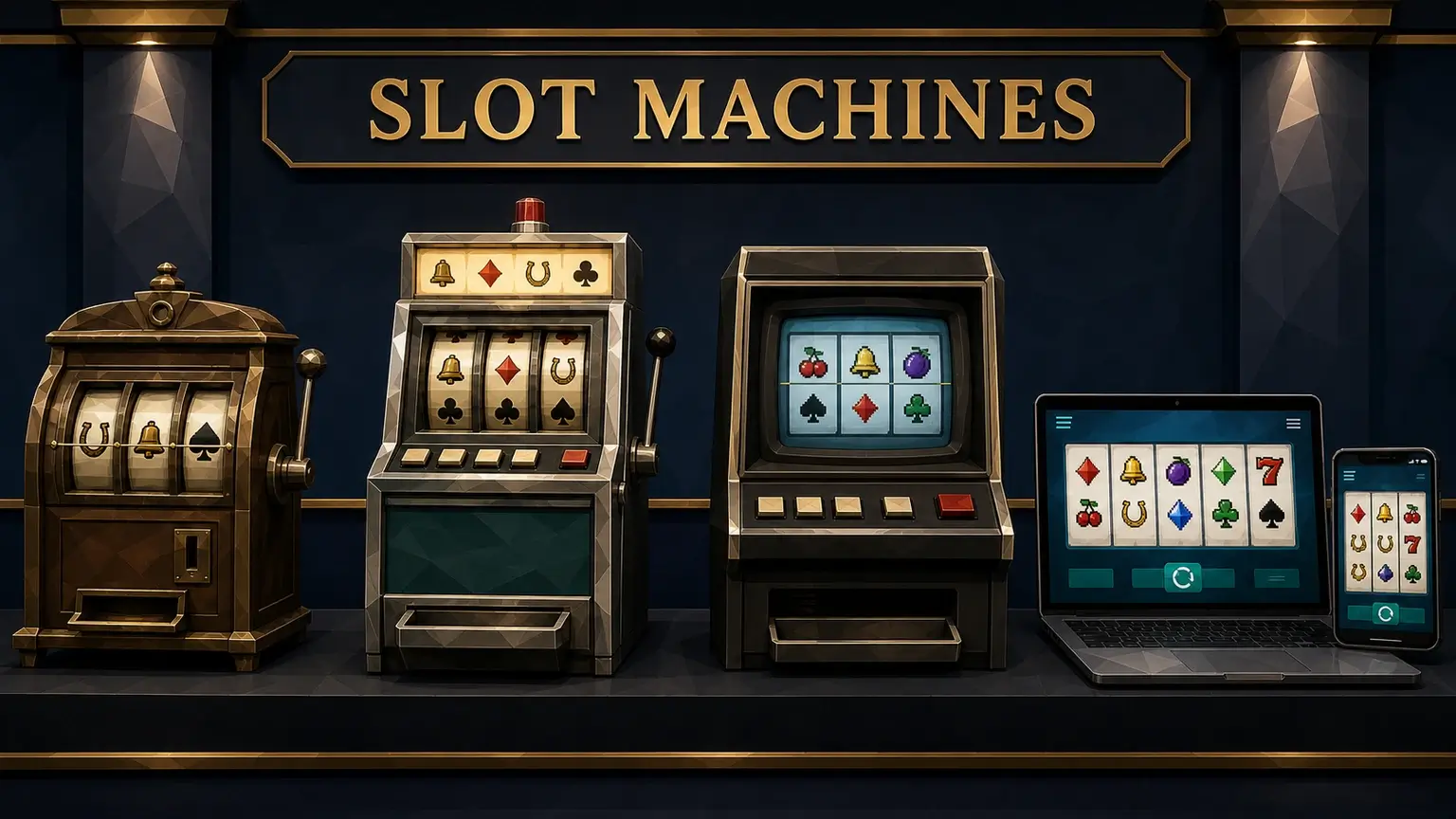
The slot machine did not move directly from a nineteenth-century lever to a modern phone screen. Its history is a sequence of mechanical, electrical and software changes that altered how outcomes were generated, displayed and paid.
Some dates differ across museum records and later company histories, particularly around Charles Fey’s earliest machines. The durable milestones are clearer: three physical reels established the familiar format; electrical components expanded what a cabinet could do; video screens separated the display from physical reels; and online software removed the cabinet altogether.
Before the Three-Reel Slot
Coin-operated amusement and gambling devices were already appearing in the late nineteenth century. Some used wheels or dials, while poker machines presented cards across several rotating drums. They could offer many possible poker combinations but were difficult to equip with a simple automatic payout.
Prizes were not always coins. Depending on the machine, operator and local law, a winning result might be exchanged for drinks, cigars, trade checks or merchandise. This history is one reason early devices can be described differently as vending, amusement or gambling machines.
The important transition was a mechanism simple enough to identify a small set of combinations and pay them automatically.
Charles Fey and the Liberty Bell
Charles August Fey, a San Francisco mechanic, is credited by California’s historical landmark programme with inventing the first coin-operated three-reel slot machine in 1895. Surviving records and museum descriptions sometimes place particular prototypes or the Liberty Bell name between 1894 and 1899, so a single exact model date should be treated cautiously.
The Liberty Bell format used three reels and a compact group of symbols including card suits, horseshoes and bells. Aligning the top bell combination produced the largest award. Its reduced number of outcomes made automatic settlement practical and established the recognisable pattern of reels, a payline, a lever and a payout mechanism.
Fey manufactured machines in San Francisco, often placing them with operators rather than selling the design outright. His workshop was destroyed in the 1906 earthquake and fire, and the machine was widely imitated.
Fruit Symbols and the Early Industry
Other manufacturers adapted the three-reel mechanism during the early twentieth century. Fruit, bell and BAR symbols became enduring visual conventions. Fruit imagery is often associated with machines that dispensed gum or other merchandise, although the legal and commercial history varied by location.
Mechanical slots used springs, gears, reel strips, stops and a payout assembly. Pulling the handle supplied mechanical energy and started the reels. The arrangement of symbols and physical stops determined the available outcomes.
Operators could change reel strips and payout schedules, but a machine remained constrained by its physical parts. Large awards were limited by coin capacity, and attendants were needed for refills, faults and payouts beyond the cabinet’s practical limit.
From Mechanics to Electromechanics
Electric lights, motors, solenoids and counters gradually entered gaming machines. The lever could remain as a familiar control even when it no longer powered every part of the result.
Bally’s Money Honey, documented in company records from the early 1960s, became an important electromechanical milestone. Its powered mechanisms and larger coin hopper supported faster operation and bigger automatic payouts than earlier all-mechanical cabinets.
Electromechanical design also made sounds, illuminated displays and more complex features easier to coordinate. The machine still looked like a traditional reel slot, but electricity increasingly controlled the experience around those reels.
The First Video Slots
The next major separation was between the outcome mechanism and the visible reels. Fortune Coin developed a video slot in the mid-1970s, widely dated to 1976. It used a television display inside a full-size cabinet rather than a window onto physical spinning reels. Early units were trialled in Nevada before wider approval and adoption.
A video display could show virtual reels, instructions and later bonus screens without requiring a new physical reel assembly for every presentation. Microprocessors allowed the game logic, accounting and display to be coordinated in software.
This did not make every machine identical. Regulators still needed to approve hardware and game programs, and manufacturers developed different reel mappings, paytables and features. The screen was a flexible display, not evidence that outcomes were arbitrary.
Random Number Generators and Virtual Reels
Modern electronic slots use random number generation to select an outcome from the game’s configured possibilities. The animation then presents that result through reels, symbols and sounds.
Virtual reel mapping allows a displayed symbol to have a probability that is not obvious from counting its appearances on the screen. This expanded the range of possible prize structures beyond what a small set of physical reel stops could conveniently provide.
The lever became optional. Pressing a button, touching a screen or clicking online could send the same instruction to begin a game. A lever on an electronic cabinet is therefore an interface choice, not a source of control over the random result.
Bonus Screens, Multiple Lines and Linked Jackpots
Video and processor-based machines made it practical to add multiple paylines, animated bonus rounds, free-game sequences, expanding symbols and pick features. These presentations became especially prominent from the 1980s and 1990s onward as displays, memory and sound improved.
Networking also allowed machines to contribute to a shared progressive jackpot. A small portion associated with eligible play could increment a meter across one cabinet, one casino or several locations. The linked system changed the jackpot structure, while each participating game still followed its approved rules.
Licensed entertainment properties became another major strand. IGT dates the introduction of its Wheel of Fortune slot series to 1996 and describes it as the industry’s first licensed slot theme. Branded games subsequently became common, but a familiar film, programme or character did not change the need for a disclosed paytable and regulated game logic.
Slots Move Online
Commercial online casinos emerged in the mid-1990s, and digital slot games were a natural fit because their reels and settlement could be reproduced entirely in software. Early games were designed for desktop computers, dial-up connections and comparatively small displays.
The online format removed the need for a coin mechanism, physical hopper or dedicated cabinet. Stakes and returns became account transactions, while the game interface supplied reels, sounds and feature sequences.
Downloadable casino software was common in the early period. Browser technologies later reduced installation requirements, and faster connections supported larger graphics, animation and audio. Online progressive networks could also pool eligible stakes across many remote players.
From Desktop to Mobile and HTML5
Early mobile casino games were restricted by small screens, slower networks and device-specific software. Smartphones and tablets changed the design target: controls had to work by touch, layouts had to adapt to portrait and landscape screens, and sessions could begin almost anywhere permitted by law.
During the 2010s, HTML5 became the standard delivery approach for many browser games as support for Flash declined. A shared web technology made it easier to offer the same underlying game across desktop and mobile devices, although interfaces could still be adjusted for each screen.
By the 2020s, online slots commonly combined high-resolution graphics, layered bonus mechanics, variable reel layouts and account-level safer-gambling controls. Physical casinos also adopted larger displays, server-supported content and cashless or account-connected systems. The cabinet and browser continued to influence each other rather than developing as separate worlds.
What Changed—and What Did Not
The physical source of motion changed first, then the display, and finally the location of play. A mechanical reel stopped according to its physical mechanism. An electronic or online game maps a random result to a visual reel display.
The basic commercial structure remained: a stake buys one chance at a paytable-defined result, and the configured probabilities produce a long-run return below 100% unless a promotion or exceptional condition changes the calculation.
Skill-like stop buttons, elaborate animations and near-miss presentations do not normally let the player redirect a result already selected by the game. Likewise, modern graphics do not by themselves prove fairness. That depends on the operator, approved software, testing, technical standards and correct implementation.
Video Poker Is a Different Game
The previous article described video poker as a slot-machine variation. Both can be housed in similar electronic cabinets, but their play is materially different.
Video poker deals a five-card hand and lets the player choose which cards to hold before a draw. Return depends on the paytable and those decisions. A slot resolves through its configured reel or ways system without a draw-poker decision.
Shared cabinet technology is part of gaming-machine history; it does not make every screen-based casino game a slot.
Why Historical Dates Sometimes Conflict
Early manufacturers did not preserve complete records, machines were copied, and model names could be applied after prototypes had already circulated. Fires, prohibition and the boundary between gambling and vending devices further complicate the archive.
For that reason, responsible histories distinguish an invention, a surviving model, a patent, a commercial release and a regulatory approval. Charles Fey’s work can be accurately placed in the mid-1890s without pretending that every source assigns the Liberty Bell to the same year.
The later transition to video also involved prototypes, casino trials and approval before broad adoption. A single date is useful as a milestone, not proof that every casino changed technology at once.
The Modern Slot as a Layered System
A current online slot combines mathematical rules, random generation, a visual interface, account transactions and operator controls. A casino cabinet adds dedicated hardware, physical controls and on-site monitoring. Both are descendants of the three-reel machine, but little beyond the reel metaphor has remained mechanically necessary.
That history explains why modern games still use bells, fruit, bars and a spin control even when no physical reel or lever is involved. The imagery provides continuity; the system underneath has been rebuilt several times.