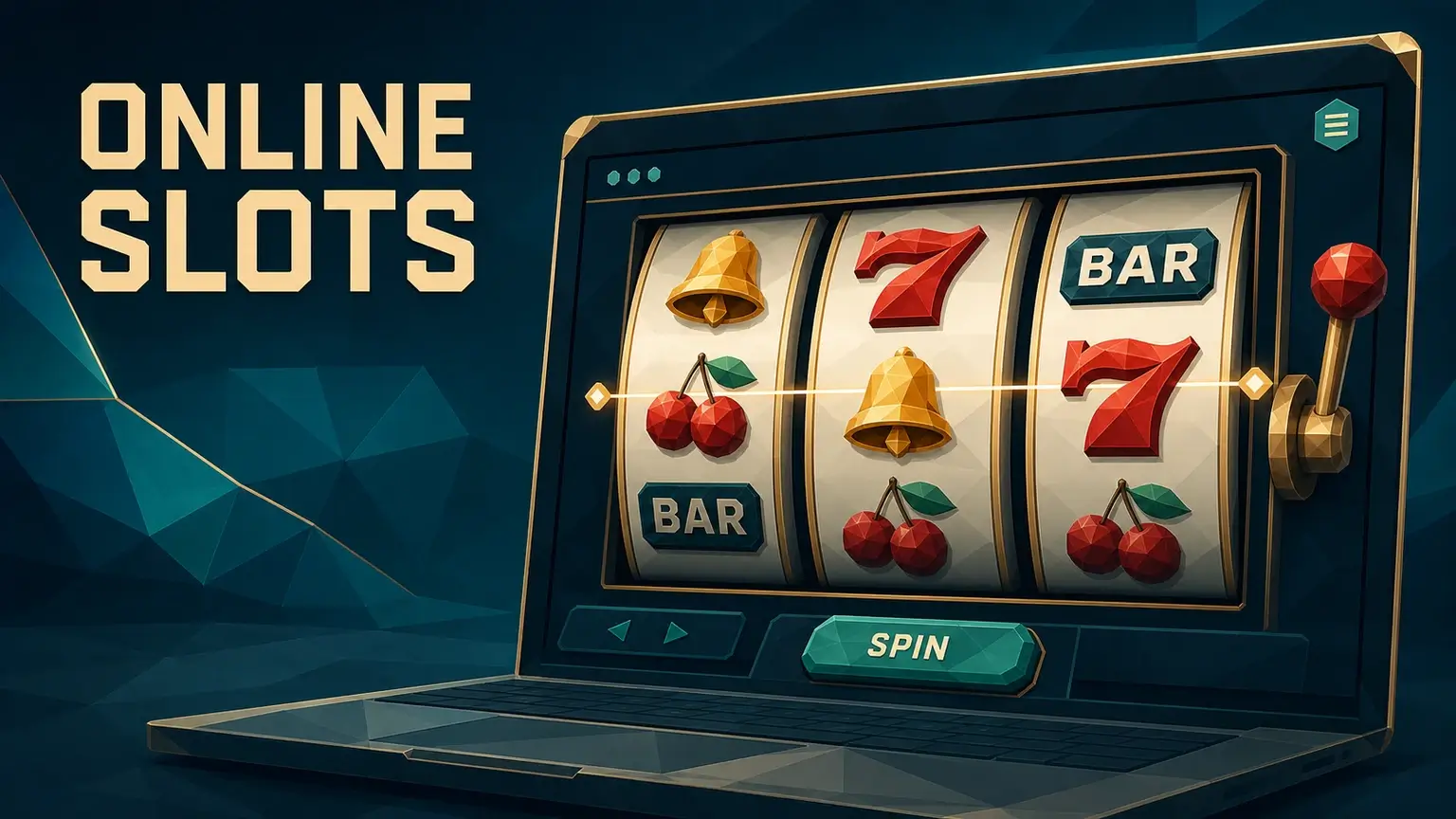
Online slots ask for few decisions once a spin begins, but the games themselves can be complicated. A modern slot may use fixed paylines, hundreds of “ways,” expanding reels, collecting symbols, free spins, multipliers and several jackpot tiers. The animation changes from game to game; the essential transaction does not. You choose a stake, start a paid round and receive an outcome under the published rules.
Understanding those rules will not create a winning system. It will show what one spin costs, which combinations pay, how features are triggered and how quickly the game can move through a budget.
What Happens When You Press Spin
In an online slot, the visible reels normally present an outcome selected through the game's random number system. The animation may imitate mechanical reels, but the screen is not waiting for physical reels to slow down and decide the result.
The game maps random inputs to reel positions, symbols or another defined result, then applies its paytable. In a regulated market, the software and mapping are subject to technical requirements and testing. Previous spins should not cause the next one to compensate for losses or reduce the chance after a win.
Each paid round therefore needs to be judged on its own. A slot that has not awarded a bonus for a long time is not necessarily closer to one, and leaving a game immediately after a large win does not allow the next player to inherit a favourable cycle.
Reels, Rows and the Game Grid
Reels are the vertical columns of symbols. Rows describe how many symbol positions are visible on each reel. A traditional format might show three reels and three rows; many video slots use five reels with three or more rows.
The visible grid does not reveal the probability of every symbol. Digital reels can use internal reel strips of different lengths and symbol distributions. Two symbols that look equally common in the artwork may not have equal chances of landing in a relevant position.
Some games change grid size during a feature or after a winning result. Expanding reels, symbol drops and cascading wins should be explained in the rules, including whether each cascade is part of the same paid round or begins a new wager.
Paylines, Ways and Cluster Pays
A payline is a defined path across the reels. A winning combination usually needs matching symbols on consecutive reels from the specified starting side, although the exact rule varies. Older online slots often allowed players to choose how many lines to activate; many current games use a fixed set of lines on every spin.
“Ways to win” games do not use drawn line patterns. They usually pay when matching symbols appear on adjacent reels in eligible positions. A five-reel game with three visible positions on each reel may advertise 243 ways because there are 3×3×3×3×3 possible position paths. That number describes possible paths, not the chance of winning or the number of distinct prizes guaranteed.
Cluster games form wins from connected groups of matching symbols rather than left-to-right lines. Because definitions differ, open the paytable instead of assuming that a familiar grid uses familiar rules.
How to Read a Paytable
The paytable identifies paying symbols, the combinations required and the amount or multiplier attached to them. It should also explain wilds, scatters, bonus triggers, jackpots and any feature-specific rules.
Check whether prizes are quoted as currency, credits, “x bet” multipliers or line-bet multipliers. In a multiline slot, a display of 100 credits may not mean 100 times the total amount staked. The game information should show how the line stake and total stake interact.
Also check whether all advertised top prizes are available at the selected stake. Some jackpots or features require a minimum bet, a separate contribution or every line to be active. Maximum betting should never be treated as a general slot strategy. It increases the amount at risk and is unnecessary unless the rules explicitly make a chosen feature conditional on it.
Wild, Scatter and Bonus Symbols
A wild commonly substitutes for other paying symbols, but it may exclude scatters, bonuses or jackpots. It can also expand, move, become sticky or carry a multiplier. Those behaviours are game rules, not universal properties of a wild symbol.
A scatter often pays or triggers a feature without needing to sit on a normal payline. Some games award free spins for three or more scatters; others use a separate bonus symbol or meter. Again, the icon alone does not establish what happens.
Bonus features may include pick games, respins, collecting mechanics or alternative reels. If a feature offers a choice, check whether the options have disclosed differences or are simply different presentations of random awards. An animation that invites skill does not necessarily mean the decision changes the expected result.
Free Spins Are Part of the Mathematics
Free spins do not require a new cash stake for each feature spin, but they are not gifts detached from the base game. Their value and frequency are included in the slot's mathematical model and funded by paid play overall.
Feature reels can differ from the base game. They may add wilds, multipliers or symbol upgrades, but the rules may also cap a win or limit retriggers. A headline such as “up to 100 free spins” does not say how often the maximum occurs or what an average feature returns.
Some casinos sell direct access to a bonus round or offer an enhanced-chance stake. This commits a larger amount to one round and can produce a rapid loss. Check the precise cost, rules and local availability; do not confuse skipping the wait with improving the underlying value.
RTP and House Edge
Return to player is the theoretical proportion of stakes returned as prizes across the game's model over a very large number of rounds. A 96% RTP corresponds to a theoretical 4% house edge. It does not mean a £1 spin is expected to return 96p in a way the player can observe, or that £100 of play will leave £96.
A substantial part of the return may sit in rare features or a top jackpot. Short sessions can therefore finish with almost any result within the game's limits. RTP is useful for comparing mathematical settings, not predicting when a prize will arrive.
The same slot title may be supplied at several RTP levels. Always check the information inside the exact game at the exact casino. An old review or another operator's figure may describe a different configuration.
Volatility and Hit Frequency
Volatility describes how a game's return is distributed. A lower-volatility slot tends to produce smaller, more frequent awards; a higher-volatility game concentrates more return in less frequent, larger outcomes. Labels such as low, medium and high are not standardised measurements across every supplier.
Hit frequency is the proportion of rounds expected to produce a prize under the game's definition. It can be misleading without context. A “win” may be smaller than the stake, so a high hit rate does not necessarily preserve the balance or indicate a low house edge.
RTP, volatility and hit frequency answer different questions. RTP describes the long-run theoretical return, volatility describes the spread of outcomes, and hit frequency describes how often a qualifying award occurs. None tells a player what the next spin will do.
Cascades, Megaways and Other Variable Systems
In a cascading slot, symbols involved in a win disappear and new ones fall into place. Several awards can occur from one paid spin, often with a multiplier that rises during the sequence. The cascade ends under the rule stated by the game, commonly when no new win forms.
Variable-ways systems can change the number of symbols visible on each reel from one round to the next. A large maximum number of ways describes the most expansive layout, not what every spin receives. It also does not make one paid round cover thousands of independently priced bets.
Feature names are often trademarks or marketing labels. Focus on the actual rule: what changes, how long it lasts, what the stake buys and whether any limit applies.
Progressive and Fixed Jackpots
A fixed jackpot has a set prize under the paytable. A progressive jackpot grows from a seed amount as qualifying play contributes to a pool, then resets after a win. It may be tied to one game, one casino or a network of operators.
Eligibility varies. Some progressives can trigger from any qualifying stake; others require a minimum or separate bet, and the chance may or may not change with stake size. Read the jackpot rules rather than assuming that maximum stake is necessary.
A progressive jackpot’s current size and reset rules do not usually show that it is due. Unless the rules specify a must-win-by amount or changing probability, the displayed total changes the prize, not the chance of the next ordinary spin.
Stake Settings and the Real Cost of Play
Before spinning, identify the total stake shown by the game. Coin value, coins per line and number of lines can combine into a total that is less obvious than a single bet selector.
Speed matters as much as stake. A modest amount repeated rapidly can expose much more money than a larger, slower wager. If one spin costs £0.50 and the game completes ten paid rounds a minute, the amount staked over an hour can reach £300 even though the starting balance moves up and down with prizes.
Autoplay, turbo modes and stop buttons vary by game and jurisdiction. A stop button generally shortens the animation rather than changing an outcome already determined. In Great Britain, autoplay is not permitted for online gaming, but its availability elsewhere should not be interpreted as a safer or more valuable way to play.
Demo Play Has Limits
Demo mode can help explain controls, paylines and features without risking money. In a regulated game, play-for-free rules should not be designed to mislead customers about the likelihood of winning compared with the real-money version.
Even so, demo play does not reproduce the emotional effect of losing real money. A short test is also far too small to verify an RTP or judge volatility. Use it to learn the interface, not to decide that a game is “paying well.”
What to Check Before Playing a Slot
Open the game information and confirm:
- the total cost of one paid spin;
- how paylines, ways or clusters form wins;
- the exact paytable and whether prizes use total-bet or line-bet multipliers;
- the RTP shown for this version;
- the stated volatility or feature frequency, if provided;
- how wilds, scatters, cascades and free spins work;
- whether a jackpot or feature needs a particular stake;
- any maximum win or feature cap; and
- what happens if the connection drops during a round.
If those details are missing or the casino is not authorised for your location, choosing a different game does not solve the underlying problem.
Slots Do Not Have a Recovery Strategy
Changing games, increasing stakes and waiting for a bonus do not recover earlier losses in a predictable way. The next random round does not know how much has already been spent.
Set an affordable loss limit and a time limit before play. Keep the total stake visible, avoid speed settings that make spending hard to follow and do not use a maximum bet merely because an old “strategy” says it pays better. If play continues because stopping would make the loss feel final, the appropriate step is to stop rather than buy another chance.