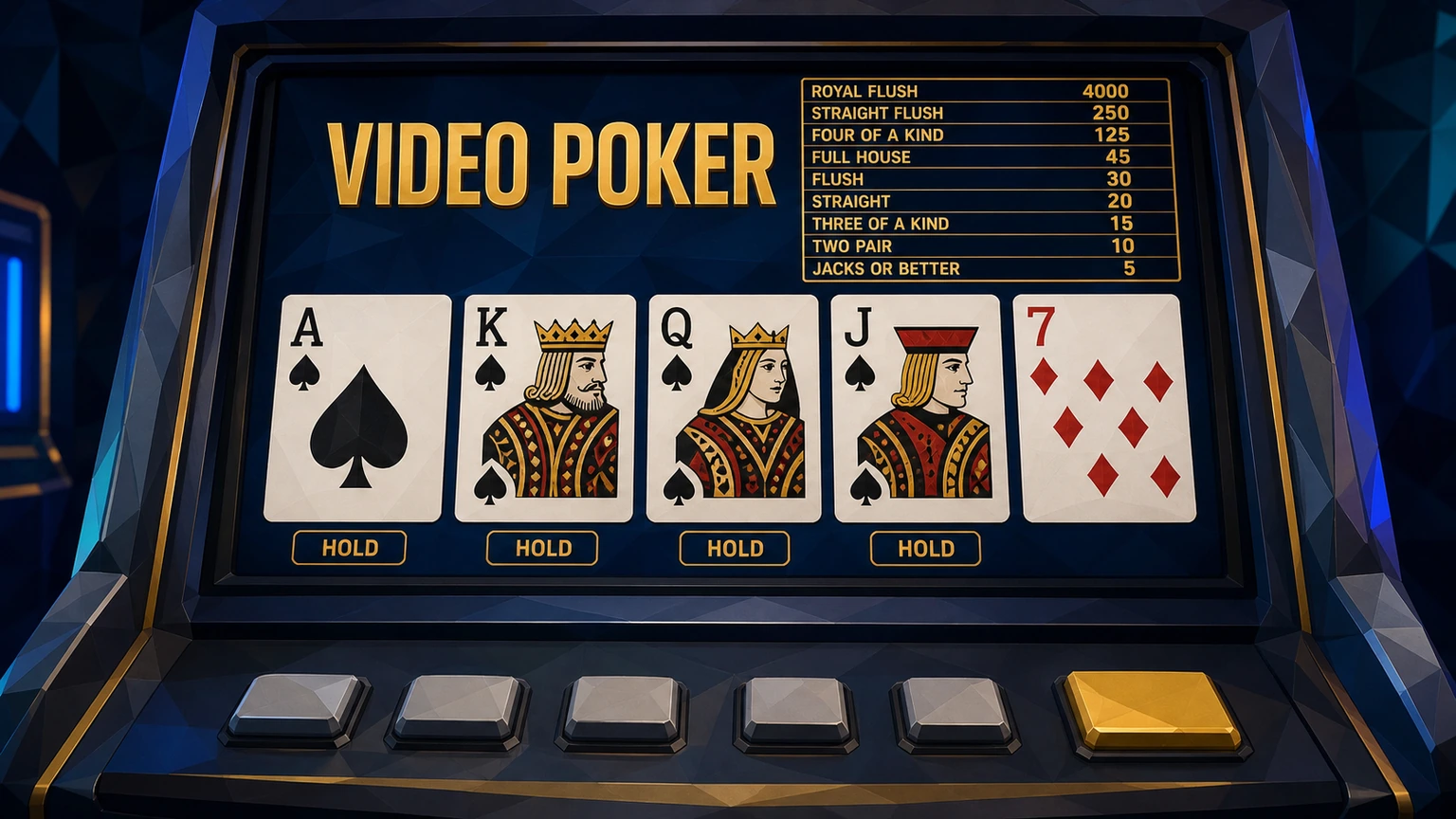
Video poker is a draw-poker game played against a fixed paytable rather than against a dealer or other players. The machine deals five cards, the player chooses which to hold, and the remaining cards are replaced once. The final hand either qualifies for a listed payout or loses.
Those decisions make video poker different from a slot. They also mean that a published return-to-player figure is conditional: it assumes a particular paytable, bet size and decision strategy.
How a Standard Round Works
After a stake is selected, five cards are dealt from a simulated 52-card deck. The player marks any cards to hold, then presses Draw. Unheld cards are discarded and replaced from the remaining deck. The final five-card hand is compared with the paytable.
Standard single-hand video poker allows one draw only. Cards cannot be rearranged into several hands, and no bluffing or betting round follows. Multi-hand versions copy the initial held cards into several independently completed hands, increasing the total stake in proportion to the number of hands played.
Jacks or Better as the Teaching Game
Jacks or Better is a useful base game because its lowest winning result is normally one pair of jacks, queens, kings or aces. A pair of tens or lower does not qualify. The usual ranking is:
| Hand | Meaning |
|---|---|
| Royal flush | A, K, Q, J and 10 of one suit |
| Straight flush | Five consecutive cards of one suit |
| Four of a kind | Four cards of one rank |
| Full house | Three of one rank plus a pair |
| Flush | Five cards of one suit, not consecutive |
| Straight | Five consecutive ranks, mixed suits allowed |
| Three of a kind | Three cards of one rank |
| Two pair | Two separate pairs |
| Jacks or Better | One pair of jacks or higher |
The ace can be high in A-K-Q-J-10 or low in A-2-3-4-5. It does not wrap around, so Q-K-A-2-3 is not a straight.
How to Read a Paytable
The paytable shows the credits returned for each final hand at each permitted stake. On a traditional full-pay 9/6 Jacks or Better table, the ordinary per-credit returns are commonly:
| Final hand | 1 credit | 5 credits |
|---|---|---|
| Royal flush | 250 | 4,000 |
| Straight flush | 50 | 250 |
| Four of a kind | 25 | 125 |
| Full house | 9 | 45 |
| Flush | 6 | 30 |
| Straight | 4 | 20 |
| Three of a kind | 3 | 15 |
| Two pair | 2 | 10 |
| Jacks or Better | 1 | 5 |
The name “9/6” refers to the full-house and flush returns per credit. It does not identify the number of decks. The enhanced 4,000-credit royal at a five-credit stake is also important: betting fewer than the qualifying maximum can reduce the return percentage on classic machines. Modern variants may use different stake rules, so inspect the displayed table.
RTP Depends on Both Rules and Decisions
With the table above and mathematically optimal play, the long-run theoretical return is about 99.54%, equivalent to a house edge of about 0.46%. That figure does not apply to every game labelled Jacks or Better.
Changing the full-house return from 9 to 8 or the flush from 6 to 5 reduces the return. Bonus Poker, Deuces Wild, Joker Poker and other families use different qualifying hands, wild-card rules and pay schedules. A strategy designed for one table can be wrong for another.
The theoretical percentage also assumes that every hold decision follows the matching optimal strategy. Ordinary mistakes lower the realised return. RTP describes a very large number of rounds and does not predict a session or make the game profitable.
What a Strategy Chart Does
A strategy chart ranks possible hand types and drawing opportunities. The player finds the highest applicable line and holds those cards. Good charts are specific to the exact game and paytable.
For example, if the initial hand is A♠ K♠ Q♠ J♠ 7♦, the four spades form four cards to a royal flush. The unrelated 7♦ should be discarded under standard 9/6 Jacks or Better strategy. That choice improves expected value; it does not promise the missing 10♠ or any payout on the draw.
Strategy can be counter-intuitive. A low made hand may sometimes be broken for a stronger draw, while an attractive-looking three-card combination may rank below a high pair. Do not use a generic list that fails to specify its variant.
Common Video Poker Variants
Bonus Poker and Double Bonus games change four-of-a-kind payouts, often by rank or kicker, and compensate elsewhere in the table. Although the cards look familiar, video poker belongs to a different family from table poker.
Progressive games divert part of the stake or expected return into a growing prize. The displayed jackpot amount can change the theoretical return, but only at a calculable threshold and under the required strategy. “Progressive” by itself does not mean favourable.
RNG, Deck Behaviour and Fairness
In a regulated digital game, an approved random number generator should determine cards unpredictably and the software should map them correctly to the displayed result. The rules should say whether discarded cards can return in the same hand; in standard video poker they cannot because replacements come from the remaining deck.
A near miss or long run without a premium hand does not show that the machine is due to compensate. Likewise, changing machines cannot reset a personal cycle. Results are evaluated through testing, game rules and records rather than visual streaks.
Common Mistakes
The most costly mistakes are assuming all similarly named games have the same table, using a strategy chart for the wrong variation, ignoring the reduced royal payout at a smaller stake and playing several hands without recognising the multiplied cost.
Another mistake is treating the maximum-bet button as a recommendation. The better return associated with a full royal schedule matters only if that total stake remains within a predetermined budget. A lower denomination may provide the required credit structure at a safer cash cost, where available.
What to Check Before Playing
Read the full paytable, the exact variant name, the number of credits needed for the top royal return, the value of one credit and the total cost of multi-hand play. Use only a strategy chart that matches those rules. Check how an interrupted game is restored and whether the operator identifies independent testing or regulatory approval.
Decision-making can slow the game, but fast interfaces and multi-hand modes can still create substantial turnover. Set limits in money and time, and do not chase a royal flush or increase stakes to recover losses.