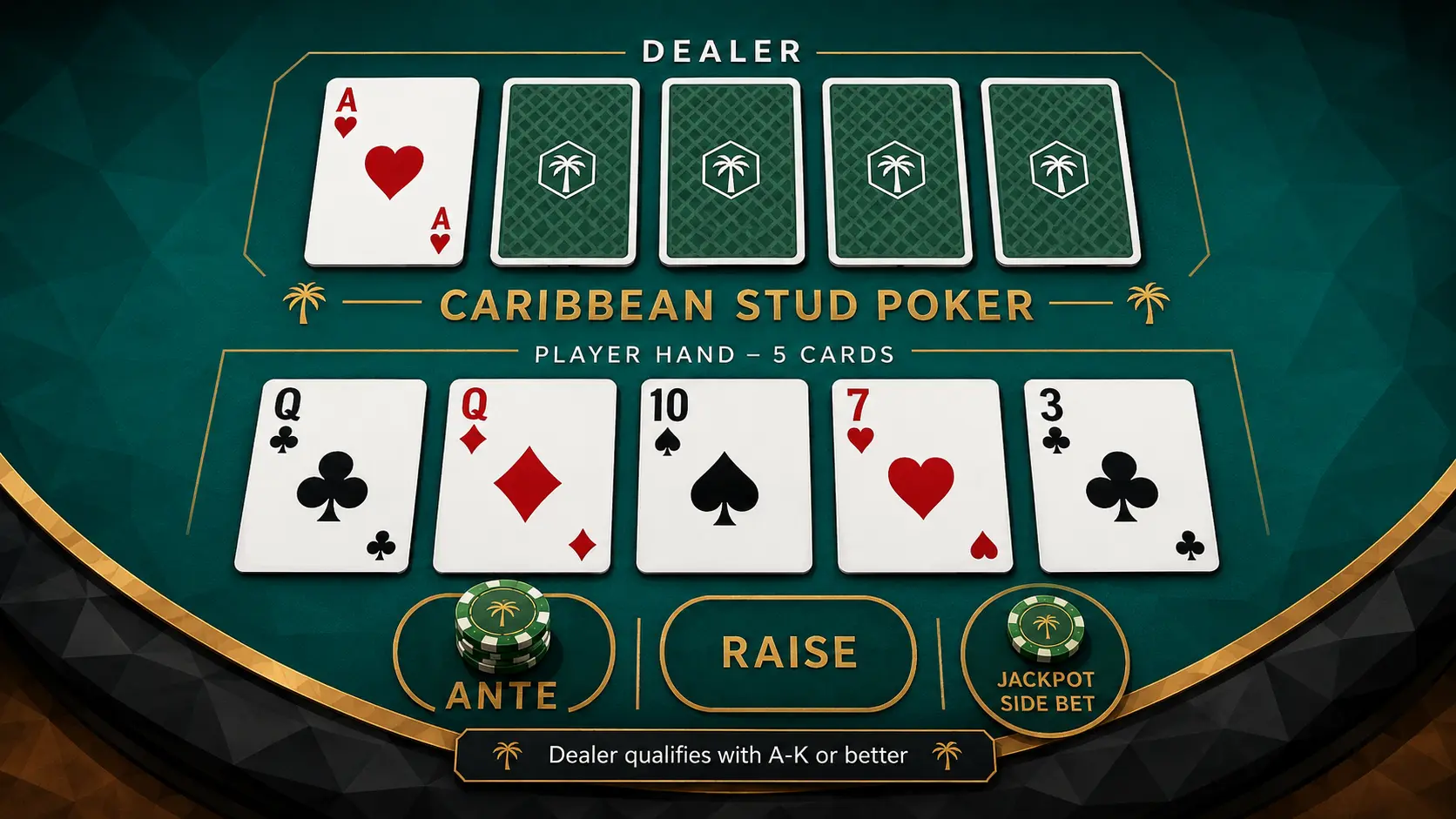
Caribbean Stud Poker can confuse new players because it looks like poker but behaves like a casino table game.
You receive poker cards. The dealer receives poker cards. The result depends on poker hand rankings. But you are not playing against other players, and you are not bluffing anyone out of the pot.
You are playing against the dealer under fixed casino rules. That difference matters.
In Texas Hold’em, players compete against each other and make decisions across several betting rounds. In Caribbean Stud Poker, the structure is simpler. You make one main decision after seeing your cards: fold or raise.
That makes the game easy to learn, but the strategy still matters.
What Caribbean Stud Poker Is
Caribbean Stud Poker is a casino poker-style table game.
Each player places an ante bet before the cards are dealt. The player then receives five cards face down. The dealer also receives five cards, usually with one dealer card exposed.
After looking at their own hand and the dealer’s exposed card, the player decides whether to fold or raise.
There is no drawing. There is no bluffing. There are no community cards. Other players at the table do not affect your result.
Your hand is compared with the dealer’s hand if you continue.
The Basic Goal
The goal is to make a stronger five-card poker hand than the dealer.
If you fold, you lose your ante.
If you raise, you place an additional bet, usually twice the ante. The dealer then reveals the full hand.
From there, the result depends on two things:
- whether the dealer qualifies
- whether your hand beats the dealer’s hand
Dealer qualification is one of the key rules in Caribbean Stud Poker.
Dealer Qualification
In most Caribbean Stud Poker games, the dealer must have at least ace-king to qualify.
That means the dealer needs an ace and a king, or any pair or better. If the dealer does not qualify, the player’s ante usually wins even money, while the raise bet pushes.
If the dealer qualifies and the player has the better hand, the ante pays even money and the raise pays according to the game’s payout table.
If the dealer qualifies and the dealer has the better hand, the player loses both the ante and the raise.
If the hands tie, the result is usually a push.
This qualification rule is what makes Caribbean Stud different from simply comparing two poker hands.
The Ante and Raise
The ante is the first required bet.
After seeing the cards, the player can fold or raise. The raise is usually twice the ante.
For example, if the ante is €5, the raise may be €10. By choosing to continue, the player now has €15 at risk in total.
That is why the fold-or-raise decision matters.
A weak hand should usually be folded because raising adds more money to a poor situation. A strong hand should usually be raised because it can beat the dealer and may qualify for a higher payout.
The difficult area is the middle: hands around ace-king.
Basic Strategy
Basic Caribbean Stud strategy is relatively simple compared with many poker games.
A common approach is:
- raise with any pair or better
- fold hands lower than ace-king
- make more careful decisions with ace-king hands
The ace-king area is where strategy becomes more detailed. If your best hand is ace-king, the dealer’s exposed card and your side cards can influence the decision.
The older version of this article focused strongly on specific ace-king situations. That detail can still be useful, but most beginners should first understand the basic principle: weak high-card hands are often not worth raising, while pairs or better are usually strong enough to continue.
Do not raise every hand just because folding feels like giving up. Folding is part of the game.
Why Ace-King Is Tricky
Ace-king is important because it is also the dealer’s usual qualifying threshold.
If you have ace-king and no pair, you may have a hand that is just strong enough to consider raising, but not strong enough to feel comfortable.
Several details can matter.
- Does one of your cards block the dealer from making ace-king?
- Does the dealer’s exposed card match one of your cards?
- Are your remaining side cards strong?
- Is the dealer showing an ace or king?
- Does the dealer’s upcard make qualification more or less likely?
These decisions are not always obvious at the table.
Players who want to play Caribbean Stud seriously should study a full strategy chart. Casual players should at least avoid the worst mistake: raising clearly weak hands below ace-king.
Payouts
The ante usually pays even money when the player wins and the dealer qualifies.
The raise bet may pay according to a payout table. A typical structure may pay more for stronger hands such as two pair, three of a kind, straight, flush, full house, four of a kind, straight flush, and royal flush.
The exact payout table can vary by casino or game provider.
That variation matters because small payout differences can affect the game’s return. A Caribbean Stud game with a weaker paytable is worse for the player than one with a stronger paytable.
Before playing, open the game rules and check the payout table.
Do not assume every Caribbean Stud version pays the same.
Side Bets and Progressive Jackpots
Many Caribbean Stud games include an optional side bet.
This side bet may pay for strong poker hands regardless of the main dealer result, or it may feed a progressive jackpot. These side bets can be exciting because they create the chance of larger payouts.
They are also usually riskier.
Side bets often carry a higher house edge than the main game. The jackpot may be large, but the chance of hitting the top prize is very small.
Players should treat side bets as optional entertainment, not as the main reason to play.
If the jackpot bet is required to qualify for the top prize, check that before playing. If you do not make the side bet, you may not be eligible for the jackpot payout even if you are dealt a very strong hand.
Caribbean Stud vs Texas Hold’em
Caribbean Stud Poker and Texas Hold’em both use poker hand rankings, but they are very different games.
Texas Hold’em is usually played against other players. It has blinds, community cards, multiple betting rounds, position, bluffing, and long-term player skill.
Caribbean Stud is played against the dealer. It has fixed rules, one main decision point, no bluffing, no community cards, and no player-versus-player strategy.
This means a good Texas Hold’em player does not automatically have an advantage in Caribbean Stud. The skills overlap only partly.
In Caribbean Stud, discipline matters more than creativity.
The player is not trying to outthink the dealer. The player is trying to make the correct fold-or-raise decision under the rules.
Common Beginner Mistakes
The most common mistake is playing too many hands.
Some players raise weak hands because they dislike folding after paying the ante. This is understandable, but it can become expensive. The ante is already at risk. Adding a larger raise with a poor hand often makes the situation worse.
Another mistake is misunderstanding dealer qualification.
If the dealer does not qualify, the raise may not pay even if the player has a strong hand. That can feel frustrating, but it is part of the rules.
Players may also overvalue side bets. A progressive jackpot can look tempting, especially when the prize is large. But the side bet should still be judged as a separate risk.
Finally, players sometimes assume that because the game uses poker hands, bluffing or table psychology matters. It does not. The dealer follows fixed rules.
Is Caribbean Stud a Skill Game?
Caribbean Stud includes some strategy, but it is not a deep player-versus-player poker game.
The player’s main skill is knowing when to raise and when to fold. Good strategy can reduce poor decisions. Bad strategy can make the game more expensive.
But the player cannot bluff, read opponents, change bet sizes freely, or influence the dealer’s choices.
Luck still plays the main role in short-term results.
That makes Caribbean Stud more of a casino table game with poker elements than a true poker-room game.
Online Caribbean Stud Poker
Online Caribbean Stud is usually straightforward.
The game interface shows the ante, deal button, player cards, dealer upcard, and fold-or-raise options. The rules and payout table should be available inside the game.
Because online play is fast, players should be careful with pace.
A simple game can still become expensive if hands are played quickly and raises are made automatically. The raise is normally larger than the ante, so continuing with too many weak hands can drain the balance faster than expected.
Slow down before deciding. The most important button in Caribbean Stud is not always raise. Sometimes it is fold.
Responsible Play
Caribbean Stud can create a specific kind of frustration, which is why the stake and loss limit should be set before the session.
A player may fold several weak hands, then feel annoyed that the ante keeps disappearing. Or they may raise, beat the dealer, and then see the dealer fail to qualify, reducing the payout. The game can feel as if it is almost working.
That feeling can lead to chasing.
Before playing, decide how much you are willing to spend and whether you will use the side bet. Do not increase the ante because you are waiting for a big hand. Do not keep playing only because the jackpot looks tempting.
A casino table game should fit your budget before the first card is dealt.
The Sensible Way to Play Caribbean Stud
Caribbean Stud Poker is easy to learn, but it should not be played blindly.
Understand the ante. Understand the raise. Understand dealer qualification. Check the payout table. Be careful with side bets. Raise strong hands, fold weak hands, and treat ace-king decisions with more care.
Most importantly, remember what kind of game this is.
It is not Texas Hold’em. You are not bluffing another player. You are not reading body language. You are making a structured decision against a fixed casino rule set.
That can make the game enjoyable and simple. It can also make mistakes easy to repeat.Know the rules before you raise.