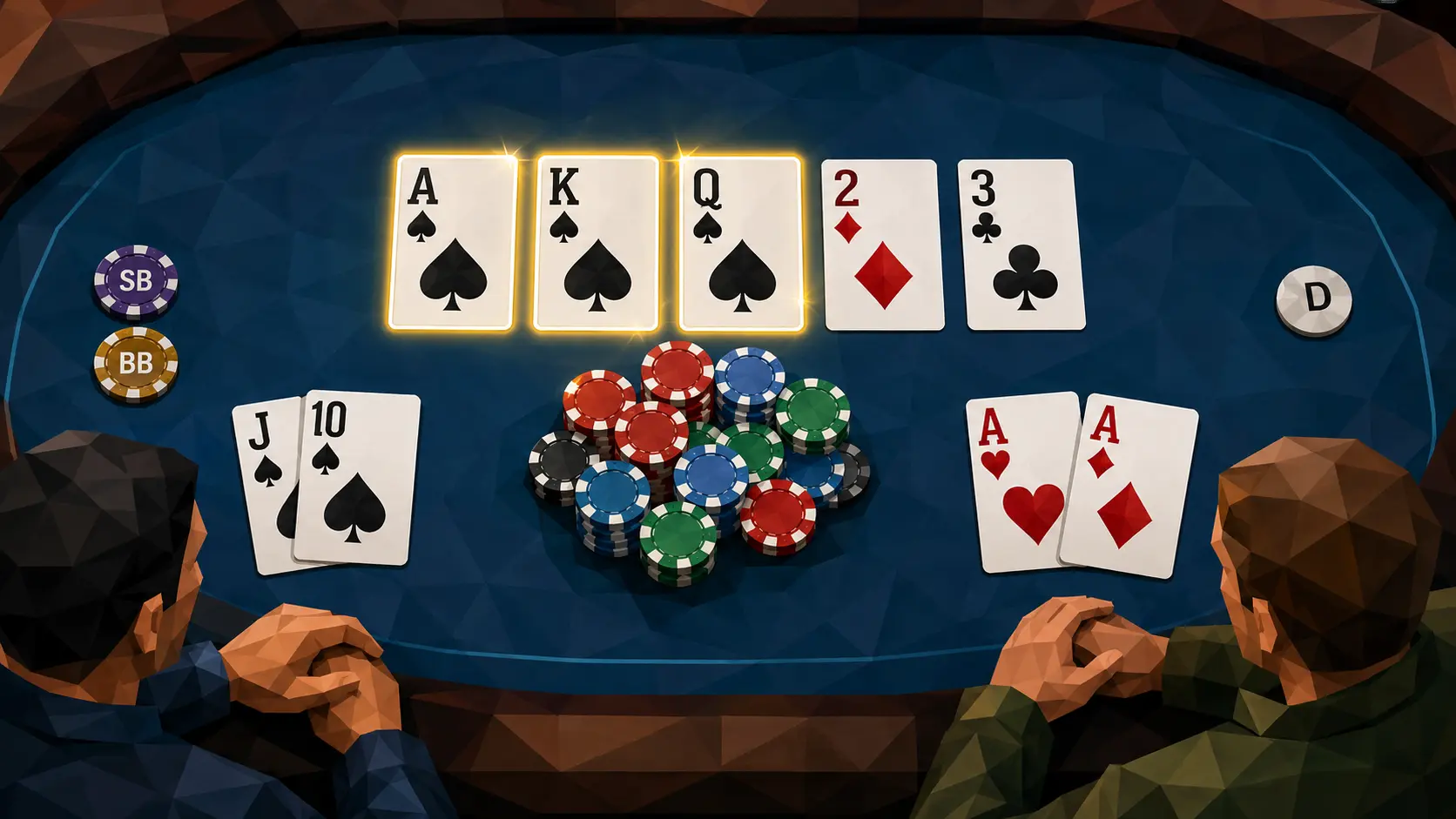
Texas Hold’em is one of the best-known poker games in the world, but it is often misunderstood by casino players.
It looks like a casino game because it is played with cards, chips, blinds, and betting rounds. But Texas Hold’em is not the same kind of game as roulette, blackjack, or slots.
In most Texas Hold’em games, players compete against each other. The house does not usually try to beat the player hand by hand. Instead, the operator earns money through rake, tournament fees, or similar charges.
That difference matters.
In roulette, the casino’s edge is built into the wheel. In slots, the game math is built into the machine. In Texas Hold’em, the biggest challenge is often the other players at the table.
Good decisions matter. Bad decisions matter. Patience matters. Position matters. And unlike many casino games, the best hand does not always win the pot.
What Texas Hold’em Is
Texas Hold’em is a poker game where each player receives two private cards, called hole cards.
Five shared cards, called community cards, are then dealt face up in the middle of the table. Every player can use these community cards together with their own two hole cards to make the best possible five-card poker hand.
A player can use both hole cards, one hole card, or neither hole card if the best hand is already on the board.
That sounds simple, but the game becomes interesting because players bet before all the cards are known.
You are not only playing the cards you have. You are also playing the situation.
The Basic Goal
The goal in Texas Hold’em is to win the pot.
The pot contains the chips or money bet during the hand. A player can win the pot in two main ways.
First, they can have the best hand at showdown. This happens when two or more players remain after the final betting round and reveal their cards.
Second, they can make every other player fold before showdown. In that case, the winning player does not need to show the best hand. They win because nobody else stayed in.
This is one reason poker feels different from many casino games.
The strongest hand is important, but pressure, timing, and table image can also matter.
The Blinds
Most Texas Hold’em games use blinds.
The blinds are forced bets posted before the cards are dealt. Usually, the player to the left of the dealer button posts the small blind, and the next player posts the big blind.
The blinds create action. Without them, players could simply wait forever for perfect cards.
The dealer button moves around the table after each hand, so the blind positions also move. This matters because position is one of the most important ideas in poker.
A player who acts later has more information than a player who acts earlier.
Hole Cards
Each player receives two hole cards.
These are private. Other players cannot see them unless the hand reaches showdown or the player chooses to show.
Some starting hands are much stronger than others. A pair of aces is the strongest starting hand. Hands like king-queen suited, ace-king, or medium pairs can also be playable depending on position and table action.
Weak hands can become expensive if beginners play too many of them.
One of the first poker lessons is that folding is not failure. Folding bad starting hands is part of good play.
The Four Betting Rounds
A Texas Hold’em hand can have up to four betting rounds.
The first betting round is pre-flop. This happens after players receive their hole cards but before any community cards are dealt.
The second betting round is the flop. Three community cards are dealt face up.
The third betting round is the turn. A fourth community card is dealt.
The fourth betting round is the river. A fifth and final community card is dealt.
After the river betting round, remaining players go to showdown.
Each round gives players more information. A hand that looked strong pre-flop may become weaker after the flop. A drawing hand may improve on the turn or river. A player who seemed confident early may slow down later.
The cards change. The story of the hand changes with them.
Checking, Betting, Calling, Raising and Folding
Texas Hold’em uses a few basic actions.
- To check means to stay in the hand without betting, if no bet has been made in that round.
- To bet means to put chips into the pot.
- To call means to match another player’s bet.
- To raise means to increase the bet.
- To fold means to give up the hand and stop contesting the pot.
Beginners often call too much. Calling feels safer than raising or folding, but it can quietly become expensive. A player who keeps calling with weak hands may lose many small pots and then wonder where the money went.
Good poker is not only about playing strong hands. It is also about knowing when a hand is not worth continuing.
Community Cards
The community cards are shared by all players.
This is what makes Texas Hold’em easy to learn but difficult to play well. Everyone sees the same board, but not everyone has the same private cards.
For example, if the board shows three hearts, a flush may be possible. If the board pairs, a full house may be possible. If the board has connected cards such as 8-9-10, straights may be possible.
Players must think about their own hand and also what other players might have.
A common beginner mistake is only looking at one’s own cards. The board often tells the more important story.
Hand Rankings
Texas Hold’em uses standard poker hand rankings.
From strongest to weakest, the main hands are:
- Royal flush
- Straight flush
- Four of a kind
- Full house
- Flush
- Straight
- Three of a kind
- Two pair
- One pair
- High card
Beginners should learn these rankings before playing for real money.
It is especially important to understand close situations. A flush beats a straight. A full house beats a flush. Three of a kind beats two pair. If two players have the same type of hand, kickers may decide the winner.
A kicker is an extra card used to break ties.
For example, if two players both have a pair of aces, the player with the stronger side card may win.
Position
Position means where a player acts in the betting order.
Late position is powerful because the player acts after others and has more information. Early position is harder because the player must act before seeing what most opponents do.
This affects which hands are playable.
A hand that may be reasonable from late position can be dangerous from early position. That is because players behind you still have the chance to raise.
Beginners often underestimate position. They focus on the cards and ignore the order of action.
In Texas Hold’em, position can turn a marginal hand into a playable one or a playable hand into a fold.
Bluffing
Bluffing means betting or raising with a hand that is probably not best, hoping opponents will fold stronger hands.
Bluffing is part of poker, but beginners often overuse it.
A good bluff usually makes sense. It tells a believable story based on the board, previous betting, position, and the opponent’s likely hand range.
A random bluff is just a guess with chips attached.
Bluffing also depends on the opponent. Some players fold too much. Others call too much. Bluffing someone who refuses to fold is usually a bad idea.
The most useful beginner advice is simple: learn value betting before trying fancy bluffs.
Value Betting
Value betting means betting because you believe worse hands can call.
This is one of the most important poker skills.
If you have a strong hand, you usually want to win more than the blinds. You want weaker hands to put money into the pot. That means choosing bet sizes that can be called by worse hands without giving opponents too easy a price.
Beginners sometimes slow-play strong hands too often. They check because they do not want to scare opponents away. Sometimes that is correct. Often it simply misses value.
Winning at poker is not only about winning pots. It is about winning enough when you are ahead and losing less when you are behind.
Cash Games and Tournaments
Texas Hold’em is commonly played as a cash game or a tournament.
In a cash game, chips represent real money. A player can usually join or leave the table more freely, depending on the rules.
In a tournament, players buy in for a fixed amount and receive tournament chips. The blinds increase over time, and players are eliminated when they lose all their chips. The prize pool is usually paid to the top finishers.
The strategy is different.
Cash games are more directly connected to chip value. Tournament play involves survival, changing blind levels, stack sizes, and payout pressure.
A player who understands one format does not automatically understand the other.
Online Texas Hold’em
Online Texas Hold’em is faster than live poker.
Hands are dealt quickly. There are no physical chips to count. Players can sometimes play multiple tables. The speed can make the game more intense and more expensive if a player is not careful, while fair play still depends on platform security and game-integrity controls.
Online poker also removes some live tells. You cannot watch someone’s face or body language in the same way. Instead, players may look at timing, bet sizing, position, and hand history.
The basic rules are the same, but the rhythm is different.
A beginner should start slowly, play one table, and avoid stakes that feel uncomfortable.
Casino Poker vs Player Poker
Some casino games use poker hands but are not really poker in the same sense.
Games such as Caribbean Stud, Three Card Poker, Casino Hold’em, and video poker are usually played against the house or a paytable. Texas Hold’em poker rooms are normally player-versus-player.
This difference matters because strategy, risk, and operator revenue work differently.
In player poker, the casino may take rake. In casino poker-style games, the house edge is usually built into the rules.
A player should know which kind of game they are playing before sitting down.
Poker words can make different games look similar, but the economics may be completely different.
Common Beginner Mistakes
Many Texas Hold’em mistakes come from impatience.
Beginners often play too many hands, call too often, chase weak draws, bluff in bad spots, ignore position, and bet without thinking about what worse hands can call or better hands can fold.
Another common mistake is emotional play.
A player loses a big hand, gets frustrated, and tries to win the money back quickly. In poker, this is often called tilt. Tilt can turn a reasonable player into a reckless one.
Texas Hold’em rewards patience more than drama.
The best fold may feel boring, but boring decisions often save money.
Is Texas Hold’em a Game of Skill?
Texas Hold’em includes a major skill element.
Over many hands, better players tend to make better decisions, choose better starting hands, manage position more effectively, read situations more accurately, and lose less in bad spots.
That does not mean a good player wins every session.
Luck matters in the short term. A weak player can win a big pot. A strong player can lose with the best starting hand. A bad river card can change everything.
Skill matters over time, but variance still exists.
This is why bankroll management is important. Even strong players can have losing stretches.
Responsible Play in Poker
Poker can feel different from casino games because the player is competing against other people.
That can make losses feel personal. A player may want revenge after being bluffed or losing a big hand. They may stay longer than planned because they believe they can outplay the table.
That mindset can become risky.
Before playing, decide how much you are willing to lose and when you will stop. Do not increase stakes because you are angry. Do not chase a player who annoyed you. Do not treat poker skill as a guarantee.
Skill can improve decisions, but it does not remove risk, so choose the buy-in and loss limit before sitting down.
The Sensible Way to Learn Texas Hold’em
Texas Hold’em is worth learning properly.
The rules are simple enough to understand in one sitting, but the game itself has depth. Starting hands, position, bet sizing, hand reading, bluffing, bankroll management, and emotional control all matter.
A beginner does not need to master everything at once.
Start with the rules. Learn hand rankings. Play fewer hands. Respect position. Understand the betting rounds. Avoid emotional calls. Know whether you are playing a cash game, tournament, or casino poker variant.
Most importantly, remember that Texas Hold’em is not a slot with cards.
It is a decision game played against other people, with luck and skill both involved.
That is what makes it interesting.
It is also what makes it dangerous when players overestimate themselves.