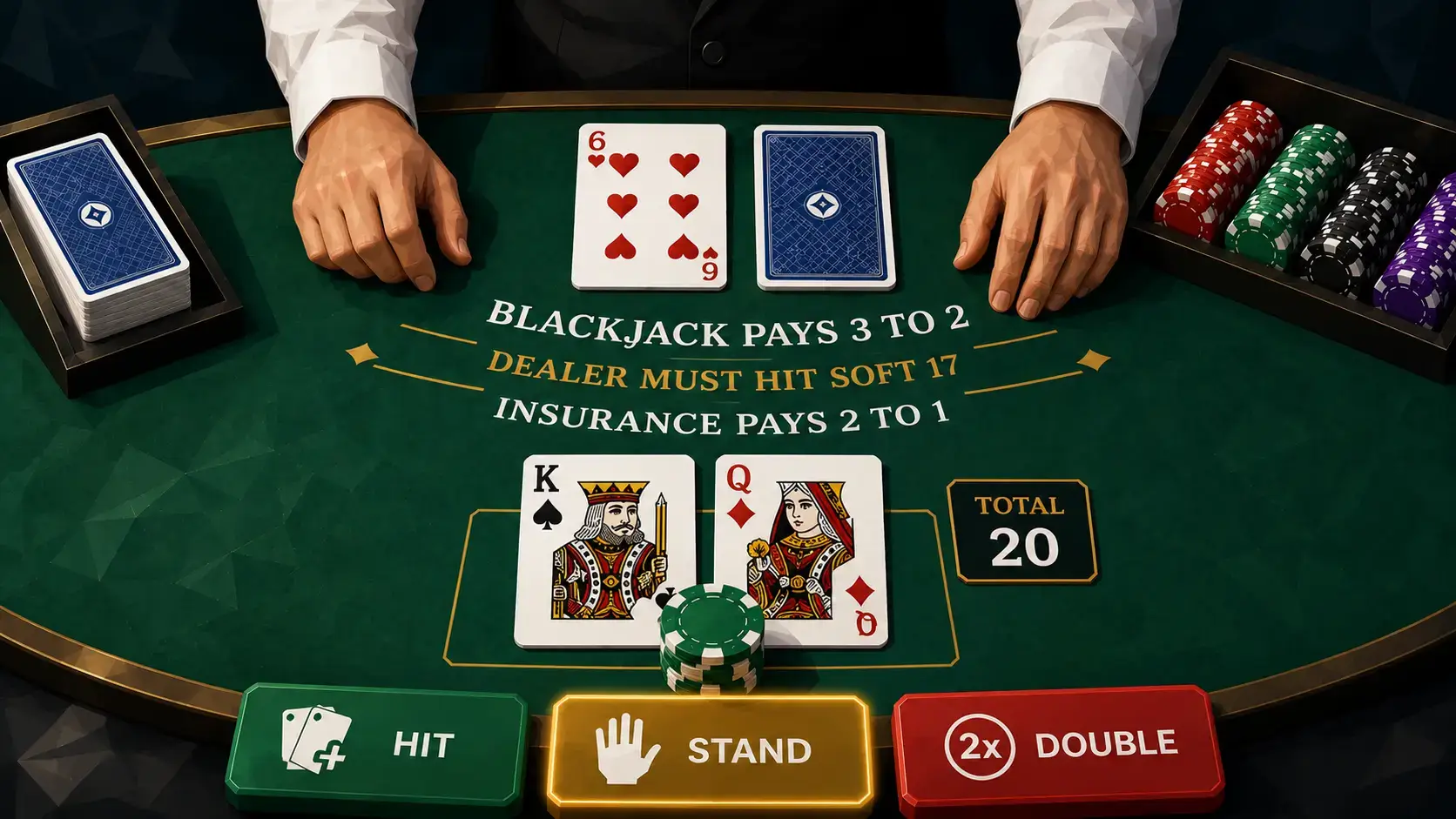
Blackjack is one of the easiest casino games to recognize and one of the easiest to misunderstand.
The basic idea sounds simple: get closer to 21 than the dealer without going over. That is true, but it leaves out the parts that actually decide whether a beginner plays sensibly or gives away money through avoidable mistakes.
Blackjack is not like roulette or slots. The player makes decisions during the hand, and those decisions matter. You can hit, stand, double, split, or sometimes surrender. You can also take insurance, although that is usually a poor choice for ordinary players.
The aim is not to guess what the next card will be. The aim is to make the best available decision based on your hand, the dealer’s visible card, and the rules of the table.
The Basic Goal of Blackjack
In blackjack, the player competes against the dealer.
You do not need to beat the other players at the table. Their hands do not directly affect whether your hand wins or loses. Each player’s hand is compared with the dealer’s hand.
The goal is to have a hand value higher than the dealer’s without going over 21. If your hand goes over 21, you bust and lose the hand. If the dealer busts and you have not busted, you win.
If your hand is closer to 21 than the dealer’s, you win. If the dealer is closer, you lose. If both hands have the same total, the result is usually a push, meaning your bet is returned.
Card Values
Blackjack card values are simple.
Cards from 2 to 10 count as their face value. A 7 is worth 7. A 10 is worth 10.
Jacks, queens, and kings are also worth 10.
An ace can count as either 1 or 11, depending on which value helps the hand. This makes the ace the most flexible card in the game.
For example, an ace and a 6 can be counted as 7 or 17. That hand is usually called a soft 17 because the ace can still change value without the hand busting immediately. A hand like 10 and 7 is a hard 17 because there is no ace being counted as 11.
Understanding soft and hard hands is important because the correct decision can be different even when the visible total looks similar.
What Counts as Blackjack?
A blackjack is a two-card hand that totals 21.
This means an ace plus any 10-value card: 10, jack, queen, or king.
A blackjack usually beats any ordinary 21 made with three or more cards. For example, ace-king beats 7-7-7, even though both hands total 21.
The payout for blackjack depends on the table rules. A traditional blackjack payout is 3:2, which means a €10 bet wins €15. Some tables pay 6:5, which means a €10 bet wins only €12.
That difference matters. A 6:5 blackjack payout is worse for the player and should not be treated as a small detail.
How a Blackjack Hand Starts
A blackjack hand begins with the player placing a bet.
The dealer then deals two cards to each player and two cards to themselves. In many versions, the player’s cards are dealt face up. The dealer usually has one visible card, called the upcard, and one hidden card, often called the hole card.
The dealer’s upcard is important because it helps guide the player’s decisions.
A dealer showing a 2 through 6 is generally in a weaker position because the dealer has a greater chance of making a difficult hand later. A dealer showing a 7, 8, 9, 10, or ace is usually stronger.
This does not mean the dealer will always win with a strong upcard or always lose with a weak one. It simply changes the best decision in many situations.
Hitting
To hit means to take another card.
You hit when your current hand is not strong enough and another card is worth the risk. If the new card takes your total over 21, you bust and lose immediately.
Beginners often hit or stand based only on fear. They may stand on weak totals because they do not want to bust, even when the dealer has a strong upcard. That can be a mistake because a weak hand may lose anyway if the dealer makes a normal total.
Good blackjack decisions are not about avoiding busts at all costs. They are about choosing the option with the best long-term expectation.
Standing
To stand means to keep your current hand and take no more cards.
Standing is often correct when the hand is already strong or when the dealer is showing a weak card and may bust.
For example, standing on a hard 17 or higher is usually standard. Standing on lower totals may also be correct when the dealer shows a weak upcard, depending on the exact hand.
The key is that blackjack is not only about your total. It is about your total compared with the dealer’s visible card.
A 12 against a dealer 6 is not the same decision as a 12 against a dealer 10.
Doubling Down
Doubling down means doubling your original bet in exchange for exactly one additional card.
This is one of the most important blackjack moves because it allows the player to put more money on the table when the situation is favorable.
A common example is doubling on 11 against many dealer upcards. The player has a strong chance of making a good total with one more card, especially because so many cards in the deck are worth 10.
Doubling can feel risky because the bet increases, but it is not a reckless move when used correctly. It is a way to take advantage of strong situations.
The exact doubling rules vary. Some tables allow doubling on any two cards. Others restrict doubling to certain totals. Some allow doubling after splitting, which is usually better for the player.
Splitting Pairs
Splitting is available when your first two cards have the same value.
If you split, the pair becomes two separate hands, and you place an additional bet equal to your original bet. Each hand then receives another card and is played separately.
Some pairs should usually be split. Aces and eights are the classic examples. Splitting aces gives you a chance to make strong hands. Splitting eights turns a poor hard 16 into two more playable hands.
Other pairs should usually not be split. Tens are the clearest example. A pair of tens gives you 20, which is already a very strong hand. Splitting tens usually turns a strong situation into two uncertain ones.
Pair strategy depends on the dealer’s upcard and the table rules, but beginners should at least understand that splitting is not something to do automatically just because the option appears.
Soft Hands
A soft hand is a hand where an ace is counted as 11 without busting.
For example, ace-5 is soft 16. If you draw a 10, the ace can become 1, and the hand becomes 16 instead of busting.
Soft hands are more flexible than hard hands, which makes them valuable. They also create doubling opportunities that beginners sometimes miss.
For example, soft 18 may look strong, but it is not always a hand you simply stand on. Against certain dealer cards, hitting or doubling can be better depending on the rules.
This is why blackjack strategy charts separate hard totals, soft totals, and pairs. They behave differently.
Hard Hands
A hard hand is a hand without an ace counted as 11.
For example, 10-6 is hard 16. If you take a 10-value card, the hand busts.
Hard hands are less flexible, so they often create the uncomfortable decisions beginners remember most. A hard 16 against a dealer 10 is a classic example. The hand is weak, but hitting can bust, and standing often loses if the dealer makes a strong total.
There is no magic answer that makes hard hands pleasant. The goal is simply to make the best long-term decision, not the decision that feels safest in the moment.
The Dealer’s Rules
The dealer does not make decisions like the player.
The dealer follows fixed rules. Usually, the dealer must hit until reaching at least 17. What happens on soft 17 depends on the table. Some rules require the dealer to stand on all 17s. Others require the dealer to hit soft 17.
This small rule difference affects the game. A dealer who hits soft 17 has more chances to improve, which is generally worse for the player.
The dealer also cannot decide to double, split, or stand early because they “feel lucky.” The dealer simply follows the table rules.
That is why the player’s decisions are the interesting part of blackjack.
Insurance
Insurance is a side bet offered when the dealer’s upcard is an ace.
The bet is based on whether the dealer has blackjack. It may sound like protection, but for most players it is usually not worth taking.
The name makes insurance feel safer than it is. In reality, it is a separate bet with its own odds. Unless a player is counting cards and has a strong reason to believe the remaining deck is rich in 10-value cards, insurance is generally a poor choice.
Beginners should be especially careful with it. If the dealer offers insurance, the simplest rule is usually to decline.
Surrender
Some blackjack tables offer surrender.
Surrender allows the player to give up the hand and lose only half the bet. It is not available everywhere, and the rules can vary.
When used correctly, surrender can be useful in very weak situations, such as certain hard totals against a strong dealer upcard. But many beginners either do not know it exists or treat it as a sign of weakness.
In blackjack, surrender is not emotional. It is just another rule option. If the table offers it, it can reduce losses in specific situations.
Basic Strategy
Basic strategy is a set of mathematically tested decisions for blackjack.
It tells the player when to hit, stand, double, split, or surrender based on the player’s hand and the dealer’s upcard. It does not guarantee profit, but it reduces avoidable mistakes.
Basic strategy changes slightly depending on the rules of the table. Number of decks, dealer action on soft 17, double-after-split rules, surrender availability, and blackjack payout can all matter.
A beginner does not need to memorize every chart before understanding the game, but using a basic strategy chart is much better than playing by instinct.
Instinct often says “stand because I might bust.” Basic strategy may say “hit because standing loses more often over time.”
Why Betting Systems Do Not Beat Blackjack
Many players are attracted to betting systems.
The idea is usually to change bet size after wins or losses. The Martingale system, for example, tells players to increase bets after losses in the hope that one future win recovers everything.
The problem is that betting systems do not change the rules of the game. They do not change the cards, the dealer’s upcard, the house edge, or the probability of the next hand.
They can also become dangerous because they encourage larger bets after losses. Table limits and bankroll limits eventually matter, even if the system looks logical on paper.
Blackjack is a decision game, but that does not mean a betting progression can overpower the casino’s edge.
Card Counting
Card counting is a technique used to estimate whether the remaining cards are favorable to the player.
It is mostly associated with live blackjack, not ordinary online blackjack games using random number generation or frequent shuffling. In many land-based casinos, card counting is not illegal, but casinos can still refuse service or ask a player to stop playing.
For beginners, card counting is not the right starting point. It requires discipline, accurate tracking, bankroll control, favorable rules, and a realistic playing environment.
The useful beginner lesson is simpler: blackjack can involve skill, but skill begins with basic strategy, not with movie-style card counting.
Online Blackjack
Online blackjack comes in several forms.
Standard digital and live dealer blackjack use different fairness controls: software deals the digital game, while the live version streams a real dealer and physical cards. Some games also include side bets, multi-hand play, autoplay, or unusual rule variants.
The rules should always be checked before playing. Do not assume every blackjack game is the same.
Look for the blackjack payout, number of decks, whether the dealer hits or stands on soft 17, doubling rules, splitting rules, surrender availability, and side bets.
Online blackjack can also move quickly. Fast play makes it easier to lose track of spending, especially if you keep increasing stakes after a bad run.
Side Bets
Many blackjack games offer side bets.
These may involve pairs, suited cards, 21+3-style combinations, perfect pairs, or other outcomes separate from the main hand.
Side bets can be entertaining because they offer larger payouts, but they often carry a higher house edge than the main blackjack game. They also distract from the core decision-making that makes blackjack more player-friendly than many other casino games.
A beginner should learn the main game first. Side bets should be treated as optional entertainment, not as strategy.
Common Beginner Mistakes
The most common blackjack mistakes are easy to understand.
Players take insurance because it sounds safe. They stand on weak totals because they fear busting. They split tens because two hands feel better than one. They fail to double when the situation is favorable. They chase losses by increasing stakes after a bad run. They ignore table rules and assume all blackjack games are equal.
Another major mistake is playing without knowing whether blackjack pays 3:2 or 6:5. That single rule can make a major difference to the value of the game.
Beginners should focus on clean decisions, reasonable stakes, and table selection before worrying about advanced tactics.
Is Blackjack a Skill Game?
Blackjack includes skill because the player makes decisions that affect the long-term result.
A player who uses basic strategy will usually do better than a player who guesses, follows hunches, or changes decisions based on emotion. However, blackjack is still a casino game with a house edge under normal conditions.
Skill can reduce the edge. It does not remove risk.
Even correct decisions lose sometimes. A good double can lose. A correct hit can bust. A correct stand can lose to a dealer draw. That does not mean the decision was wrong. It means the result of one hand is not the same thing as the quality of the play.
Responsible Play in Blackjack
Blackjack can feel more controllable than slots because the player makes decisions.
That can be good, but it can also be dangerous. A player may believe they can recover losses by playing “smarter” on the next hands or by increasing the stake when the dealer seems beatable.
The dealer is not trying to outthink you. The game simply follows its rules.
Set a budget before playing. Choose stakes that make sense for that budget. Do not raise bets because you are frustrated. Avoid side bets if they pull you away from the plan. Stop when the session is no longer enjoyable.
Good blackjack play is not only about knowing when to hit. It is also about knowing when to leave the table.
The Sensible Way to Learn Blackjack
Blackjack is a strong beginner game because the rules are easy to understand and the decisions are meaningful.
Start with the basics: card values, dealer rules, hitting, standing, doubling, splitting, and blackjack payouts. Then learn the difference between hard hands, soft hands, and pairs. After that, use a basic strategy chart for the rule set you are actually playing.
Avoid insurance unless you have a specific advanced reason to take it. Be cautious with side bets. Do not trust betting systems to solve the game. Most importantly, remember that correct decisions can still lose in the short term.
Blackjack rewards better decisions over time, but it never becomes risk-free.
That is the balance every player should understand before the first hand is dealt.