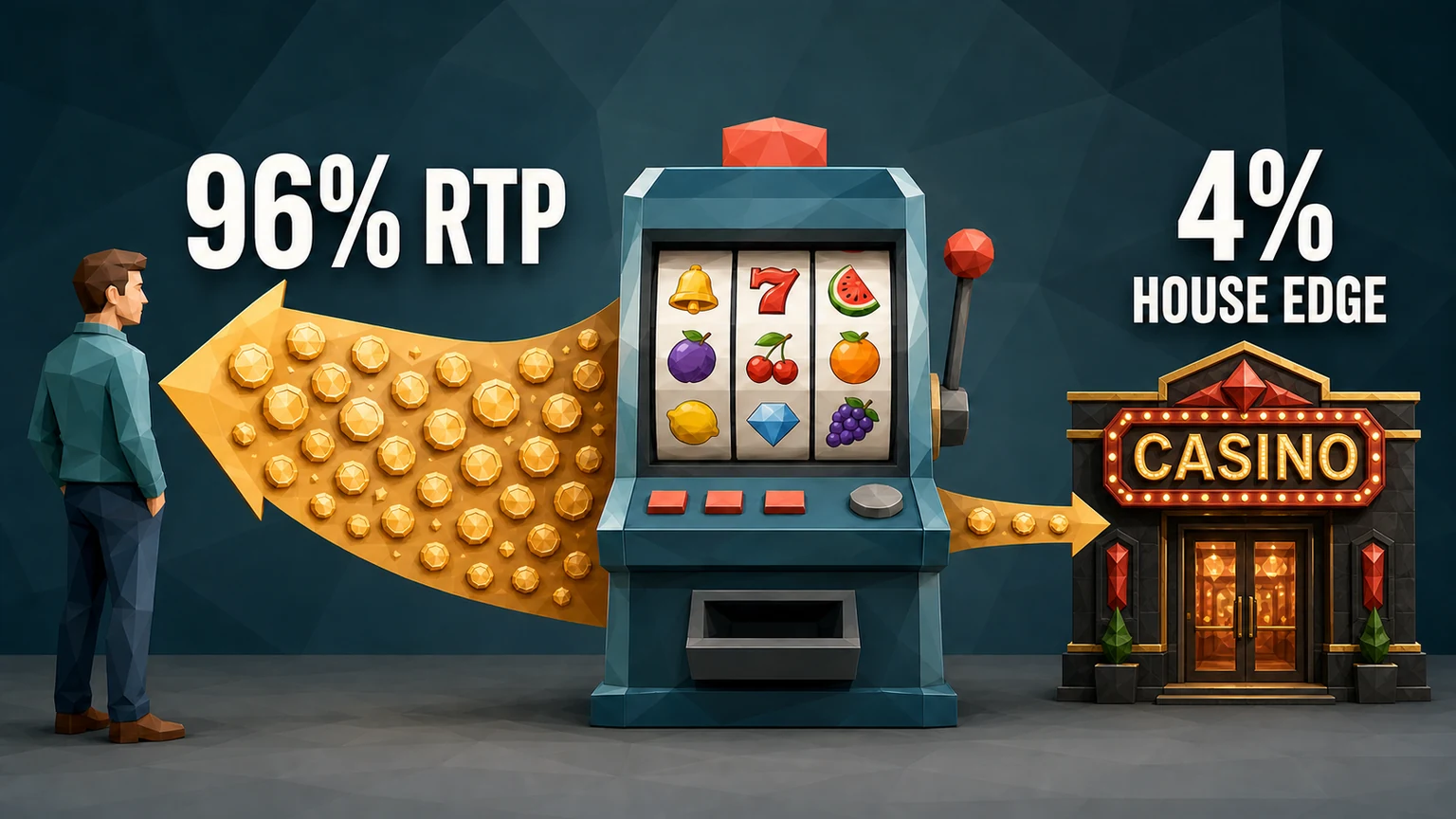
RTP, house edge and volatility describe different parts of a casino game’s mathematics. RTP estimates how much of the total money wagered is returned as prizes over the game’s model. House edge expresses the casino’s expected advantage. Volatility describes how widely individual results are spread around the long-run average.
Those figures can help compare games and variants, but none predicts what will happen in one session. A game can have a relatively high RTP and still produce a quick loss. Two games can share the same RTP while one pays small amounts regularly and the other concentrates much of its return in rare large prizes.
This is an explanation of the mathematics, not a way to turn gambling into income or recover losses.
The Three Measures Answer Different Questions
The shortest useful distinction is:
- RTP: What proportion of total stakes is the game theoretically designed to return as prizes over a very large sample?
- House edge: What proportion of total stakes does the casino theoretically expect to retain over the same kind of long-run play?
- Volatility: How much can individual outcomes and shorter samples vary around that expected return?
Hit frequency is another figure sometimes shown for slots. It describes how often the game records an award under its own definition. It is not a fourth name for volatility, and a frequent award can still be smaller than the stake placed.
The casino terms glossary provides quick definitions. This guide deals with how the measures interact and where a simple percentage can mislead.
What RTP Actually Measures
RTP stands for return to player. A theoretical RTP of 96% means that the game’s mathematical model allocates 96% of total stakes to prizes over a sufficiently large volume of play. The remaining 4% represents the theoretical house advantage when RTP and house edge are being measured on the same basis.
The word “theoretical” matters. The figure comes from the game’s probabilities and paytable, not from a promise to each player. It may take millions of rounds—or more—for the combined results to settle close to the designed percentage.
Regulators also distinguish theoretical RTP from actual RTP. The UK Gambling Commission defines theoretical RTP as the game’s designed and advertised return. Actual RTP is calculated from the prizes and turnover recorded while the game is operating.
If a game records £960,000 in prizes from £1,000,000 of stakes, its actual RTP for that measured period is 96%. That observation does not prove that the theoretical RTP is 96%, and a shorter period can sit well above or below the design because of normal variation.
Why 96% RTP Does Not Mean £96 Back From £100
A 96% RTP does not mean that a player who deposits £100 will finish with £96. It does not even mean that exactly £100 will be wagered.
RTP is based on turnover: the sum of all stakes placed, including money won and then staked again. A player might begin with £100, make 500 spins at £1 each and therefore generate £500 of turnover by recycling the balance.
At a theoretical 96% RTP:
- expected prizes across £500 of turnover are £480;
- the corresponding theoretical loss is £20; and
- the actual session could finish far above or below either figure.
The arithmetic describes the average built into the game, not a forecast for that player. It also shows why time and speed matter. Replaying the same balance exposes it to the house edge repeatedly.
The practical online slots guide explains how stake settings, paytables, features and repeated spins contribute to the real cost of play.
How House Edge Relates to RTP
House edge expresses the expected casino advantage as a percentage of the amount wagered. For a straightforward banked game measured on the same basis, RTP and house edge are complementary:
House edge = 100% − RTP
A 97.30% RTP therefore corresponds to a 2.70% house edge. Over £1,000 of turnover, that edge represents an expected loss of £27. It does not mean the casino deducts £27 from a particular session or that every £1,000 produces the same result.
The relationship needs context when a game involves strategy, commission, different betting options or a separate jackpot contribution. Poker against other players, for example, is normally discussed through rake rather than a single casino house edge. A blackjack figure may assume a particular rule set and a defined playing strategy. One percentage should not be transferred to a different product merely because the game name looks similar.
Roulette Makes the House Edge Visible
Roulette offers a clean worked example because the wheel, payouts and probabilities can be counted directly.
A single-zero wheel has 37 pockets: 1 to 36 plus zero. A straight-up number wins on one pocket and pays 35 to 1, with the original stake also returned. The payout behaves as though there were 36 possible outcomes, while the wheel has 37.
For standard bets:
- the single-zero house edge is 1 ÷ 37, or about 2.70%;
- the corresponding theoretical RTP is about 97.30%;
- a double-zero wheel has a house edge of 2 ÷ 38, or about 5.26%; and
- its corresponding theoretical RTP is about 94.74%.
Changing from a straight-up number to red or black alters the chance of winning and the size of the payout, but not the standard house edge on the same wheel. The zero or zeros remain outside the even-money groups.
Where la partage applies to eligible even-money bets on a single-zero wheel, half the stake is returned when zero wins. That reduces the house edge on those bets to about 1.35%, with a corresponding theoretical RTP of about 98.65%.
These figures apply only to the stated wheel and rules. The roulette guide covers the layouts, payouts, five-number basket, triple-zero wheels and en prison in context.
Blackjack RTP Depends on Rules and Decisions
Blackjack shows why one headline RTP cannot always describe every version of a game.
The mathematical return is affected by rules such as:
- whether blackjack pays 3 to 2 or 6 to 5;
- whether the dealer hits or stands on soft 17;
- which pairs may be split;
- whether doubling after a split is allowed;
- whether surrender is available; and
- how many decks are used.
Player decisions matter as well. A published return may assume optimal or otherwise disclosed strategy. If a player regularly makes lower-return decisions, the effective house edge against that play will be higher than the figure calculated for the stated strategy.
That does not turn blackjack into a reliable source of profit. Strategy can reduce avoidable mathematical disadvantage; it cannot guarantee a positive session or remove the casino’s long-run edge under ordinary rules.
Check the table information for the exact version rather than applying a figure from another casino or rule set. The blackjack guide explains the actions, common rule differences and limits of betting systems.
Volatility Describes the Spread of Results
Volatility concerns the distribution of outcomes rather than the average return itself. In statistical work it is commonly represented by standard deviation, which measures how widely results vary around the mean.
A lower-volatility game generally concentrates more of its return in smaller, more frequent prizes. A higher-volatility game generally places more of the return in larger but less frequent outcomes. The second game may produce longer losing stretches and more extreme short-term results even when both games have the same RTP.
Imagine two fictional slots, each with a 96% theoretical RTP:
- Game A returns much of its value through regular small awards.
- Game B returns much of its value through rare features and large prizes.
Their long-run average can be identical while the experience of playing them is very different. Game B does not have a better chance of producing profit simply because its top prizes are larger. It has a wider distribution of possible outcomes.
Descriptions such as low, medium and high are also not standardised across every provider. They are useful only as broad labels unless the supplier explains the underlying measure.
Volatility Is Not Hit Frequency
Hit frequency is the proportion of rounds that produce a qualifying award. It can help describe how often a slot’s win counter moves, but it does not say how large those awards are.
A game can record frequent outcomes that return less than the original stake. If a £1 spin produces a 40p award, the game may count a hit while the balance still falls by 60p. A high hit frequency therefore does not necessarily mean low volatility, high RTP or slow losses.
The same caution applies to near misses and entertaining feature animations. They may affect how the game feels without changing the mathematical value of the result.
Actual RTP Can Be Far From Theoretical RTP
Actual RTP is calculated from observed prizes divided by observed turnover. It naturally moves around as new results enter the sample.
In a short or highly volatile sample, one large jackpot can push actual RTP well above the theoretical figure. A long stretch without that prize can pull it below. As the volume of play grows, the expected range normally narrows.
The UK Gambling Commission’s RTP monitoring guidance explicitly uses volatility when setting acceptable tolerances around a theoretical return. The regulator’s worked monitoring material shows why hundreds of thousands of games can still produce an actual percentage that is meaningfully different from the design without proving a fault.
One player’s history is not a suitable audit sample. An unusual run can be real and random. If a result or settlement appears technically wrong, preserve the round ID and game record so the operator can investigate the specific event instead of trying to prove the game’s RTP from a few sessions.
RTP Does Not Control the Next Result
On an independently generated random game, previous wins and losses do not make a future outcome due. A slot running below its theoretical RTP for one player does not need to correct itself during that player’s next session.
The random number generator selects outcomes according to the game’s implementation. The paytable and probability model determine what those outcomes are worth across the long run. RTP describes the combined mathematical result; it is not a target that the game must visibly reach for every account.
The distinction is covered fully in Random Number Generators in Slots Explained. Faster spins, changing stake after losses or moving to a machine that looks “cold” does not improve the next random result.
The Same Game Can Have Different RTP Settings
Some slot titles are supplied in more than one approved mathematical configuration. The artwork, features and name may be almost identical while the theoretical RTP differs.
Check the information inside the exact game at the exact casino. Do not rely on:
- a percentage quoted by another operator;
- an old game review;
- a provider’s highest available setting;
- a figure taken from demo mode without checking the real-money version; or
- a lobby label that does not identify the configuration.
Progressive jackpots require another check. Part of the stake may contribute to the jackpot, and part of the theoretical return may depend on winning it. The displayed information should explain how the progressive contribution is treated. A very large advertised total does not mean the base game returns more frequently.
What Regulated Games Should Disclose
In Great Britain, the UK Gambling Commission’s remote technical standards on game rules and chances require information about the player’s chance of winning to be easily available before a wager is placed. Depending on the game, that information can be a house edge, RTP percentage or probability of winning. The rules and available payouts must also be explained.
Ontario’s Registrar’s Standards for Gaming similarly require accurate information that enables informed choices. For each game, the theoretical payout must be provided. The standards also address progressive contributions, different returns for different betting options and the strategy used to calculate returns for games involving skill.
Disclosure is useful, but it still needs to be read carefully. A displayed percentage does not prove that an operator is licensed for the player’s location or that every other part of the service is sound. The guide to casino game fairness and testing explains the wider role of game certification, operator licensing and complaint routes.
A Note for Australian Readers
The mathematics of RTP, house edge and volatility is the same wherever a game is studied, but the legal availability of online casino play is not.
The Australian Communications and Media Authority states that online casinos and casino-style games such as slots, blackjack, roulette and poker are prohibited from being provided to people in Australia. An RTP figure on an offshore website does not make that service legal, licensed or protected for an Australian player.
This article should not be used as a route into offshore casino play. ACMA’s guidance on illegal gambling operators explains the legal and practical risks for Australian users.
What These Numbers Cannot Tell You
RTP, house edge and volatility cannot tell you:
- whether the next round will win;
- how long a balance will last;
- when a bonus or jackpot will appear;
- whether a losing sequence is about to end;
- whether a particular stake is affordable; or
- whether an operator will handle withdrawals and complaints properly.
They also cannot turn a negative-expectation game into an investment. A lower house edge reduces the expected cost per unit wagered; it does not remove risk. Lower volatility reduces the spread of outcomes; it does not create a positive expectation.
The sensible use of these figures is limited but worthwhile: compare exact game versions, understand where the casino’s advantage comes from and avoid confusing a long-run average with a personal forecast.
The Practical Takeaway
RTP describes the long-run theoretical return, house edge describes the corresponding casino advantage and volatility describes how unevenly results can arrive.
Check all three where the information is available. Confirm the exact game, paytable and rule set, especially for slots supplied at several RTP settings and table games affected by strategy or variant rules.
Then keep the limits of the figures in view. A percentage cannot predict a session, rescue a loss or make unaffordable play reasonable. The more money turned over, the more often the balance is exposed to the edge.