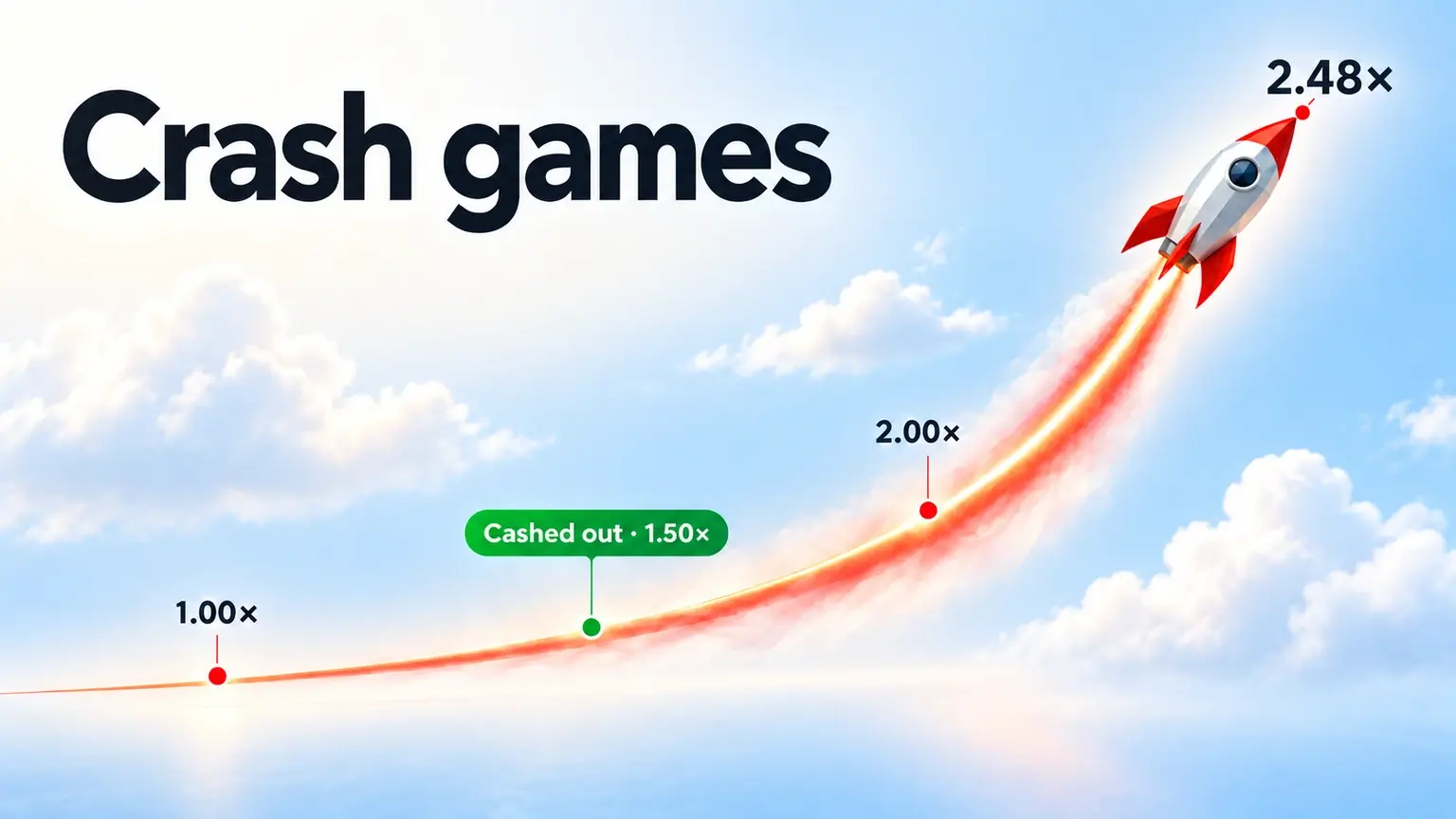
A crash game puts a rising multiplier on screen and asks you to cash out before the round ends. A successful cash-out returns your stake multiplied by the accepted multiplier. If the crash happens first, you lose the unsettled bet. Choosing when to leave changes the size and frequency of payouts, but it doesn't turn a random game into a reliable source of profit.
The useful questions are how the game settles a cash-out, which rules and RTP apply, and how much you're staking across repeated rounds. A plane, rocket or astronaut is the presentation; the payout rules are what determine the financial result.
How a crash round works
In the familiar multiplayer format, a betting window opens before the round. Once it starts, everyone watches the same rising multiplier, although each player has their own stake and cash-out decision. Bets that remain active when the round ends are lost. Some games can end at or near 1.00×, before a profitable cash-out is possible.
For example, a $5 bet settled at 2.00× returns $10 in total: your $5 stake plus $5 profit. At 1.20× it returns $6, leaving $1 profit. If the round crashes before your cash-out is accepted, the $5 bet is lost. A displayed multiplier is therefore a possible settlement amount, not money already secured.
“Cash out” here means settling a game bet into your casino balance. It isn't a withdrawal to your bank account or wallet. Account verification, withdrawal limits and any applicable bonus conditions remain separate.
Three crash games you may recognise
Aviator, JetX and Spaceman illustrate the format, but their controls and rules aren't interchangeable. Availability and permitted features depend on the market and the version offered.
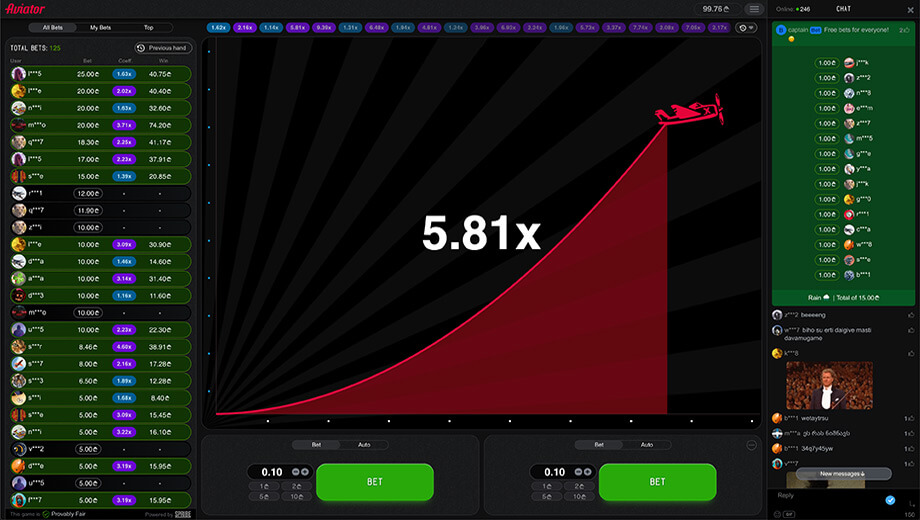
Aviator — SPRIBE. A red aircraft follows a rising curve while the multiplier grows. SPRIBE's official product page lists 97% RTP and describes live bets, chat and statistics. Its supplied screenshots show the multiplier beside other players' bets and cash-outs. Those displays provide social context; they don't tell you where the next round will end.
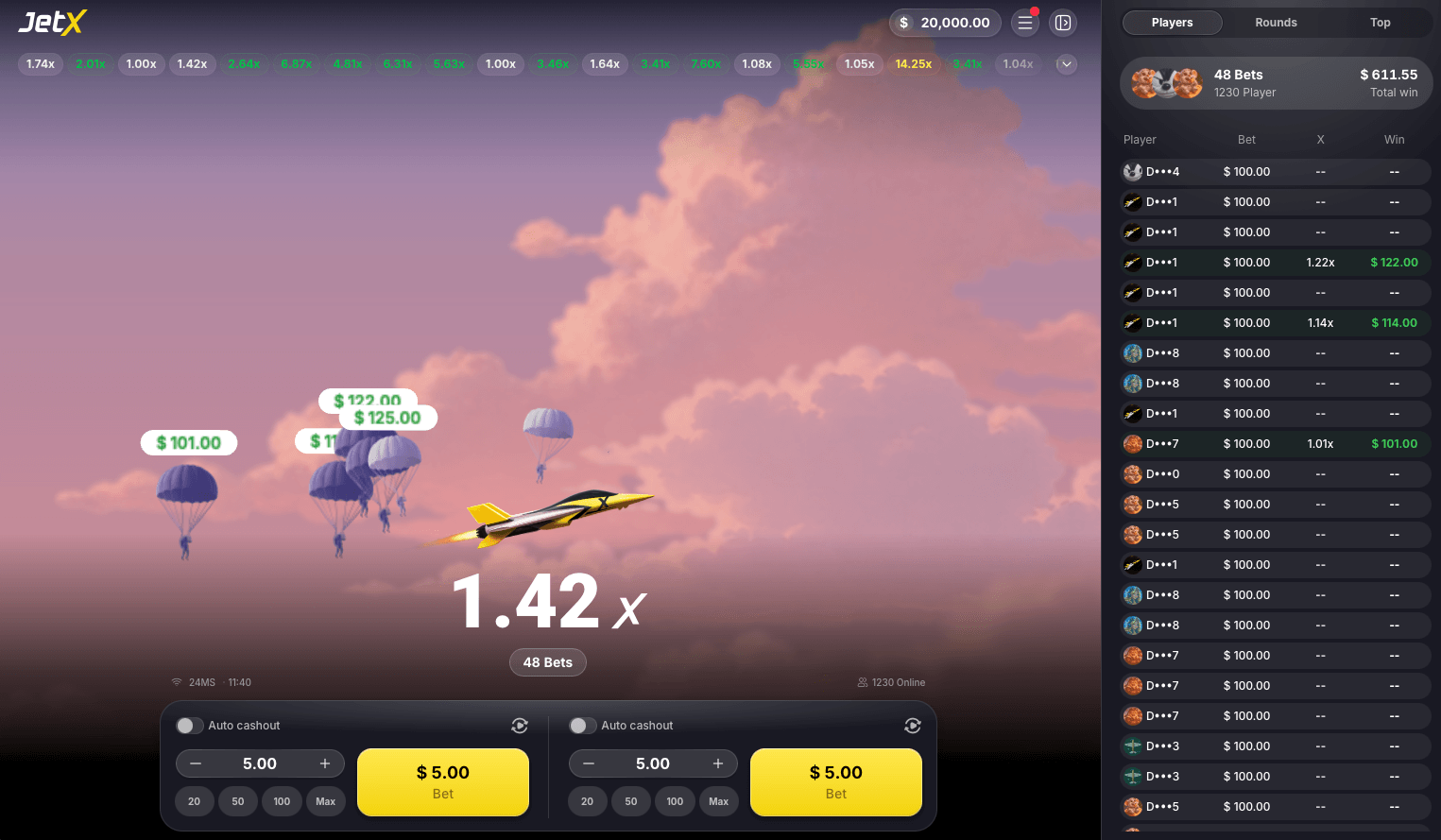
JetX — SmartSoft. JetX uses a flying jet and the same broad cash-out-before-the-round-ends decision. SmartSoft's current “New Era of JetX” page describes up to four simultaneous bets, auto cash-out and round history. Earlier versions use a different layout, so a screenshot or rule summary for one version may not match another. Read the help screen in the version actually offered rather than assuming every JetX installation has identical controls or returns.
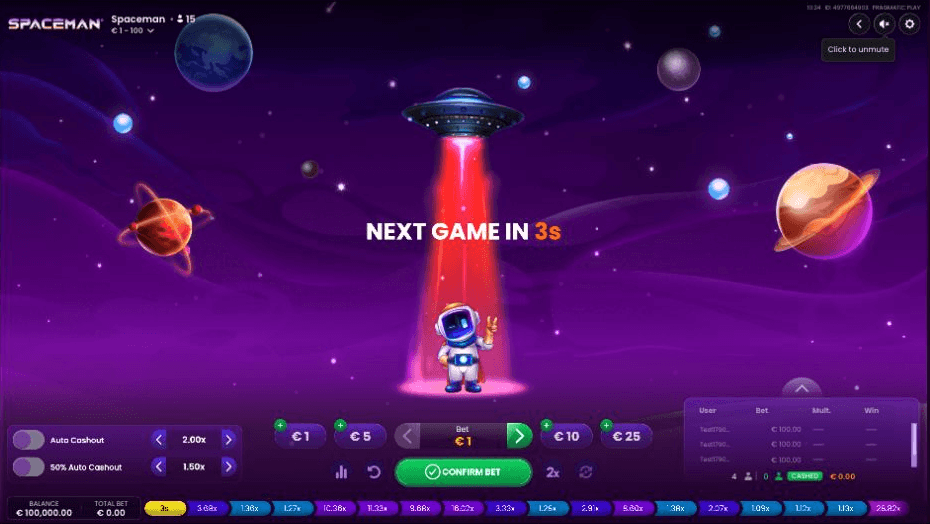
Spaceman — Pragmatic Play. An astronaut rises through space as the multiplier increases. The provider describes both automatic cash-out and a 50% cash-out option, allowing part of an active bet to be settled while the remainder continues under the game's rules. The continuing portion can still be lost; a partial cash-out is not protection for the whole wager.
Provider pages and screenshots were checked on 25 September 2026. Check the in-game rules for the current RTP, limits and settlement conditions.
Manual cash-out, automatic cash-out and connection problems
A manual cash-out depends on a request being accepted while the bet is still eligible to settle. The number visible on your screen may not be the multiplier at which the server processes that request. Animations, connection delays and the game's acceptance rules matter, so a click just before the displayed crash isn't by itself proof of a successful cash-out.
Where available, automatic cash-out lets you set a target multiplier in advance. If the round reaches that target under the game's settlement rules, the system settles the bet automatically. It removes the need to make that particular click; it doesn't ensure that the target will be reached. Check what happens when the crash and target share the same displayed value, because rounding and event order can matter.
Automatic cash-out and automatic betting are different features. The first settles a bet; the second places further bets. A setting that keeps staking money can increase your total exposure even if each individual stake is small.
Disconnection rules also differ. Don't assume that closing a tab cancels an accepted bet, that an automatic target stops working, or that a connection failure produces a refund. If a round is disputed, retain its ID, time, stake, target and settlement record, then ask support which rule was applied. A screenshot helps document what you saw but may not establish the order of events on the server.
What RTP means in a crash game
RTP is the theoretical proportion of total stakes returned as payouts over a very large amount of play under the relevant rules. A 97% RTP corresponds to a 3% house edge. It doesn't mean a 97% chance of winning, or that a $100 deposit will leave you with $97.
The distinction between deposits and stakes matters. Reusing the same balance across rounds creates additional turnover. At an assumed 3% edge, $1,000 in total stakes has an expected loss of $30. Your actual result may be far above or below that amount, including losing the available balance. The calculation describes an average, not a session forecast or loss limit.
There is no single RTP for the crash category. Check the exact game and rules, including any explanation of how target choices, maximum payouts or additional features affect the advertised return. A headline percentage alone is not enough to infer the probability of reaching every multiplier.
Why a lower target doesn't necessarily improve the return
A lower cash-out target can win more frequently while paying less each time. A higher target offers a larger payout but is reached less often. An illustrative model shows how both choices can have the same expected return.
Suppose a fictional game is designed so that the probability of a successful cash-out at target M is 0.97 ÷ M. This is an explicit assumption for the example, not a verified formula for Aviator, JetX or Spaceman. Ignore rounding, payout caps and other special rules in this model.
| Cash-out target | Chance of reaching it in this model | Total payout on a successful $1 bet | Expected return per $1 staked |
|---|---|---|---|
| 1.20× | 80.83% | $1.20 | $0.97 |
| 2.00× | 48.50% | $2.00 | $0.97 |
| 5.00× | 19.40% | $5.00 | $0.97 |
| 10.00× | 9.70% | $10.00 | $0.97 |
At 2.00×, for instance, 0.485 × $2 gives an expected return of $0.97. The other targets produce the same result because their larger or smaller payouts are offset by their probabilities. The cash-out choice changes the pattern of results without removing this model's 3% edge.
Frequent wins can be misleading when the profit on each is small. At 1.20×, a winning $5 bet earns $1 profit, while a losing bet costs $5. One loss cancels five such wins. Actual games may have different probability distributions, so use their own rules rather than applying this example universally.
Can history, predictors or betting systems beat crash games?
In a properly implemented game with independent random rounds, a run of low multipliers doesn't make a high result due. Waiting through several rounds changes when you bet, not the underlying odds of an independent next round. A history panel records outcomes; it isn't a forecast.
The same limitation applies to a “predictor”, AI signal or paid group claiming to identify the next crash from past multipliers. Historical results alone don't establish an ability to predict independent outcomes. Screenshots of successful calls aren't evidence of a reliable method: you would need the complete record, including unsuccessful predictions and their timing. Don't hand over account credentials, wallet recovery phrases or remote access to someone selling such a tool.
Increasing stakes after losses can make the next loss much more expensive. It cannot make a negative-expectation bet favourable, and finite funds and stake limits eventually constrain any progression. Using several bet panels in the same round also doesn't create independent outcomes: each unsettled bet is exposed to the same crash. Different targets divide the exposure but don't eliminate it.
What “provably fair” does—and doesn't—show
Some crash games provide a way to check a completed result against committed cryptographic inputs and a published calculation. When correctly implemented and verified, that can provide evidence that the recorded result follows the disclosed process. It is a retrospective check, not a preview of the next multiplier.
It doesn't establish that the payout distribution favours you, that the casino will pay a withdrawal, or that the operator is authorised where you live. Nor should you assume that every crash game uses the same verification system. Read the specific explanation and distinguish result verification from the wider operator and licensing checks.
Keeping the pace and stakes in view
A rapid succession of rounds can make a modest stake add up quickly. For example, 100 bets of $2 amount to $200 staked, even if some of that money is recycled winnings. Multiple active panels add to that total. Track the amount committed across all bets rather than looking only at the smallest number on a button.
Before risking money, check the minimum and maximum stake, maximum payout, cash-out and disconnection rules, RTP and any bonus restrictions. A demo can help explain the controls, but a successful demo session doesn't predict a profitable real-money session. The presence of a familiar provider's game also doesn't establish that a particular casino is authorised for your location.
If you choose to play where it is lawful, set a money limit you can afford to lose and a time limit before starting. Stop rather than increase stakes to recover a loss. If repeated rounds make those limits difficult to follow, take a break and use account restrictions, self-exclusion or gambling support. No target multiplier makes crash games a dependable way to earn money.