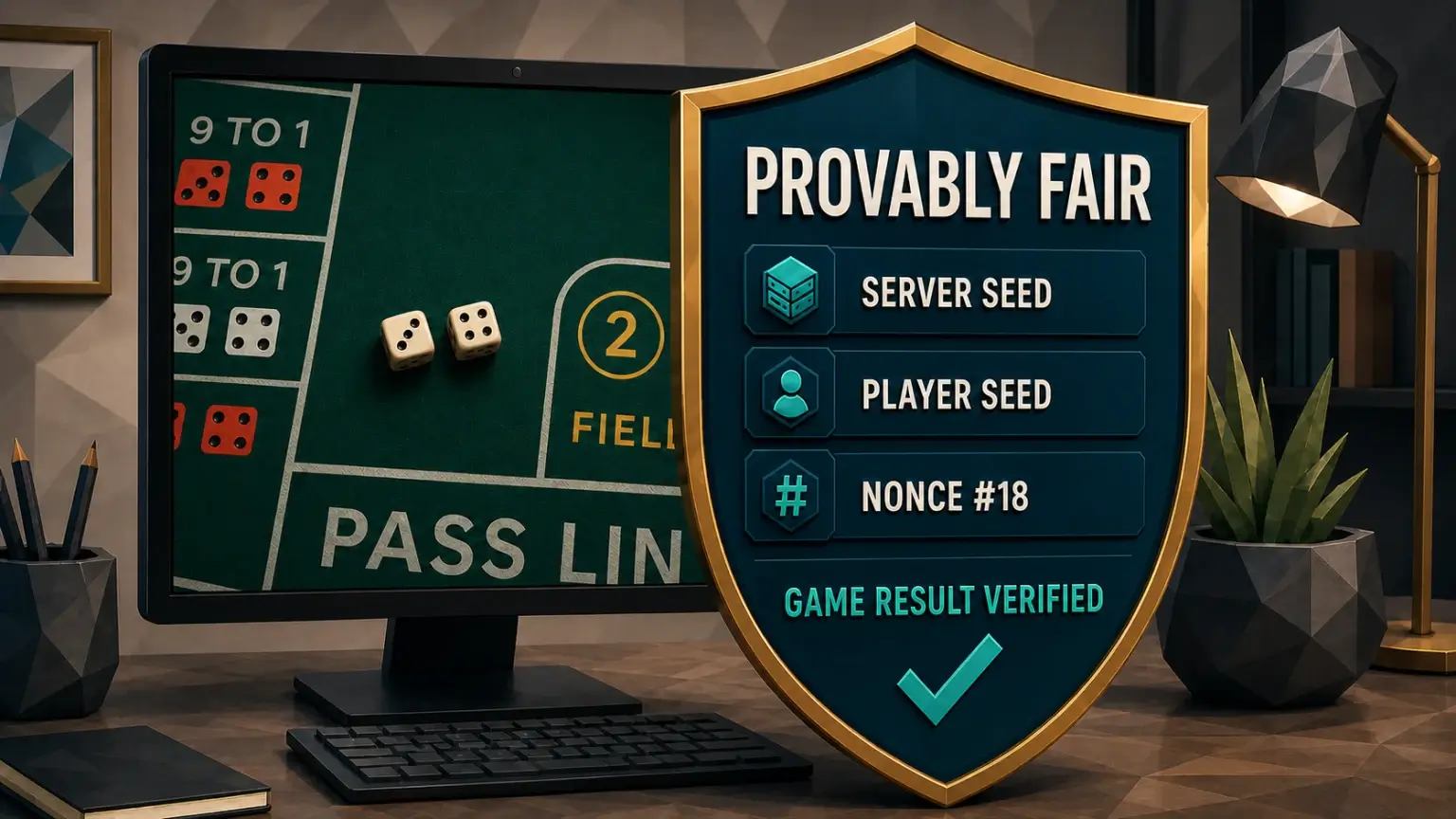
Provably fair games are most closely associated with crypto casinos, which commonly promote independently checkable results alongside digital-asset payments. A provably fair game gives the player enough information to check how a recorded result was produced. A common system commits the operator to a secret server seed before the bet, combines that seed with a player-side seed and a round number, and later reveals the secret so the calculation can be repeated.
If the recomputed result matches the game record, the evidence can show that the disclosed inputs and published algorithm lead to that result. It can also show that the operator did not replace its committed server seed after seeing the outcome.
That connection explains why this guide sits in the Crypto Casinos category, but the mechanism itself uses cryptography rather than cryptocurrency and does not require a blockchain. It is useful, but narrower than the name can sound. “Provably fair” does not prove that a casino is licensed, that its advertised rules are legal, that the game offers favourable odds or that the operator will safeguard an account and pay withdrawals. It is one transparency mechanism, not a complete judgement about a casino.
What “Provably Fair” Means
Ordinary online casino games ask the player to trust systems they cannot see. A licensed market addresses that problem through technical standards, independent testing, operator controls and regulatory oversight. A provably fair game adds a different kind of evidence: it lets someone reproduce the calculation behind an individual result.
The term is most closely associated with crypto casinos and games such as dice, mines, limbo, Plinko and crash. However, the mechanism does not require cryptocurrency or a blockchain. It normally relies on familiar cryptographic tools, including secure hash functions and keyed hashes, running in ordinary software.
The broader guide to crypto casinos explains the payment, volatility, verification and operator risks of gambling with digital assets. This article deals only with the game-result proof.
The Commitment Comes Before the Result
The central idea is a commitment-and-reveal sequence.
Before a verifiable bet, the casino generates a secret value called the server seed. It then applies a cryptographic hash function—often SHA-256—and shows the resulting hash to the player. The hash acts like a fingerprint of the secret seed. It does not reveal the seed itself, so the player cannot use it to calculate upcoming results.
The casino has nevertheless committed to that particular seed. When the seed is revealed later, anyone can hash it again. If the new hash differs from the value shown before play, it is not the seed to which the casino originally committed.
A hash is not encryption. There is no decryption key that turns the displayed hash back into the secret. The useful property is that the same input produces the same digest, while a changed input produces a different one. The US National Institute of Standards and Technology’s Secure Hash Standard specifies SHA-256 and related algorithms used to create message digests.
Server Seeds, Client Seeds and Nonces
Most provably fair implementations use at least three inputs:
- Server seed: A secret generated by the operator. Its hash should be supplied before the relevant bets and the seed itself revealed afterwards.
- Client seed: A value associated with the player. A stronger, clearer implementation lets the player replace the platform’s default with a value of their own choosing.
- Nonce: A counter that changes for each bet made with the same seed pair. It prevents every round from producing the same output.
Some games also use a cursor or similar counter when one bet needs more random bytes than a single calculation supplies. A card game may need a long stream to shuffle and deal a deck, while a simple dice game may need only one converted number.
The precise order, punctuation and encoding of these inputs matter. seed:18 is not necessarily the same message as seed18, and text, hexadecimal and raw bytes can produce different results. A verification page must disclose the actual construction rather than saying only that it uses “SHA-256”.
Many systems use HMAC-SHA-256 or a related keyed-hash function to combine the inputs. NIST’s HMAC standard describes a keyed message-authentication construction using a cryptographic hash function and a secret key. The presence of a respected primitive is not enough by itself; the surrounding game implementation and the conversion from bytes to outcomes must also be correct and public.
How a Verifiable Round Usually Works
Implementations differ, but a transparent round normally follows this sequence:
- The casino generates a server seed and displays its hash.
- The player is shown a client seed and can ideally choose or change it.
- The bet record identifies the seed pair, nonce, game and algorithm version used.
- The system combines those inputs using the published cryptographic procedure.
- The resulting bytes are converted into the game event: a dice value, multiplier, card order, mine position or another defined result.
- When the seed pair is rotated or closed, the casino reveals the old server seed.
- The player hashes the revealed seed, confirms the earlier commitment and reruns the result calculation.
The server seed is normally revealed only after it is retired. Revealing an active seed could allow future results under that seed pair to be calculated before bets are placed.
A matching check is retrospective. It verifies a completed record; it is not a method for predicting the next result.
How to Verify One of Your Results
Start with the original bet record. Save the game name and version, bet ID, server-seed hash, client seed, nonce and any cursor or event number. Do this before rotating the seeds if the interface might stop showing part of the record afterwards.
Once the old server seed has been revealed:
- Apply the stated hash function to the revealed server seed.
- Confirm that the result exactly matches the server-seed hash displayed before the bet.
- Enter the revealed server seed, client seed, nonce and any other required input into the published verification algorithm.
- Check that the calculated random bytes match the recorded intermediate value, if one is supplied.
- Apply the game’s published conversion method and confirm the final cards, number, multiplier or positions.
Use an offline script or genuinely independent verifier when possible. A calculator hosted only by the same casino is convenient, but it still asks the casino’s current website to assess the casino’s past result. Open source code is most useful when the player or an independent specialist can inspect and run the same version that governed the bet.
Do not enter passwords, wallet recovery phrases, private keys or identity documents into a verifier. Result verification should need game seeds and round data, not control of a wallet or casino account.
The Outcome Conversion Matters as Much as the Hash
A correct hash proves that particular data was used. It does not automatically prove that the data was converted into a game result without bias.
Suppose a calculation produces a large hexadecimal number. The game still needs a rule that maps it to one of six dice faces, a position on a board or a crash multiplier. Poor scaling can make some outcomes slightly more likely than others. A card game also needs an exact, reproducible shuffle procedure rather than an unexplained claim that the hash “creates random cards”.
A useful disclosure therefore includes:
- the hash or HMAC construction;
- the exact input order and encoding;
- the way additional bytes are generated;
- the conversion from bytes to game events;
- the game rules and paytable; and
- a version identifier when the algorithm or game mathematics changes.
If any one of those pieces is missing, the player may be able to confirm the seed commitment without being able to confirm the displayed outcome.
What a Successful Verification Can Prove
When the system is correctly disclosed and the necessary records are complete, a successful verification can support several limited conclusions:
- the revealed server seed matches the hash committed before play;
- the recorded client seed, nonce and other inputs reproduce the calculated bytes;
- the published conversion maps those bytes to the recorded game result; and
- the operator could not substitute a different server seed after committing to the displayed hash without the mismatch being visible.
The sequencing is important. The player should be able to see the server commitment before the relevant bet, and ideally choose the client seed only after that commitment exists. If the casino controls every input or can choose a new server seed after learning the player’s contribution, the claim is weaker.
Verification also depends on a complete and authentic record. A player needs a reliable connection between the displayed commitment, the accepted bet and the result being checked. A mathematical match cannot repair missing bet IDs, unexplained seed resets or incomplete histories.
What “Provably Fair” Does Not Prove
Provably fair describes result generation, not the whole gambling service. A matching calculation does not establish:
- that the operator is licensed for the player’s location;
- that the public verifier matches all production code running on the casino;
- that the disclosed paytable or RTP is competitive;
- that the game’s house edge has been explained correctly;
- that a bonus term is reasonable or was applied fairly;
- that balances and personal information are secure;
- that the casino will process withdrawals reliably;
- that customer support or complaint procedures are effective; or
- that gambling with the game is affordable.
It also does not make a losing result suspicious or a winning result more likely. A fair random process includes losing streaks, clusters and results that look unusual in a small sample. The guide to RTP, house edge and volatility explains why a sound long-run model cannot predict or protect one session.
The label should therefore never replace the broader checks used to decide whether an online casino is safe and legitimate.
Provably Fair and Independently Tested Games Are Different
Provably fair verification and regulated game testing address overlapping concerns in different ways.
A provably fair system lets a player reproduce a particular disclosed result. Independent testing examines the game, random-number generation, scaling, mapping, source code, mathematics and controls against a regulator’s standards. Operational monitoring can then look for faults or unexpected performance across many rounds.
In Great Britain, the Gambling Commission’s RTS 7 standard requires random outcomes to be acceptably random and the mapping of random inputs to follow the stated probabilities and paytables. Its testing strategy includes third-party examination of game mathematics, source code, scaling and mapping before release for relevant products.
Ontario similarly requires games, random-number generators and critical components that determine and record bets to be approved or certified by a registered independent testing laboratory before use. The AGCO’s technology-certification requirements explain that obligation.
A licensed game does not need to expose seeds to every player to satisfy those regimes. Conversely, an offshore casino does not become licensed or independently supervised merely by placing a “provably fair” button beside a game. The broader guide to casino-game fairness explains how regulation, testing and operating controls fit together.
Check the Player’s Location as Well as the Code
In Great Britain, confirm the operator and website domain in the Gambling Commission’s public register. A cryptographic result check does not extend a licence to a different company, domain or market.
Canada does not have one national online-casino system. Ontario players should use an operator participating in the regulated provincial market and can check the current gaming sites in iGaming Ontario’s directory. Players elsewhere in Canada need to check the law and authorised services in their own province or territory.
Australian readers should not treat provably fair casino software as a route to lawful offshore play. ACMA states that the Interactive Gambling Act prohibits online casinos from being provided to people in Australia. Its Interactive Gambling Act guidance also explains that banned services must not be advertised in Australia. This article does not recommend using an offshore crypto casino from Australia.
A Practical Provably Fair Checklist
Before treating a game as independently verifiable, check whether:
- the server-seed hash is visible before the bet;
- the player can enter or replace the client seed;
- the bet record preserves the seeds, nonce, game version and result;
- the server seed is revealed after rotation;
- the full algorithm and outcome conversion are published;
- the same calculation can be run away from the casino’s own interface;
- changes to the game or verifier are versioned;
- the rules, paytable, RTP or house edge are available separately; and
- the operator, licence, payment terms and complaint route also withstand scrutiny.
Changing a client seed does not improve the odds. Rotating seeds does not reset a losing game into a winning state. Those actions change the input sequence, not the house edge or the amount it is sensible to risk.
What to Do if a Result Does Not Verify
First rule out a recording or input error. Confirm the exact game and algorithm version, whether the nonce starts at zero or one, the input order, text encoding, punctuation and whether a cursor was required. Check that the revealed server seed belongs to the same retired seed pair as the bet.
If the result still differs, preserve the original bet page, bet ID, timestamps, all seed values, the displayed commitment, the result, the verifier version and screenshots or exported records. Do not keep placing bets to see whether the problem repeats.
Ask the operator for a written technical explanation and identify the exact mismatch. Where the game was supplied through a regulated operator, use that operator’s formal complaint process and the correct external route for the player’s jurisdiction if the issue is not resolved.
A failed verification is a specific technical concern. It should be investigated precisely rather than turned immediately into a claim that every result or every casino game is manipulated.
The Useful Conclusion
Provably fair technology can replace one part of “trust us” with a calculation the player can repeat. The strongest implementations commit before play, include a genuine player contribution, preserve complete round data, disclose the outcome conversion and allow independent verification after the server seed is revealed.
That proof should be valued for what it actually establishes. It can show that a disclosed algorithm and set of inputs reproduce a recorded result. It cannot make the odds favourable, make gambling a source of income or prove that the business holding the player’s money is legal and trustworthy.
Check the result mechanism, then check the casino.