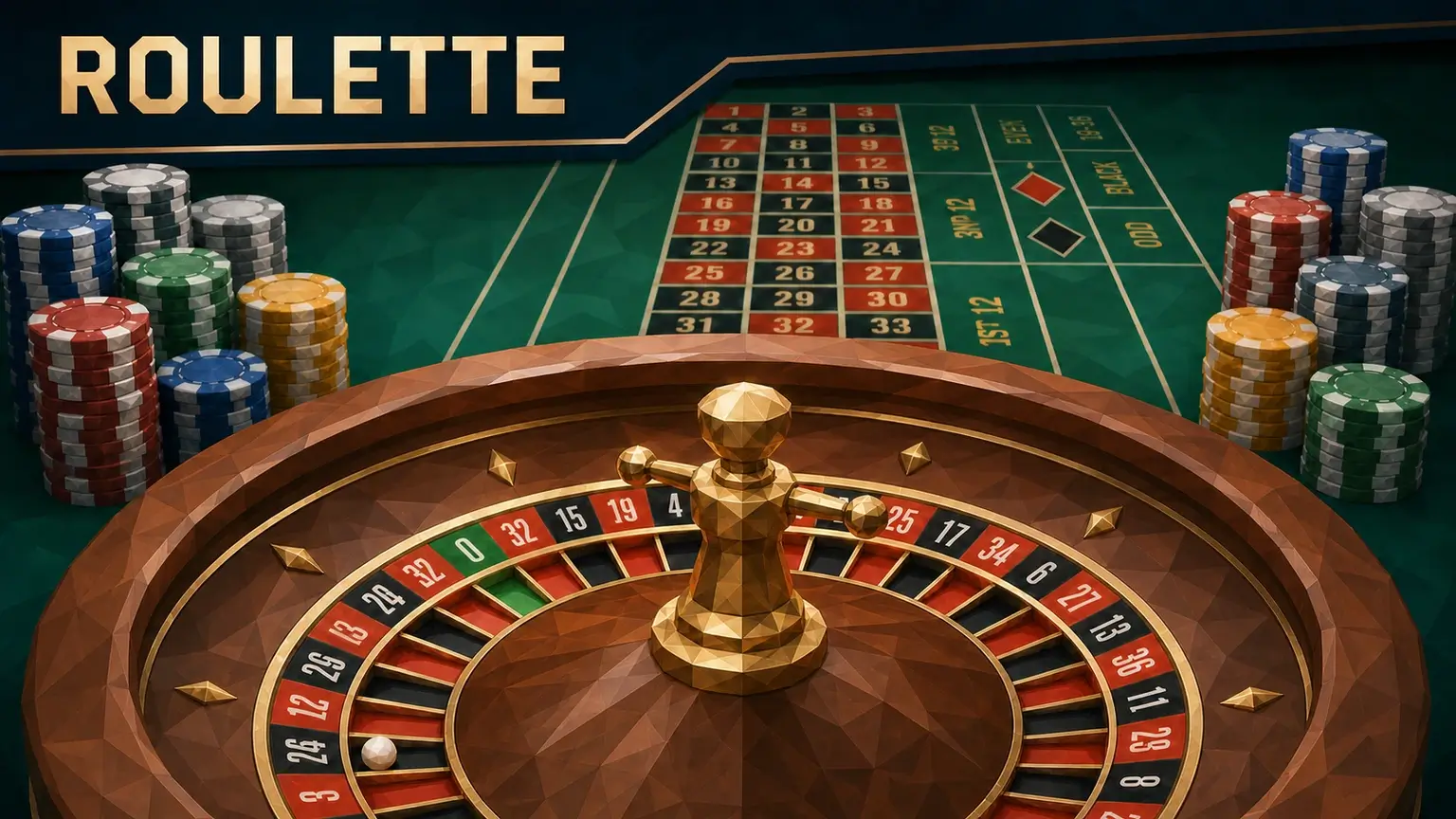
Roulette is built around one uncertain result: the numbered pocket in which the ball comes to rest. Players can bet on a single number, a small group or broad properties such as red, black, odd or even. Bets covering fewer pockets pay more; bets covering more pockets win more often but pay less.
The wheel version matters before any chip is placed. A European or French wheel normally has one zero, while an American wheel has zero and double zero. That extra pocket almost doubles the house edge on standard bets.
The Wheel and Betting Layout
A single-zero wheel contains 37 pockets: numbers 1 to 36 and one green zero. A double-zero wheel contains 38: 1 to 36, zero and double zero. The red and black assignments are fixed, while the zero pockets are green.
The betting layout arranges 1 to 36 in three columns of twelve numbers. The zero area sits above them. Inside bets are placed on individual numbers or the lines between them; outside bets sit around the main grid and cover larger groups.
The numerical order on the layout is not the order around the wheel. This matters for “neighbour” or racetrack bets, which cover adjacent wheel pockets rather than adjacent boxes on the table.
How a Roulette Round Works
Players place bets during the betting period. At a live table, the dealer or croupier spins the wheel in one direction and the ball in the other, then closes betting before the ball settles. In a digital RNG version, the interface accepts bets until its timer closes and the software determines the result under the game rules.
When the winning pocket is confirmed, losing chips are collected and winning bets are paid. Straight-up and combination bets that include the winning number are settled according to the payout table. A new betting period then begins.
Online games should explain how late bets, interrupted connections, disputed results and cancelled rounds are handled. In live roulette, the video is useful context, but the operator's recorded game result and transaction history are normally the formal account record.
Inside Bets and Payouts
Inside bets cover one to six numbers on the main grid:
| Bet | Numbers covered | Standard payout |
|---|---|---|
| Straight up | 1 | 35 to 1 |
| Split | 2 | 17 to 1 |
| Street | 3 | 11 to 1 |
| Corner | 4 | 8 to 1 |
| Six line | 6 | 5 to 1 |
A straight-up chip sits on one number. A split sits on the border between two adjacent numbers, a street covers one horizontal row of three, a corner sits where four numbers meet, and a six-line bet covers two adjacent streets.
Zero combinations vary with the layout. On a double-zero wheel, the five-number basket covering 0, 00, 1, 2 and 3 normally pays 6 to 1. It has a higher house edge than the wheel's other standard bets and should not be mistaken for an ordinary five-pocket equivalent of a six-line bet.
Outside Bets and Payouts
Outside bets cover twelve, eighteen or another broad group of numbers:
| Bet | Numbers covered | Standard payout |
|---|---|---|
| Dozen | 12 | 2 to 1 |
| Column | 12 | 2 to 1 |
| Red or black | 18 | 1 to 1 |
| Odd or even | 18 | 1 to 1 |
| 1–18 or 19–36 | 18 | 1 to 1 |
Zero and double zero are not included in red/black, odd/even, low/high, dozens or columns. If the ball lands in a zero pocket, those bets normally lose unless a special French rule applies to an eligible even-money wager.
Outside bets win more often than a straight-up number, but the payout is correspondingly smaller. On the same wheel, moving from an inside bet to a standard outside bet does not remove the house edge.
Why Zero Creates the House Edge
Consider a single-number bet on a single-zero wheel. There are 37 possible pockets, but a win pays 35 to 1 plus return of the stake. The payout is priced as though there were only 36 outcomes. The extra zero creates the casino's expected advantage.
For standard bets on a single-zero wheel, the house edge is 1/37, approximately 2.70%. This is true for a straight-up number, a dozen and an ordinary red/black bet because the payouts scale consistently with the numbers covered.
On a double-zero wheel, two of 38 pockets sit outside the standard even-money groups. The house edge is 2/38, approximately 5.26%, on standard bets. The five-number basket is worse: its 6-to-1 payout produces a house edge of approximately 7.89%.
Some casinos offer triple-zero wheels. With 0, 00 and 000 among 39 pockets, standard bets carry a house edge of approximately 7.69%. Check the actual wheel rather than assuming every game labelled American roulette stops at double zero.
European, French and American Roulette
European roulette normally means a single-zero wheel with the standard layout and payouts. It is the simpler comparison choice because its base house edge is lower than double-zero roulette.
French roulette also uses a single-zero wheel but often presents French bet names, a racetrack layout and rules such as la partage or en prison for even-money bets. The physical wheel does not by itself guarantee those rules; they must appear in the table information.
American roulette uses a double-zero wheel and includes the 00 pocket and five-number basket. Online lobbies sometimes use the labels loosely, so inspect the wheel and help screen before relying on the title.
La Partage and En Prison
La partage applies to eligible even-money bets when zero wins. Instead of losing the entire stake, the player receives half back. On a single-zero wheel, that reduces the house edge on those bets from about 2.70% to about 1.35%.
Under en prison, an eligible even-money bet is held or “imprisoned” after zero. The next spin decides whether it is returned or lost under the table's detailed rule. Some versions have additional conditions or handle repeated zeros differently.
These rules usually apply only to red/black, odd/even and low/high wagers, not dozens, columns or inside bets. Read the exact table rules; French presentation alone does not prove that either concession is active.
Announced and Racetrack Bets
French-style tables may allow bets based on sectors of the wheel. Common examples include voisins du zéro, tiers du cylindre and orphelins. They place a defined group of splits, corners and straight-up bets across neighbouring wheel pockets.
These calls are packages of ordinary wagers, not a separate way to beat the wheel. The total stake is divided into several chips, and the return depends on which component wins. Check the chip count and coverage shown by the interface before confirming the bet.
Neighbour bets are more flexible: a selected number is covered together with a chosen number of pockets on each side of it on the wheel. Adjacent boxes on the number grid are not the same thing.
Digital RNG and Live Roulette
Digital and live roulette use different fairness controls: digital roulette generates the result in software, while live roulette streams a physical wheel from a studio. Both should publish the wheel type and rules, but they are evaluated as different game models.
The presentation changes, but no format removes the house edge. A fast RNG table can expose a budget to more spins per hour, while live tables add dealing time and betting cut-offs. Lightning-style multipliers and side features alter payouts and probabilities; their rules should be evaluated as a different game model, not ordinary roulette with free extra value.
Use a casino authorised for your location and check the exact game's rules, wheel and payout table. A live feed or familiar studio brand does not establish that the operator offering access is licensed.
Why Roulette Systems Do Not Change the Mathematics
Martingale, Fibonacci, d’Alembert and other staking systems change the size or sequence of bets after wins and losses. They do not change the wheel probabilities or turn roulette into dependable income.
A progression can produce many small winning sessions followed by a loss large enough to erase them. Table limits, finite bankrolls and the zero pockets prevent indefinite doubling. Reversing the system or switching colours does not solve those constraints.
Wheel histories do not predict independent spins. Five black results do not make red due, and a number described as “hot” has no special claim on the next round. A biased physical wheel is an operational fault for a casino to detect and correct, not a practical strategy for ordinary online play.
Comparing Bets Sensibly
The first useful comparison is the wheel: single zero is mathematically better for the player than double or triple zero under otherwise identical standard rules. La partage or en prison can make eligible even-money bets on a single-zero table better again.
After that, choose a bet based on the outcome spread you understand and can afford. Inside bets trade a lower chance of winning for a larger payout. Outside bets win more often but cannot turn a negative-expectation game positive.
Placing several overlapping bets may smooth some results, but it also increases the total amount staked. Always look at the combined cost of the layout, not the size of one chip.
What to Check Before Playing
Confirm all of the following in the table information:
- whether the wheel has one, two or three zero pockets;
- the total stake placed across all positions;
- the payouts for standard and special bets;
- whether la partage or en prison applies and to which bets;
- the minimum and maximum limits for inside and outside wagers;
- whether multipliers or side features change the ordinary model; and
- how late bets, disconnections and cancelled rounds are settled.
Set a loss limit before the first spin. Roulette has no playing decision that can overcome its payout structure, so chasing, increasing stakes and switching systems add exposure rather than correcting earlier results.