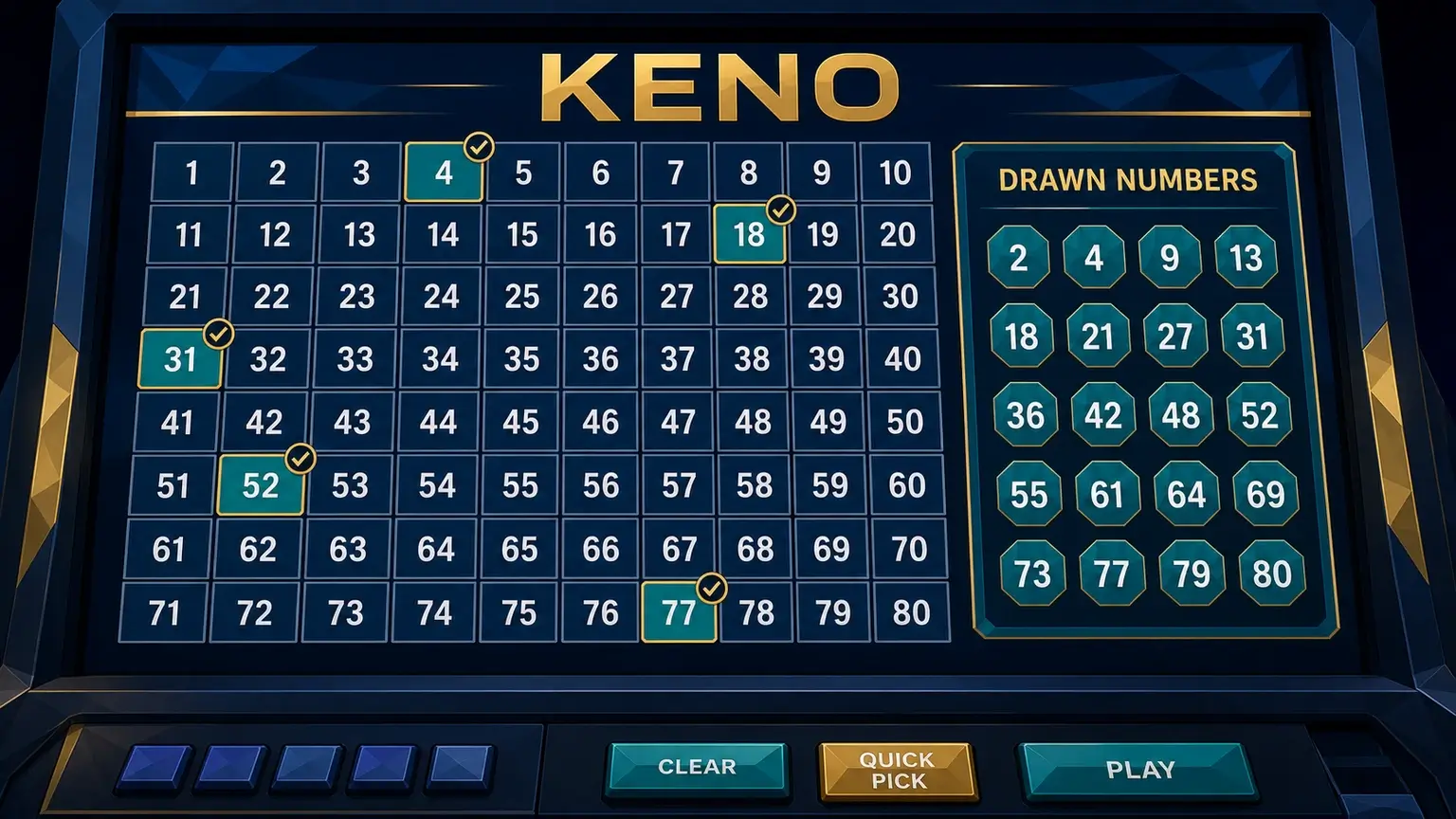
Keno is a number-draw game. In its common form, a player selects a group of numbers from 1 to 80, the game draws 20 numbers without replacement, and the payout depends on how many selections match. The selected quantity is called the number of spots, while each match is a hit.
The draw model is straightforward. The value is not. Operators choose different hit tables, bonus features and payouts, so two games using the same 20-from-80 draw can have materially different returns.
How a Standard Keno Round Works
First choose how many spots to play, subject to the game’s limits. Mark that many distinct numbers on the 80-number field or use Quick Pick to generate them. Select the stake and number of consecutive draws, then confirm the total cost.
The game draws 20 different numbers. The ticket is settled by finding the intersection between the selected set and the drawn set. A five-spot ticket with three matching numbers has three hits; whether that pays anything depends entirely on the five-spot paytable.
Some games award prizes for zero hits on certain tickets. Others begin paying only at two, three or more hits. The rules must be read before the stake is placed.
Spots, Hits and Payout Tables
Choosing more spots does not simply create a larger version of the same bet. Each spot count has a separate distribution of possible hits and its own payout row.
A paytable should state whether listed figures include return of the stake or show winnings in addition to it. It should also identify stake multipliers, maximum-win caps and whether a bonus changes the ordinary result.
For illustration, a five-spot game could pay on two, three, four and five hits, while another could pay nothing on two but more on four. The second is more volatile, but neither can be judged without multiplying every possible payout by its probability.
The Probability of a Hit
In a standard 20-from-80 draw, every individual selected number has a 20 in 80, or 25%, chance of appearing. Matches within a multi-spot ticket are not independent, because the draw contains exactly 20 distinct numbers.
For a ticket with s selected spots, the probability of exactly k hits is calculated by choosing k winners from the selected numbers and the remaining drawn numbers from the unselected field, divided by all possible 20-number draws. This is a hypergeometric probability rather than a series of coin flips.
The approximate outcomes for a five-spot ticket are:
| Hits | Probability | Approximate frequency |
|---|---|---|
| 0 | 22.7184% | 1 in 4.40 |
| 1 | 40.5686% | 1 in 2.47 |
| 2 | 27.0457% | 1 in 3.70 |
| 3 | 8.3935% | 1 in 11.91 |
| 4 | 1.2092% | 1 in 82.70 |
| 5 | 0.0645% | 1 in 1,551 |
These are draw probabilities, not prize probabilities. A two-hit result pays only if the chosen five-spot table says it does.
For scale, matching all ten numbers on a ten-spot ticket occurs with probability of about 0.0000112%, or roughly 1 in 8.9 million, under the same standard draw. A large top prize reflects a rare event; it does not reveal the overall return.
How the House Edge Is Calculated
Expected return is found by multiplying the probability of every outcome by its total return, adding those values and comparing the result with the stake. House edge is 100% minus that return percentage.
For example, if a complete paytable returns an average of £0.75 for every £1 staked over the long run, its theoretical RTP is 75% and its house edge is 25%. This does not mean each £1 ticket loses 25p. Most tickets will produce a different result, while the average emerges only over a very large number of plays.
There is no useful universal keno house-edge figure. Lottery keno, casino keno, video keno and bonus variants publish different tables. Some official products are designed around a 50% prize payout, while others return more or less. Quote only the figure for the exact game and current table.
Why the Top Prize Is Not Enough
A game may advertise a very large amount for ten out of ten while offering weak returns for the far more common results. Another may have a smaller jackpot but pay more frequently. Comparing only the maximum ignores nearly all the expected-value calculation.
Check whether the top amount assumes the maximum stake, a multiplier purchase, a progressive contribution or an additional bonus event. Also check whether it is paid as cash, instalments or bonus credit and whether it is capped across simultaneous tickets.
Quick Pick, Favourite Numbers and Systems
Every valid combination of a given spot count has the same chance in a fair draw. Quick Pick, birthdays, geometric patterns and “hot” or “cold” numbers therefore have identical mathematical status.
Past draws do not make a number due. A number that appeared repeatedly can appear again, and a long-absent number is not pushed closer to selection. Tracking history can be entertaining, but it cannot alter a random draw without evidence of a fault or bias.
Wheeling systems spread a larger set of numbers across several tickets. They may guarantee that certain matches are represented if enough chosen numbers are drawn, but the guarantee is purchased through additional combinations. It does not overcome the paytable’s house edge.
Multi-Draw, Bonus and Progressive Keno
Multi-draw tickets repeat the same selection for a chosen number of future draws. The convenience does not improve probability, and the full multi-draw cost is committed at purchase unless cancellation is expressly allowed.
Bonus keno may apply a random multiplier or require an extra stake. Progressive keno diverts value into a growing jackpot with a specified trigger. These variants need their own paytable and should not be judged from the base game alone.
Casino, Lottery and Online Variants
Traditional casino keno may use scheduled draws and paper tickets. Video keno resolves individual rounds on a machine, while online versions can use RNG animation, live draws or results shared across a network. Lotteries may set draw times, sales cut-offs and claim periods in regulation.
The familiar 80-number field and 20-number draw are common, not universal. Some games alter the field size, numbers drawn, permitted spots or prize pool. If those inputs change, the probabilities in this guide no longer apply.
Randomness and Result Records
A regulated digital game should use tested random generation or a controlled physical draw, prevent duplicate numbers within one draw and retain enough information to resolve disputes. The ticket should show the selected numbers, stake, draw identifier and result.
Animation is presentation. The official result may be generated before balls or tiles finish moving on screen. Read the rules for the authoritative record and for interrupted or delayed games.
What to Check Before Playing
Confirm the field and draw size, permitted spots, complete hit table, whether returns include the stake, maximum win, bonus cost and total multi-draw commitment. Look for the published theoretical return for that exact version, where available, and check draw IDs, cancellation rules and claim deadlines.
Keno can combine a low ticket price with a high house edge and rapid repeated play. Judge the total amount staked across all spots, multipliers and draws. Set a limit in advance and do not add tickets to recover a run of misses.