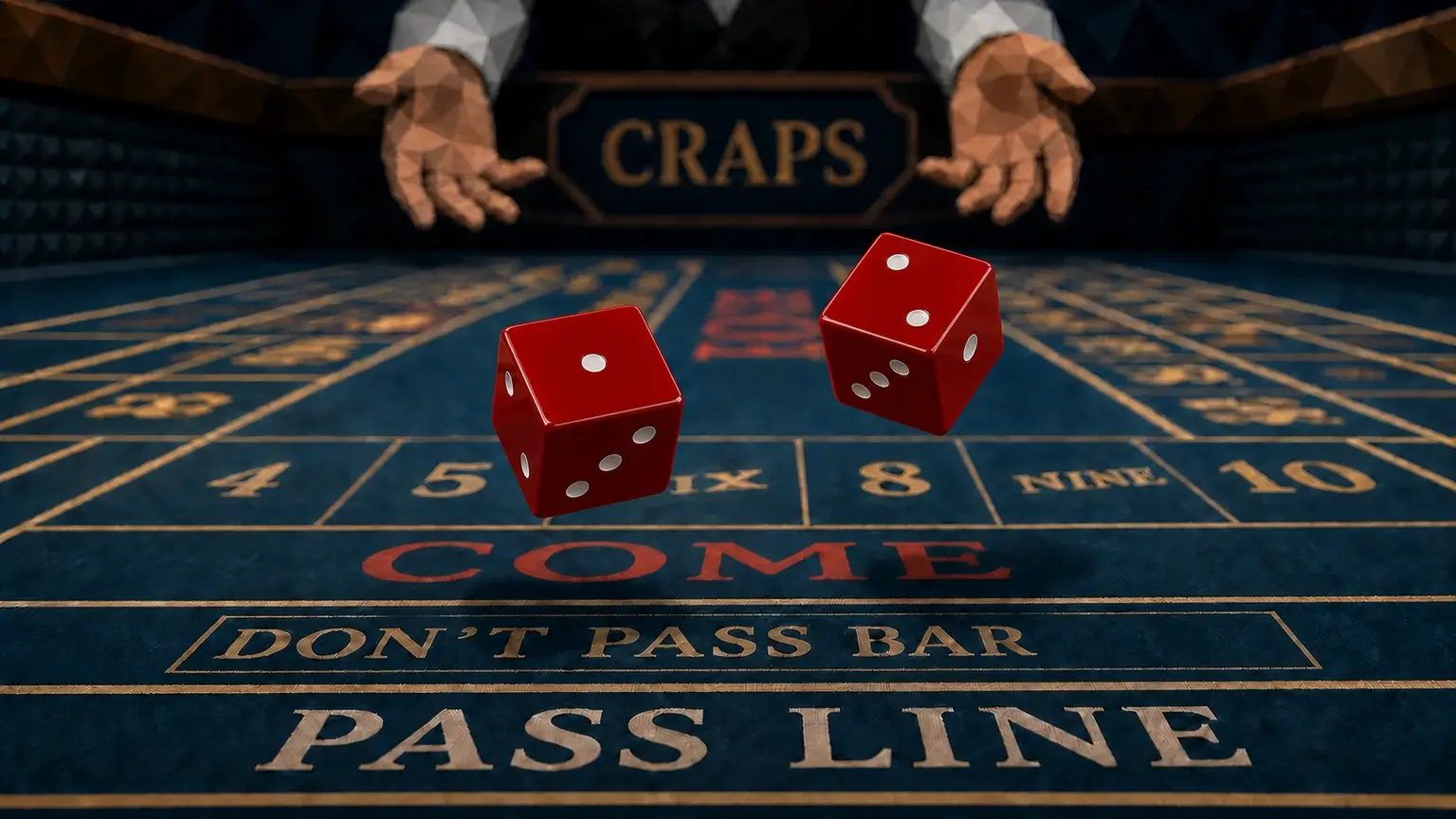
Craps is played with two dice and a table full of wagers that do not all follow the same rules. The central game is much simpler than the layout suggests: a come-out roll either ends the decision immediately or establishes a point, after which the shooter tries to repeat that point before rolling a seven.
The important distinction is between the dice result and the bet placed on it. A seven can win one wager and lose another on the same roll. No general rule such as “seven always loses after the come-out” describes every area of the table.
The Table, Shooter and Dice
At a physical table, one participant is the shooter and rolls two dice. The dice must normally hit the opposite wall of the table. Other players may bet without shooting. The shooter continues until a seven ends an established point, a result known as seven-out, and the dice then pass to the next eligible player.
Online RNG craps reproduces the bet settlement in software. Live and bubble versions use physical or automated dice. The table rules should explain how rolls are generated, when betting closes and how interrupted rounds are handled.
The Come-Out Roll and Point Cycle
A new Pass Line or Don’t Pass decision begins with a come-out roll.
For a Pass Line bet, 7 or 11 wins immediately, while 2, 3 or 12 loses. Any 4, 5, 6, 8, 9 or 10 becomes the point. The dice keep rolling until the point repeats, which wins the Pass Line bet, or a 7 appears first, which loses it.
Once that decision ends, the next roll is a new come-out roll. Other bets can remain active or resolve on different schedules, so the puck showing ON or OFF is a useful indicator but does not control every wager.
Pass Line and Don’t Pass
The Pass Line is the usual starting bet. It pays even money and has an approximate house edge of 1.41% under standard rules.
Don’t Pass takes the opposite side with one important exception. On the come-out roll, 2 or 3 wins, 7 or 11 loses, and 12 normally pushes. If a point is set, Don’t Pass wins when 7 appears before the point and loses when the point repeats. Its standard house edge is about 1.36% when 12 is barred.
Some tables bar 2 rather than 12. Read the layout instead of assuming. Betting Don’t Pass is permitted at ordinary tables, although local etiquette is to avoid celebrating another shooter’s loss.
Come and Don’t Come Bets
Come and Don’t Come allow a player to begin a similar individual cycle after the table point has been established.
A Come bet wins on 7 or 11 and loses on 2, 3 or 12 on its first roll. Otherwise its number moves to the corresponding box and wins if that number repeats before 7. Don’t Come is the reverse, usually with 12 barred on its first roll.
Several Come or Don’t Come numbers can be active at once. A seven may therefore win a new Come bet while losing older Come bets already sitting on numbers. Settlement order matters, even though the same dice result controls them all.
Odds Bets Pay at True Odds
After a point is established, a Pass Line or Come bettor can usually take odds. A Don’t Pass or Don’t Come bettor can lay odds. These additional wagers have no built-in house edge when paid at the standard true-odds rates:
| Point | Pass/Come odds payout | Don’t odds stake needed to win 1 unit |
|---|---|---|
| 4 or 10 | 2 to 1 | 2 units |
| 5 or 9 | 3 to 2 | 1.5 units |
| 6 or 8 | 6 to 5 | 1.2 units |
“No house edge” applies only to the odds portion. The required line bet still carries its edge, and the combined stake is larger. Tables cap odds at levels such as single, double, 3-4-5 or ten times; the label should be explained in the rules.
Place, Buy and Lay Bets
A place bet backs a specific box number to appear before 7 without using a Come bet. Common payouts and approximate edges are:
| Place bet | Common payout | Approximate house edge |
|---|---|---|
| 6 or 8 | 7 to 6 | 1.52% |
| 5 or 9 | 7 to 5 | 4.00% |
| 4 or 10 | 9 to 5 | 6.67% |
Buy bets pay at true odds less a commission, while lay bets back 7 to arrive before a chosen number and also involve commission. Whether the commission is charged when the bet is made or only when it wins materially changes the return. Minimum chip multiples also affect whether the displayed payout can be made exactly.
Proposition and One-Roll Bets
The centre of the layout contains bets on particular totals, combinations or the next roll. Their larger headline payouts do not mean better value.
| Example bet | Common payout | Approximate house edge |
|---|---|---|
| Field, with 2 and 12 paying 2 to 1 | 1 to 1; 2 and 12 pay 2 to 1 | 5.56% |
| Field, with either 2 or 12 paying 3 to 1 | Varies | 2.78% |
| Hard 6 or Hard 8 | 9 to 1 | 9.09% |
| Hard 4 or Hard 10 | 7 to 1 | 11.11% |
Horn, any craps, any seven, hop and bonus bets need their own paytables. Names and payouts vary, particularly online. Check the exact rules rather than transferring a percentage from another table.
House Edge and Average Cost
House edge is the average fraction of initial stakes retained over a very large number of resolved bets. It does not predict a short session. A 1.41% edge means an average theoretical loss of about £1.41 per £100 repeatedly wagered on Pass Line, not that any particular £100 session will lose that amount.
Adding odds reduces the blended edge as a percentage of the total money in action because the odds portion is paid fairly. It does not turn the combination positive, and it increases the amount exposed on each point.
Betting Systems Do Not Change the Dice
Pressing after wins, increasing after losses or selecting numbers because they are “due” cannot change the probability of the next independent roll. A progression changes the size and timing of stakes, not the house edge attached to the wager.
Dice control claims also require extraordinary evidence. Casinos enforce throwing rules and use table surfaces designed to keep the dice moving. A controlled-looking throw is not proof of a repeatable way to produce income.
What to Check Before Playing
Confirm the Pass and Don’t Pass come-out rules, the maximum odds multiple, place and proposition payouts, commission timing on buy and lay bets, minimum and maximum stakes, and whether bets are working on a come-out roll. For an online game, also check whether the result uses certified RNG software, a live feed or an automated physical device.
Start with the small group of bets you understand. The layout is not a checklist, and covering more areas usually increases the total amount at risk. Set spending and time limits before playing, and never increase stakes to recover earlier losses.