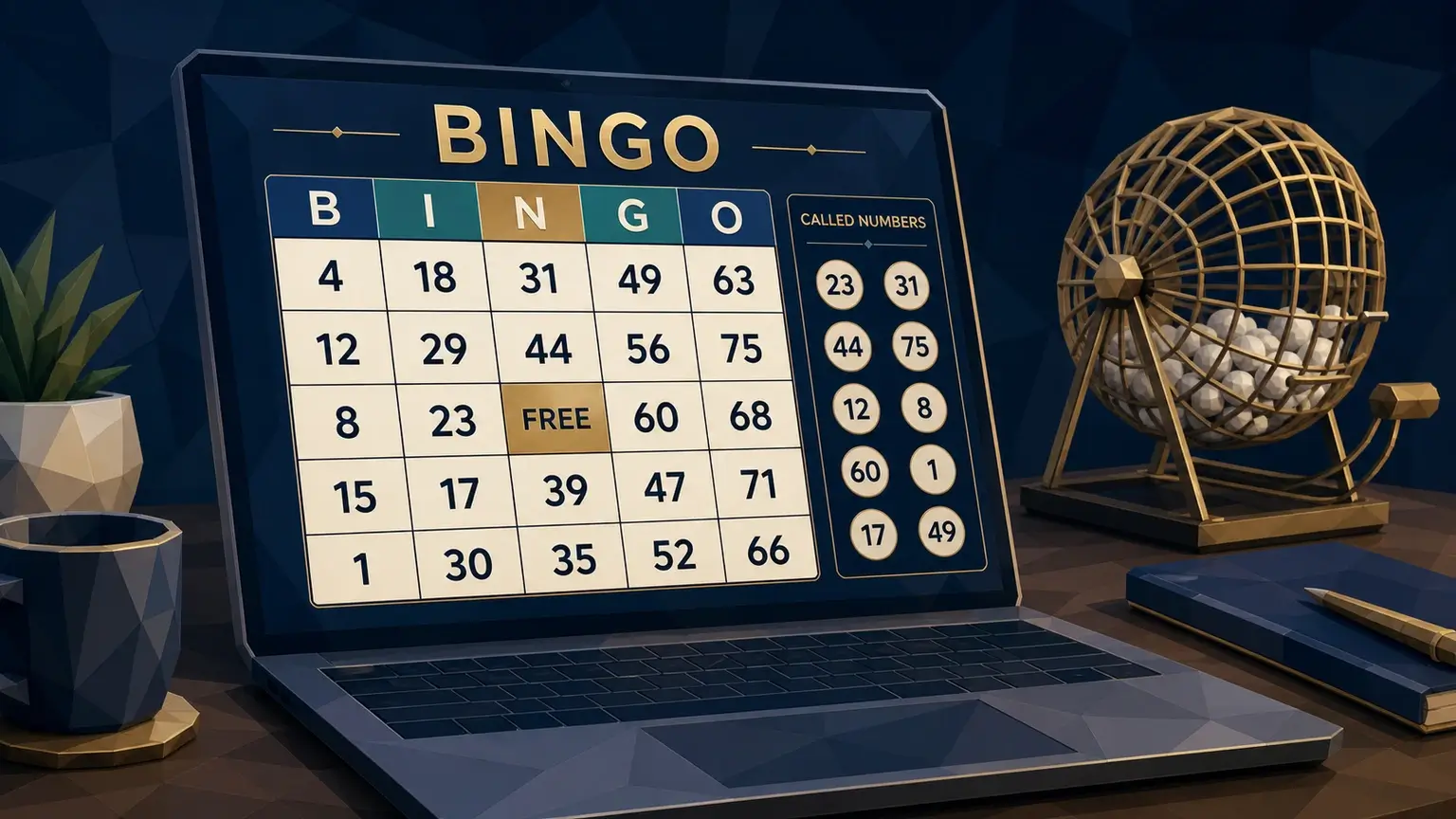
Bingo is a shared draw game in which players buy tickets containing numbers and try to complete a stated pattern as numbers are called. Online software can mark tickets automatically, but the essential result still comes from the random call sequence, the ticket layout and the prize rules announced before the game.
The word bingo covers several formats. A 75-ball card is not arranged like a 90-ball ticket, and the usual winning patterns differ. Always read the room information rather than relying on the title alone.
How an Online Bingo Round Works
Before sales close, the player chooses a room, stake and number of tickets. Each ticket has a unique number arrangement or reference. The game then draws numbers without replacement from its stated range and displays the calls.
Numbers matching a ticket are marked, commonly called daubing. A prize is awarded when a ticket completes the required pattern at the valid point in the call sequence. The game ends at the published winning condition or moves to the next prize stage.
Online games normally validate a winning ticket automatically. In some regulated markets, the player must still perform an interaction to participate, record a determinant or claim; auto-daub does not remove whatever legal participation requirement applies.
75-Ball Bingo Cards
A standard 75-ball card is a 5-by-5 grid headed B-I-N-G-O. It contains 24 numbers and a free centre space. The columns use these ranges:
| Column | Number range |
|---|---|
| B | 1–15 |
| I | 16–30 |
| N | 31–45, with the centre normally free |
| G | 46–60 |
| O | 61–75 |
Games may pay for one line, several lines, a full card or a displayed shape. Letters, frames, corners and themed patterns are valid only when shown in the game rules. A pattern may have rotations or may require one exact orientation.
90-Ball Bingo Tickets
A 90-ball ticket has three rows and nine columns. Each row contains five numbers and four blank spaces, for 15 numbers on a ticket. Numbers are arranged by decade ranges across the columns.
A traditional strip contains six tickets that together cover every number from 1 to 90 once. Buying a strip therefore guarantees that each called number appears somewhere on those six tickets, but it does not guarantee that one ticket completes a prize before competing tickets.
The usual prize stages are one line, two lines on the same ticket and a full house of all 15 numbers. Exact prize order, tie handling and whether a game continues after each stage must be displayed.
80-Ball and Other Formats
Online 80-ball games commonly use a 4-by-4 card and colour-coded columns, with line, shape or full-card patterns. Operators also offer 30-ball speed games and themed variants.
These formats are less standardised than the familiar 75- and 90-ball structures. Confirm the number pool, card dimensions, winning pattern and maximum calls rather than assuming that a familiar interface uses familiar rules.
Calls, Patterns and Claims
A fair game needs a clear winning condition and end point. The pattern should be visible before ticket sales close, and the system should determine a win from the ticket and call history rather than from how quickly a participant presses a button.
If multiple tickets complete the same prize on the same call, the prize may be split. Some games pay the full stated amount to each winner, but this must be explicit. A fixed prize, a shared prize and a progressive jackpot are different promises.
In a hall, failing to call bingo before the next number can affect a claim under local rules. Online validation usually removes that timing problem, but connection and interruption rules still matter.
Auto-Daub and Pre-Buy Features
Auto-daub marks called numbers across purchased tickets. It reduces the clerical task and makes it practical to play several cards, but it does not improve any ticket’s probability. The underlying ticket either completes the pattern or it does not.
Pre-buy and favourite-room features can schedule entries into later games. Check the total commitment, cancellation cut-off and what happens if a room is merged or cancelled. Convenience can make spend less visible when many low-priced tickets are purchased together.
How Bingo Prizes Work
Fixed-prize games publish a set amount for a winning condition. Pari-mutuel or shared games divide a pool among qualifying winners. Networked bingo combines ticket sales or prize pools across several rooms or brands, while a progressive jackpot grows according to stated contributions and trigger rules.
Some jackpots require a full house within a limited number of calls. If it is not won, there may be a lower consolation prize or the jackpot may carry forward. The advertised maximum is not the same as the ordinary expected payout.
Review whether the prize is cash, bonus credit or another benefit, whether ties split it, and whether wagering or withdrawal conditions apply. Side games displayed beside bingo are separate products with separate stakes and returns.
Odds and the Number of Tickets
When tickets are generated fairly, buying more valid tickets gives more chances in that game, but it also increases the cost in the same proportion. It does not make an individual ticket luckier or ensure a profit.
Exact winning probability depends on the number of competing tickets, the ticket-generation method, the pattern and the prize stage. A room with fewer visible players is not necessarily easier if the game uses networked sales or computer-generated house tickets; the operator should explain the pool.
No choice of favourite numbers can influence a randomly generated ticket or call sequence. In formats where ticket selection is offered, a visually pleasing card has the same status as any other valid card unless the rules create a genuine structural difference.
Randomness and Ticket Integrity
Regulated online bingo should use acceptably random number generation and maintain reliable ticket and call records. Tickets must be distinguishable so that wins can be traced and duplicate identifiers cannot create ambiguity.
Random does not mean evenly spaced within a short game. Several numbers from one range or a long gap for another range can occur naturally. Past calls do not make an undrawn number “due” in the next independent game.
What to Check Before Buying Tickets
Confirm the ball format, ticket price, number of tickets selected, pattern or prize stages, sales closing time, tie rules and whether prizes are fixed or shared. Read the jackpot trigger, maximum-call condition and any bonus-credit terms. Check auto-daub, pre-buy, disconnection and cancelled-game rules.
Treat the combined basket as the stake, not the price printed on one ticket. Set a session budget before using multi-ticket or pre-buy controls, and avoid adding side games simply while waiting for calls.