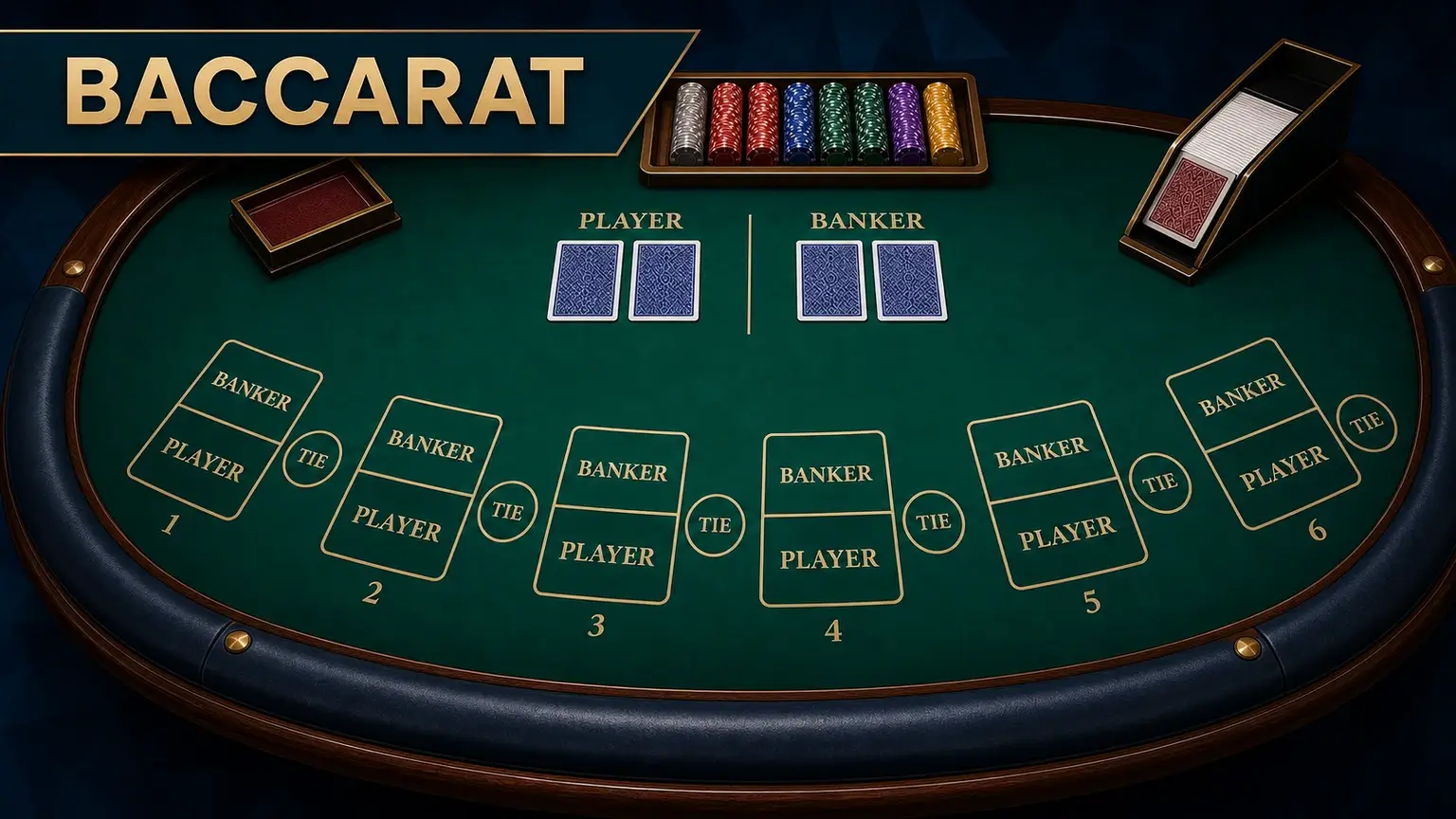
Baccarat looks formal, but the ordinary casino version asks the customer to make one main choice: bet on the Player hand, the Banker hand or a Tie. The dealer then completes both hands under fixed rules. The person placing a bet does not choose whether either hand takes a third card.
Most online and casino baccarat is punto banco. “Player” and “Banker” are names for the two hands, not descriptions of who receives the cards or who owns the casino. You can bet on either hand from one round to the next.
The Aim of the Game
The winning hand is the one with a final total closer to nine. Two or three cards may be used, and only the last digit of the sum counts.
Aces are worth one. Cards 2 to 9 use their face value. Tens, jacks, queens and kings are worth zero. Suits have no effect.
For example, 7 + 8 totals 15, so the baccarat value is 5. A king + 6 is worth 6, and 9 + 4 + 7 totals 20, so its value is 0. There is no “bust” total as in blackjack.
Player, Banker and Tie Bets
A Player bet wins when the Player hand finishes closer to nine. It normally pays 1 to 1. A Banker bet wins when the Banker hand finishes closer to nine. In traditional commission baccarat it also pays 1 to 1, less a 5% commission on the win.
A Tie bet wins when both hands finish with the same total. Common payouts are 8 to 1 or 9 to 1, but the exact table rule matters. When the round ties, ordinary Player and Banker bets normally push and are returned.
Side bets such as Player Pair, Banker Pair, Perfect Pair or bonus totals use separate rules and paytables. They should not be confused with the three main bets, and they commonly carry a higher house edge.
How a Round Is Dealt
Betting closes before any cards are exposed. Four initial cards are dealt alternately: the first and third form the Player hand, and the second and fourth form the Banker hand.
If either initial two-card hand totals 8 or 9, it is a natural. Both hands stand and the higher total wins, or the round ties if the totals match.
If there is no natural, the fixed tableau determines whether Player draws a third card and then whether Banker draws. The dealer applies this automatically. A live-table “squeeze,” where cards are slowly revealed, changes the presentation but not the result or drawing decision.
Player Third-Card Rule
The Player rule is straightforward:
| Player's first two cards | Action |
|---|---|
| Total 0–5 | Draw a third card |
| Total 6–7 | Stand |
| Total 8–9 | Natural; both hands stand |
The label Player does not mean that the customer decides. A third card is compulsory or prohibited according to the total.
Banker Third-Card Rule
If Player stands with 6 or 7, Banker draws on totals 0–5 and stands on 6–7. If Player draws, Banker's action depends on its own total and the value of Player's third card:
| Banker's first two cards | Banker draws when Player's third card is |
|---|---|
| 0–2 | Any value |
| 3 | Any value except 8 |
| 4 | 2–7 |
| 5 | 4–7 |
| 6 | 6–7 |
| 7 | Banker stands |
Totals 8 and 9 are naturals, so this table is never reached. The pattern may look complicated, but a player does not need to memorise it to place a standard bet. It is useful for checking that a live or digital round was completed correctly.
Why Banker Draws Differently
Banker acts after the Player rule has been resolved and may take the value of Player's third card into account. That information creates a small structural advantage for the Banker hand: before commission, it wins slightly more often than Player.
The traditional 5% commission adjusts the payout so the casino still has an edge on a Banker bet. This is why “Banker” is not an even-money advantage for the customer despite being the most likely of the two hands to win.
The drawing rules are not a strategy chosen by the casino after seeing the bets. They are fixed in advance and should be available in the table information.
Standard Payouts and House Edge
For a common eight-deck punto banco game with standard rules, the approximate figures are:
| Main bet | Common payout | Approximate house edge |
|---|---|---|
| Banker | 1 to 1 less 5% commission | 1.06% |
| Player | 1 to 1 | 1.24% |
| Tie | 8 to 1 | 14.36% |
| Tie | 9 to 1 | 4.84% |
These percentages are long-run mathematical expectations, not predictions for a session. Deck count and rule variation can move them slightly. The payout difference makes the Tie bet especially important to check: 9 to 1 is substantially better than 8 to 1, but it still carries a larger edge than the standard Player or commissioned Banker bets.
House edge is usually expressed against the initial stake, with tied Player or Banker rounds treated as pushes. Some sources quote “element of risk” figures that exclude tied money from action; those percentages are different and should not be mixed into an ordinary comparison.
Commission and No-Commission Baccarat
At a traditional table, a £10 winning Banker bet produces £10 gross winnings, then a 5% commission of £0.50, for £9.50 net winnings plus return of the stake. Live casinos may track commission until it is collected; online games normally deduct it automatically.
No-commission baccarat removes that calculation but changes another rule or payout to retain a house advantage. A common version pays only half on a Banker win with a total of 6. Other tables push a particular Banker result or use different conditions.
“No commission” therefore does not mean zero house edge or automatically better value. Read how Banker wins are settled and compare the complete paytable. A familiar title such as Super 6, EZ Baccarat or commission-free baccarat can represent a specific variant, not a cosmetic change.
Mini Baccarat, Live Baccarat and RNG Baccarat
Mini baccarat uses a smaller table and faster dealer-led format, but the standard Player, Banker and Tie mechanics can remain the same. Full-size baccarat may let selected customers handle or squeeze the cards, yet the tableau still controls the draw.
Live online baccarat streams physical cards from a studio. RNG baccarat uses software-generated card outcomes and animated dealing. Both should display the rules and keep transaction records, but their technical controls differ: live games depend on physical dealing, surveillance and card recognition, while digital games depend on tested random generation and correct mapping.
Speed can change the financial experience even when the house edge is identical. A faster table allows more money to be staked per hour, so compare round pace and total spend rather than looking only at the minimum bet.
Side Bets Need Separate Evaluation
Pair, suited-pair, total-card and margin-of-victory wagers can make the layout look more varied. They are separate games layered onto the same deal, with their own probabilities and often large top payouts.
A dramatic payout does not show value. Check the exact trigger, payout and house edge for that table. Two casinos may use the same side-bet name with different paytables, and one live feed may offer side bets not present on another interface.
Combining a main bet with several side bets also raises the total stake per round. The £5 chip shown on each position is not the relevant budget figure if four positions have been covered.
Scoreboards Do Not Predict the Next Hand
Baccarat tables often show roads or scoreboards recording sequences of Player, Banker and Tie results. These displays describe the past. They do not change the shoe or reveal that one side is due.
Patterns such as streaks, chops and repeats will appear naturally in random sequences. Betting with a streak, against it or according to a progression does not alter the fixed payouts and probabilities.
Cards already dealt can change the remaining shoe's composition by a small amount, but punto banco offers no playing decision comparable to blackjack strategy. Practical attempts to exploit those changes are constrained by shallow penetration, reshuffling, table rules and the small size of the effect. A scoreboard pattern is not card analysis in any case.
Common Baccarat Mistakes
The word Player leads some newcomers to think that it represents their own hand. It does not; it is simply one of the two table positions.
Another mistake is assuming that Banker is the casino and must therefore win in a tie. Equal totals are a Tie, and ordinary Player and Banker bets push.
Players may also believe they can choose to draw, as in blackjack. The tableau makes every drawing decision. Finally, a no-commission label is sometimes mistaken for a player advantage even though the modified payout replaces the commission.
What to Check Before Betting
Open the table rules and confirm:
- whether the game uses standard punto banco drawing rules;
- the number of decks, if disclosed;
- the payout and commission for a Banker win;
- the payout for a Player win and what happens on a tie;
- whether “no commission” changes a Banker 6, 7 or another result;
- whether Tie pays 8 to 1, 9 to 1 or another amount, and whether the combined stake and stopping point were set before the first hand;
- the rules and house edge for any side bet considered;
- the combined stake across every selected position; and
- how connection failures, misdeals and cancelled rounds are handled.
Among the standard bets, the commissioned Banker wager usually has the lowest house edge, closely followed by Player. That mathematical comparison does not make either bet profitable or tell you which side will win the next hand.
Keep the Simplicity in Perspective
Baccarat is easy to operate because the dealer makes no discretionary drawing decision. That simplicity can also make repeated betting fast and automatic.
Set a loss limit and time limit before the first round. Do not raise stakes to recover a losing run, follow a scoreboard as though it predicts the future or add side bets because the main game feels slow. Every resolved wager remains subject to a house edge.