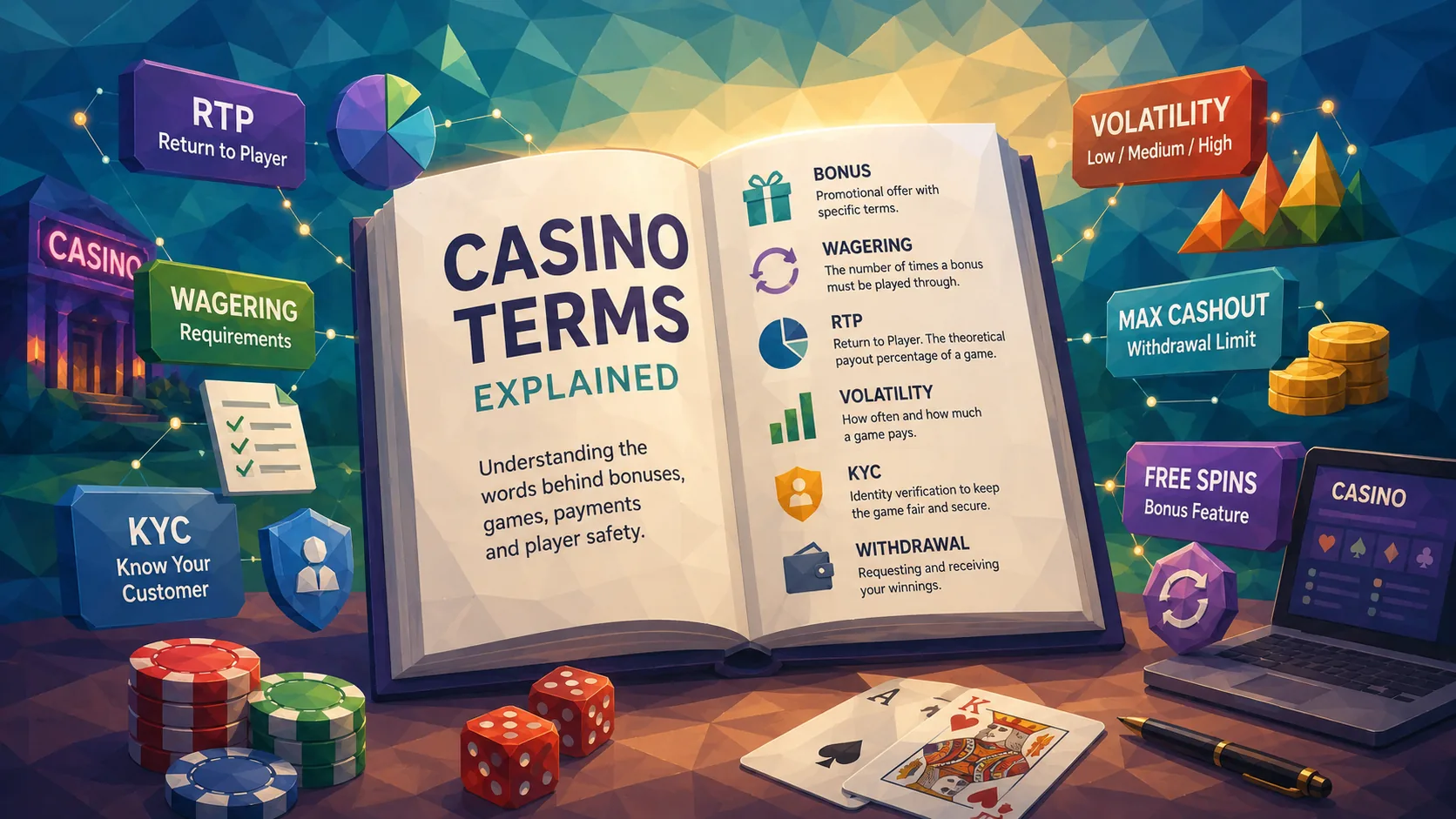
Casino language can be strangely unfriendly. A player may only want to know whether a bonus is good, whether a game is risky, or why a withdrawal is taking longer than expected. Instead, they run into words like wagering requirements, RTP, volatility, sticky bonus, KYC, max cashout, bonus abuse, pending period, and source of funds.
Some terms are useful. Some are used carelessly. Some make simple things sound more complicated than they are.
This guide explains the casino terms players are most likely to see when reading reviews, comparing bonuses, choosing games, making payments, or dealing with support. It is not meant to be a complete gambling dictionary. It focuses on words that actually matter before you deposit, claim a bonus, or play.
Wagering Requirements
Wagering requirements explain how many times a bonus, or sometimes a bonus plus deposit, must be played before winnings can be withdrawn.
For example, a 35x wagering requirement on a €100 bonus means the player must make €3,500 in qualifying bets before the bonus is fully cleared. You can compare the same figures in our casino bonus calculator, including whether the multiplier applies to bonus funds or the combined balance and how game contribution changes the target.
This does not mean the player needs to lose €3,500. It means the total value of all eligible bets must reach that amount. The important word is eligible. Not every game may count fully.
Slots often count 100%. Table games may count less. Some games may not count at all.
Wagering requirements are one of the most important casino terms because they decide whether a bonus is realistic or mostly decorative.
Bonus Balance and Cash Balance
Many casinos separate a player’s account into a cash balance and a bonus balance.
The cash balance is the player’s own deposited money or withdrawable winnings. The bonus balance is promotional money, free spin winnings, or funds still connected to bonus rules.
This distinction matters because the two balances may behave differently. Bonus money may be locked until wagering is complete. Cash money may still become restricted if the player has accepted a bonus.
A common mistake is assuming that money shown in the account is automatically withdrawable. It may not be.
Before claiming a bonus, check whether the casino uses separate balances and in what order funds are used when placing bets.
Sticky Bonus
A sticky bonus is a bonus that cannot be withdrawn.
The player may be able to use the bonus money to play, and may be able to withdraw winnings from it, but the bonus amount itself stays with the casino.
For example, if a player receives a €100 sticky bonus and wins €300, they may only be able to withdraw €300, not €400. The original €100 bonus remains locked or disappears when the withdrawal is requested.
Sticky bonuses are not automatically bad, but they need to be understood. They can look bigger than they really are because part of the displayed balance is never actually withdrawable.
Non-Sticky Bonus
A non-sticky bonus is usually more flexible than a sticky bonus.
In many cases, the player can use their own deposit first and only touch the bonus if needed. This can make the offer less restrictive, especially if the player wins early with their own money.
But the exact structure varies from casino to casino.
Some non-sticky bonuses are genuinely player-friendly. Others still come with heavy wagering requirements, maximum bet limits, game restrictions, and expiry times.
The label alone is not enough. The full bonus terms still matter.
Free Spins
Free spins are promotional spins on slot games.
They may be offered as part of a welcome bonus, reload offer, loyalty promotion, tournament prize, or no-deposit bonus. Players often like them because they are easy to understand: the casino gives a certain number of spins on one or more slot games.
But free spins are rarely as simple as they look.
The casino may set a fixed bet value per spin. Winnings from free spins may have wagering requirements. Some free spin winnings may have a maximum cashout. The spins may also expire quickly.
A headline such as “100 free spins” tells only part of the story. The useful question is: what happens if the spins win?
Max Bet Rule
The max bet rule limits how much a player can bet while using a bonus.
This is one of the easiest bonus rules to break accidentally.
A casino might say that the maximum allowed bet during wagering is €5 per spin or round. If the player bets more than that while the bonus is active, the casino may cancel bonus winnings.
This can feel harsh, especially when the player did not notice the rule. But it is very common.
Anyone playing with a bonus should check the maximum bet before starting. It is one of the most important bonus terms on the page.
Max Cashout
Max cashout means the maximum amount a player can withdraw from a certain bonus or promotion.
This is common with no-deposit bonuses, free spin offers, and sometimes very large matched bonuses.
For example, a casino may give a no-deposit bonus but limit withdrawals from that bonus to €100. If the player wins €700, the extra amount may be removed once the withdrawal is processed.
Max cashout rules can make a bonus much less valuable than it first appears. They are not always shown as clearly as the bonus headline, so they deserve special attention.
RTP
RTP stands for return to player.
It is a theoretical percentage showing how much a game is designed to pay back to players over a very large number of rounds.
If a slot has an RTP of 96%, that does not mean every player gets €96 back from every €100. It means that, over the long term and across a huge amount of play, the game is mathematically designed around that return.
In the short term, almost anything can happen. A player can win quickly, lose quickly, or have a session that looks nothing like the RTP number.
RTP is useful for comparing games, but it is not a prediction for one session.
House Edge
House edge is the casino’s mathematical advantage.
If a game has an RTP of 96%, the house edge is 4%. The two numbers are connected. RTP looks at the player side. House edge looks at the casino side.
A lower house edge is generally better for the player, but it does not guarantee a good result.
Blackjack with correct strategy may have a low house edge. Some slot games have a higher house edge. But even low house edge games can produce losing sessions, and high-volatility games can still create large wins.
House edge is about probability over time, not certainty today.
Volatility
Volatility describes how a casino game tends to pay.
A low-volatility slot may produce smaller wins more often. A high-volatility slot may produce fewer wins, but the wins can be larger when they land.
This matters because two games with similar RTP can feel completely different.
A player who wants longer sessions may prefer lower volatility. A player chasing bigger payouts may prefer higher volatility, but should expect longer losing stretches.
Volatility does not tell you whether a game is fair. It tells you how bumpy the ride may be.
Variance
Variance is closely related to volatility.
In casino discussions, the two words are often used almost interchangeably. Both refer to the way short-term results can move away from the expected mathematical average.
A high-variance game can swing heavily. A player may see long dry periods and then a large win. A low-variance game tends to move more gently, though it can still lose money over time.
When players say a slot is “swingy”, they are usually talking about variance or volatility.
Payline
A payline is a pattern across the reels of a slot game that can create a win.
Older slots often had a fixed number of paylines, such as 5, 10, 20, or 25. Modern slots may use many paylines, ways to win, cluster pays, or other systems.
The important point is that not every matching symbol automatically pays. The game rules explain which combinations count and how wins are formed.
Before playing an unfamiliar slot, it is worth opening the paytable. It usually explains paylines, symbols, bonus features, and special mechanics.
Paytable
The paytable shows how a casino game pays.
On a slot, it usually lists symbols, winning combinations, bonus features, wilds, scatters, free spin rules, and sometimes RTP or volatility information. On table games, it may show payouts for different bets.
The paytable is not exciting reading, but it is useful.
It tells the player what they are actually playing. A slot can look simple on the surface but have special rules that affect the value of certain symbols or features.
If a game feels confusing, the paytable is usually the first place to check.
Wild Symbol
A wild symbol is a slot symbol that can usually replace other symbols to help form a winning combination.
It works a little like a joker in a card game.
Some wilds are simple. Others expand, move, multiply wins, remain sticky for several spins, or appear only during bonus rounds.
The exact rules depend on the game. A wild is usually helpful, but how helpful it is depends on what it can replace and when it appears.
Scatter Symbol
A scatter symbol is a special slot symbol that often pays or triggers features regardless of its position on the reels.
Scatters are commonly used to trigger free spins or bonus rounds. For example, three scatter symbols may start a free spin feature.
Unlike ordinary symbols, scatters often do not need to appear on a normal payline.
Again, the paytable explains the exact rules.
Bonus Round
A bonus round is a special game feature that interrupts or expands the base game.
In slots, this may include free spins, pick-and-click games, multipliers, respins, hold-and-win features, jackpots, or other mini-games.
Bonus rounds are often the most exciting part of a slot, but they are not guaranteed to pay well. Some bonus rounds are huge. Others are disappointing.
That is normal. The feature is part of the game’s overall math.
Progressive Jackpot
A progressive jackpot is a prize that grows over time.
Each qualifying bet may contribute a small amount to the jackpot pool. The prize keeps increasing until someone wins it. After that, it resets to a lower starting amount.
Progressive jackpots can become very large, but the chance of winning them is usually very small.
Players should check whether a maximum bet is required to qualify for the jackpot. Some games only make the jackpot available if the player bets at a certain level.
RNG
RNG stands for random number generator.
It is the system used to produce random results in digital casino games such as slots, roulette, blackjack, video poker, and many instant-win games.
A properly tested RNG should make results unpredictable and independent. That means previous spins or rounds do not control the next result.
This is why common ideas like “the slot is due” or “it has not paid for a while” are usually misleading. A random game does not owe the player a win because of what happened earlier.
Live Casino
A live casino game is hosted by a real dealer and streamed to players online.
Common live casino games include blackjack, roulette, baccarat, game shows, and money wheel-style games. Players place bets through the casino interface while watching the dealer or presenter on video.
Live casino games can feel more social and more realistic than standard digital games.
But they still have rules, limits, house edge, and possible delays. A live dealer does not make the game beatable. It simply changes the format.
KYC
KYC stands for know your customer.
It is the process where a casino verifies a player’s identity. The casino may ask for documents such as an ID card, passport, proof of address, payment method proof, or sometimes source-of-funds information.
Players often dislike KYC because it can delay withdrawals. But it is a normal part of regulated online gambling.
The important point is timing. Some casinos verify players early. Others allow deposits first and request documents before withdrawal. That second approach can surprise players.
Before depositing, check when verification may be required.
Source of Funds
Source of funds means evidence showing where a player’s gambling money came from.
This may be requested after larger deposits, unusual account activity, regulatory checks, or risk reviews. Documents might include bank statements, payslips, tax documents, business income evidence, investment sale records, or other financial records.
This can feel intrusive, but casinos may be required to ask for it in certain situations.
Players who gamble larger amounts should know that normal ID verification may not always be the final check.
Withdrawal Limit
A withdrawal limit is a restriction on how much money a player can withdraw within a certain time.
For example, a casino may have daily, weekly, or monthly withdrawal limits. A player who wins a large amount may not be able to withdraw it all at once.
This is especially important with smaller casinos or casinos using lower-tier licences.
A large win is less attractive if the casino only pays it out slowly over many months. Withdrawal limits should be checked before playing, not after winning.
Pending Period
A pending period is the time between requesting a withdrawal and the casino actually processing it.
During this period, the withdrawal may be reviewed, approved, reversed, or delayed.
Some casinos allow players to cancel pending withdrawals and return the money to their balance. This can be risky because it encourages players to gamble winnings before they leave the account.
Fast withdrawals with no unnecessary pending period are generally more player-friendly.
Reverse Withdrawal
A reverse withdrawal happens when a player cancels a withdrawal request and moves the money back into the casino balance.
This can be dangerous.
A player may request a withdrawal after winning, then later reverse it during a moment of boredom, frustration, or chasing losses. The result is often that the money is played away before it ever reaches the bank account.
Some regulators and player protection systems discourage or restrict reverse withdrawals for this reason.
From a player perspective, it is usually better when a casino processes withdrawals quickly and does not make reversal too easy.
Chargeback
A chargeback is a dispute raised through a card issuer or payment provider.
In normal online shopping, chargebacks can protect consumers against fraud or non-delivery. In gambling, they are more complicated. If a player deposits, plays, loses, and then tries to reverse the payment simply because they lost, that can be treated as abuse.
Legitimate payment disputes can exist, but chargebacks should not be used as a way to undo gambling losses.
Players should contact casino support first if there is a genuine payment problem.
Bonus Abuse
Bonus abuse is a broad term casinos use when they believe a player has misused promotions.
This may include duplicate accounts, false details, coordinated play, restricted betting patterns, using someone else’s payment method, breaking max bet rules, or exploiting unclear terms.
The problem is that the term can also be used vaguely.
A casino should be able to explain which rule was broken. Players should not accept “bonus abuse” as an explanation without details.
The best protection is to use one account, use your real details, read bonus terms, avoid unusual betting tricks, and keep records.
Dormant Account
A dormant account is an inactive casino account.
If an account is not used for a long time, the casino may classify it as dormant. Some casinos charge inactivity fees after a certain period. Others may close the account eventually.
This is usually explained in the general terms and conditions.
Players who leave money in casino accounts should be especially careful. It is usually better to withdraw unused funds rather than leave them sitting there.
Self-Exclusion
Self-exclusion is a responsible gambling tool that allows a player to block themselves from gambling for a set period or permanently.
During self-exclusion, the casino should not allow the player to deposit or play. In some systems, self-exclusion may apply across multiple operators or licensed sites.
This is different from a simple cooling-off period. Self-exclusion is usually more serious and harder to reverse.
Players who feel they are losing control should use self-exclusion early rather than waiting for the situation to become worse.
Deposit Limit
A deposit limit restricts how much money a player can deposit over a chosen period.
Limits may be daily, weekly, or monthly. They are one of the most practical responsible gambling tools because they control spending before it happens.
A deposit limit should be set before playing, not after a bad session.
Some casinos allow limits to be reduced immediately but require a waiting period before they can be increased. That is a good protection because it prevents impulsive changes during emotional moments.
Cooling-Off Period
A cooling-off period is a temporary break from gambling.
It may last 24 hours, a few days, a week, or longer, depending on the casino. During this time, the player cannot access gambling services or deposit.
Cooling-off is useful when a player wants space without committing to long-term self-exclusion.
It can be especially helpful after emotional sessions, chasing losses, or gambling more than planned.
Chasing Losses
Chasing losses means continuing to gamble in an attempt to win back money already lost.
This is one of the most dangerous gambling patterns.
The problem is that the player stops making decisions based on entertainment or budget and starts gambling to repair damage. That pressure often leads to larger bets, faster deposits, and poorer decisions.
No casino term matters more than this one from a safety perspective.
If you notice yourself chasing losses, stop playing. The next bet is not a recovery plan.
What These Terms Have in Common
Most casino terms are not just vocabulary.
They describe rules, risks, restrictions, or mathematical realities. Understanding them helps players avoid bad assumptions.
A bonus balance may not be withdrawable. A free spin win may still need wagering. A fast deposit may not mean a fast withdrawal. A high RTP does not guarantee a good session. A crypto casino may still require KYC. A jackpot can be large because it is difficult to win.
The words matter because they shape the real experience.
A player does not need to know every gambling expression ever invented. But the terms above are worth understanding before depositing, claiming a bonus, or contacting support.
The best casino language is clear. When it is not clear, slow down.
Confusion is rarely a good reason to keep playing.